News
White Paper
Why Enterprise AI Fails at Scale

Databricks is betting big on agentic AI, raising $4 billion to build the infrastructure enterprises need to deploy intelligent systems at scale.
The San Francisco-based data and AI company announced December 16 it closed Series L funding at a $134 billion valuation while surpassing a $4.8 billion revenue run-rate with over 55% year-over-year growth. The company's AI products and data warehousing business each exceeded $1 billion in annual revenue run-rate.
Insight Partners, Fidelity Management & Research Company and J.P. Morgan Asset Management led the round. Additional participants included Andreessen Horowitz, BlackRock, Blackstone, Coatue, GIC, MGX, NEA, Ontario Teachers Pension Plan, T. Rowe Price Associates, Temasek, Thrive Capital and Winslow Capital.
The capital will support development of three strategic products as well as provide employee liquidity and support potential AI acquisitions.
Databricks' new funding advances three core products:
| Core Product | What It Enables |
|---|---|
| Agent Bricks | Platform for building multi-agent systems on enterprise data |
| Lakebase | Serverless Postgres database designed for AI workloads |
| Databricks Apps | Deployment layer for data and AI applications |
The company also reported several financial milestones:
Company officials said Lakebase gained thousands of customers in its first six months, growing revenue at twice the pace of its data warehousing product.
Related Article: OpenAI Launches GPT-5.2, Dubbed Its 'Most Capable' Work Model Yet
In September 2025, Databricks broke through a $4 billion annualized revenue run-rate with over 50% year-over-year growth in Q2. The company finalized a $1 billion Series K financing round, valuing Databricks north of $100 billion.
Databricks maintains strong enterprise traction with more than 650 clients generating over $1 million annually, net revenue retention above 140% and positive free cash flow throughout the past year.
The company has deepened collaborations with Microsoft, Google Cloud, Anthropic, SAP and Palantir. Additionally, in February 2025, Databricks expanded its partnership with Confluent for real-time AI capabilities.
While AI adoption accelerates, experimentation still far outpaces production-ready deployment. Recent analysis shows the AI market fracturing into three distinct segments:
While 88% of organizations actively monitor generative AI's evolution, far fewer have moved beyond experiments and into production use. Futhermore, research from MIT found that despite spending close to $40 billion on generative AI over the last two years, only 5% of enterprises could point to a real business return.
Today, AI deployment architecture is converging toward unified platforms. Vendors are now embedding governance, lineage and semantic capabilities natively, as evidenced by Salesforce's Informatica acquisition and platform expansions by Snowflake and Databricks.
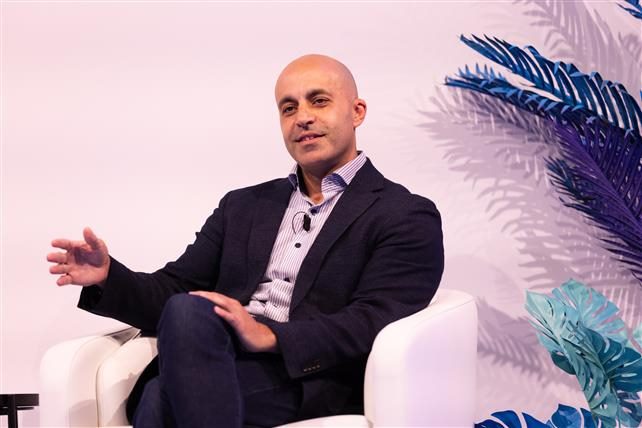
"Enterprises are rapidly reimagining how they build intelligent applications," said Ali Ghodsi, Databricks co-founder and CEO, "and the convergence of generative AI with new coding paradigms is opening the door to entirely new workloads. With this investment, we're deepening our commitment to help every organization innovate with AI on their own data."
Related Article: Disney Invests $1B in OpenAI, Becomes First Major Licensing Partner for Sora
Databricks, founded in 2013 in San Francisco, provides a unified data intelligence platform for platform and data leaders, data engineers and analytics teams in large and mid-market enterprises. The company offers a data and AI platform based on its lakehouse architecture, integrating data lakes and warehouses to support analytics, data engineering and AI workloads.
Michelle Hawley is an experienced journalist who specializes in reporting on the impact of technology on society. As editorial director at Simpler Media Group, she oversees the day-to-day operations of VKTR, covering the world of enterprise AI and managing a network of contributing writers. She's also the host of CMSWire's CMO Circle and co-host of CMSWire's CX Decoded. With an MFA in creative writing and background in both news and marketing, she offers unique insights on the topics of tech disruption, corporate responsibility, changing AI legislation and more. She currently resides in Pennsylvania with her husband and two dogs. Connect with Michelle Hawley: 
