News
White Paper
Why Enterprise AI Fails at Scale

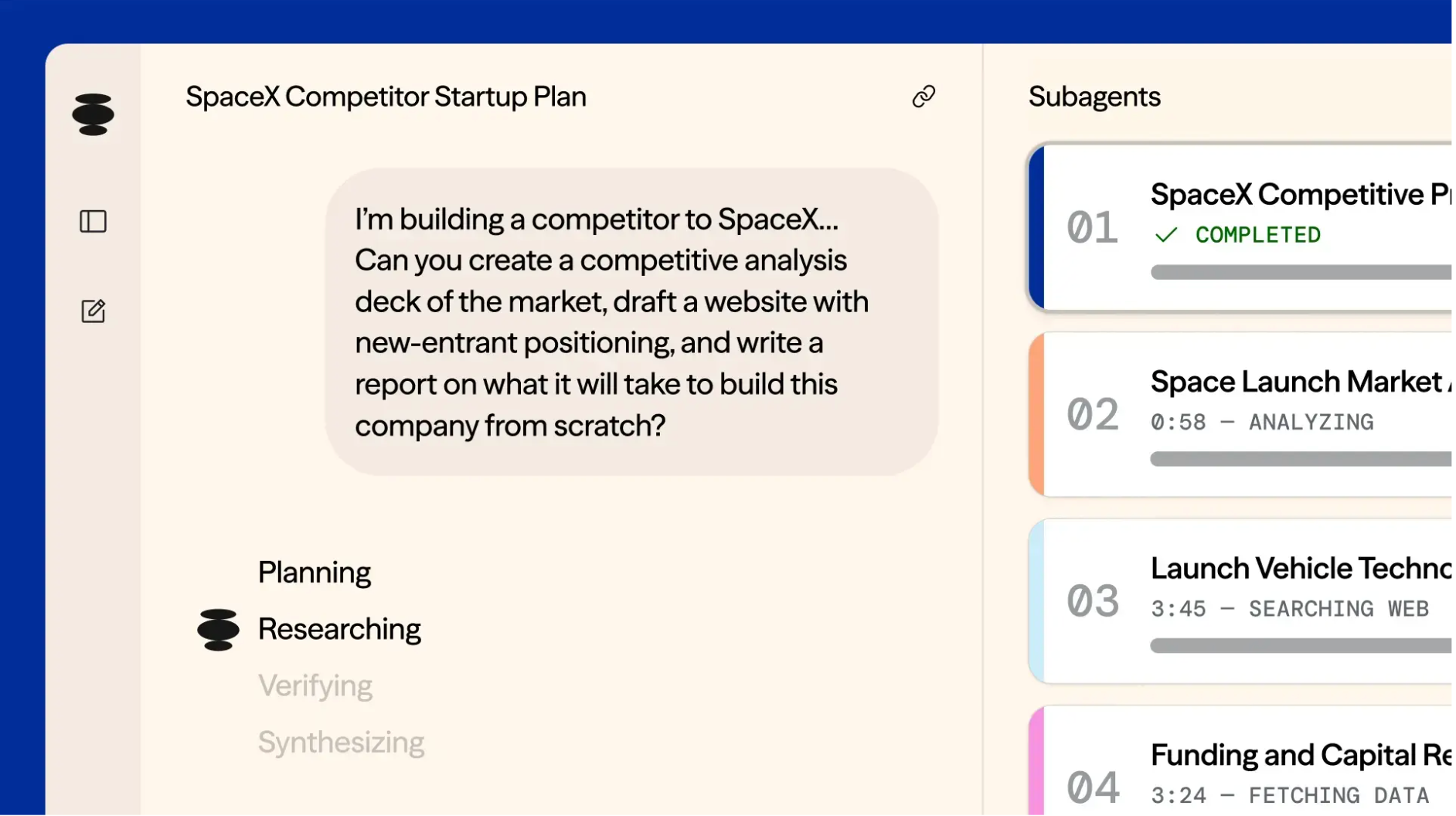
On January 27, 2026, Airtable launched Superagent, a multi-agent AI product that coordinates specialized AI agents working in parallel to deliver finished, presentation-ready research.
According to company officials, Superagent — the company's first standalone product in 13 years — deploys a coordinating agent that plans work, assigns specialist agents to investigate different dimensions simultaneously and synthesizes their outputs into interactive deliverables. The product was built on Airtable's October 2025 acquisition of DeepSky, an AI research firm specializing in autonomous agent technology.
Airtable claims over 500,000 organizations use its platform, including 80% of the Fortune 100.
"You're not prompting an AI. You're orchestrating a team," said Howie Liu, co-founder and CEO at Airtable. "That's the difference between asking a traditional chat product to research a competitor and asking Superagent: instead of a sequential summary built by one agent working through tasks one at a time, Superagent deploys a coordinated team to investigate multiple dimensions simultaneously, then delivers an interactive competitive landscape ready to present."
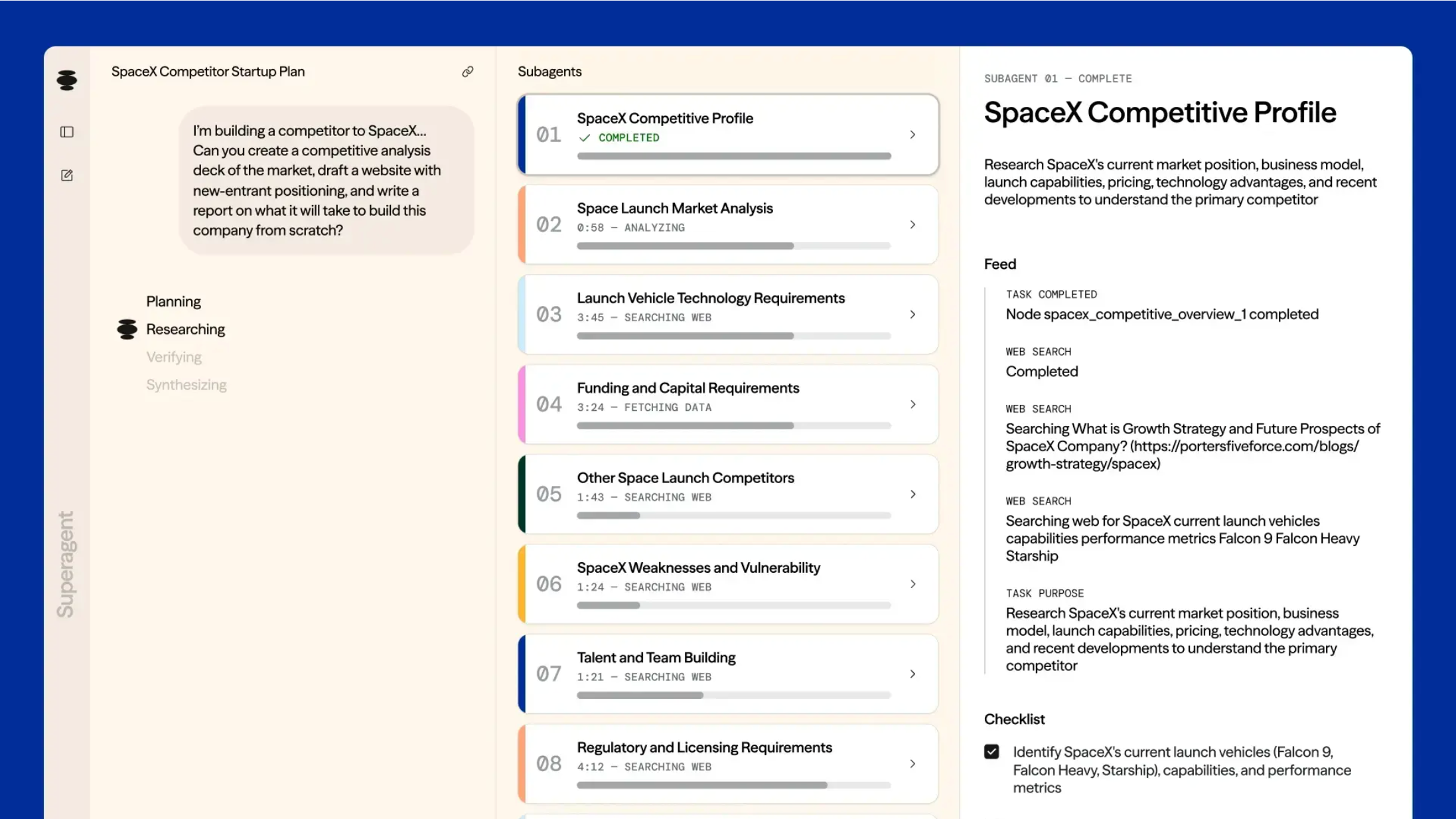
According to company officials, Superagent offers the following features:
| Feature | How It Works |
|---|---|
| Multi-agent coordination | Deploys specialist agents working in parallel, coordinated by a planning agent |
| Premium data sources | Integrates with FactSet, Crunchbase, SEC filings and earnings transcripts |
| Flexible agent architecture | Agents can adapt approaches, coordinate and backtrack as tasks require |
| Interactive deliverables | Outputs include comparison matrices, detail cards and visual positioning maps |
| Planned Airtable integration | Future ability to invoke Superagent directly from Airtable bases |
Airtable has spent the past year aggressively repositioning itself as an AI-native company through rapid product launches, a strategic acquisition and a high-profile leadership hire.
The transformation began in April 2025 when the company released an AI assistant designed to function as a personal app builder, data analyst and web researcher. Two months later, the company relaunched its entire platform as AI-native, introducing an assistant called Omni that enables conversational app building and data analysis.
In October 2025, Airtable acquired DeepSky and appointed David Azose — formerly the engineering lead for ChatGPT's business products at OpenAI — as chief technology officer. The company followed in December with an integration with ChatGPT that allows users to access Airtable data without leaving OpenAI's interface.
Multi-agent AI systems mark enterprise AI's next phase: coordinated networks of specialized agents functioning as a digital workforce.
KPMG US classified enterprise AI agents into four core categories:
These systems rely on a central planner to map goals to agents and an orchestration layer that coordinates tasks. Communication flows through standardized protocols like A2A (agent-to-agent), enabling interoperability across platforms.
Enterprise interest in AI agents has intensified between 2024 and 2026. Agent piloting nearly doubled to 65% between Q4 2024 and Q1 2025, according to KPMG research. Over 80% boosted AI budgets specifically for agents, per PwC data.
Gartner projected that 33% of enterprise software will include agentic AI by 2028, up from less than 1% in 2024. However, with most companies lacking the required data infrastructure, less than one-quarter are able to fully capitalize on the advantages that autonomous agents offer.
Airtable targets cross-functional teams in mid-market and large enterprises, offering tools for building custom applications and AI-driven workflows. The company was founded in 2012 and is headquartered in San Francisco. According to public reports, it has raised $1.36 billion.
Michelle Hawley is an experienced journalist who specializes in reporting on the impact of technology on society. As editorial director at Simpler Media Group, she oversees the day-to-day operations of VKTR, covering the world of enterprise AI and managing a network of contributing writers. She's also the host of CMSWire's CMO Circle and co-host of CMSWire's CX Decoded. With an MFA in creative writing and background in both news and marketing, she offers unique insights on the topics of tech disruption, corporate responsibility, changing AI legislation and more. She currently resides in Pennsylvania with her husband and two dogs. Connect with Michelle Hawley: 
