Editorial
White Paper
Why Enterprise AI Fails at Scale

Editor's Note: This article is part of a four-part series mapping the emerging experiments worldwide that could reshape capitalism and democracy for the AI era. Don't forget to check out Part 1 and Part 2.
In my previous articles, I highlighted the economic, governance and information integrity challenges emerging in our post-AI era, and some of the possible solutions. To chart a path toward a positive outcome, we need a framework for thinking about how these factors combine into whole systems; to identify system archetypes, which are essentially different combinations of economic model, governance model and information environment that could emerge as AI transforms society.
We can imagine a three-dimensional space with three axes:
If you take these three binary dimensions, you get a cube with eight possible combinations. Eight archetypal "post-AI society" scenarios. To make them memorable, let's give each corner of the cube a name:
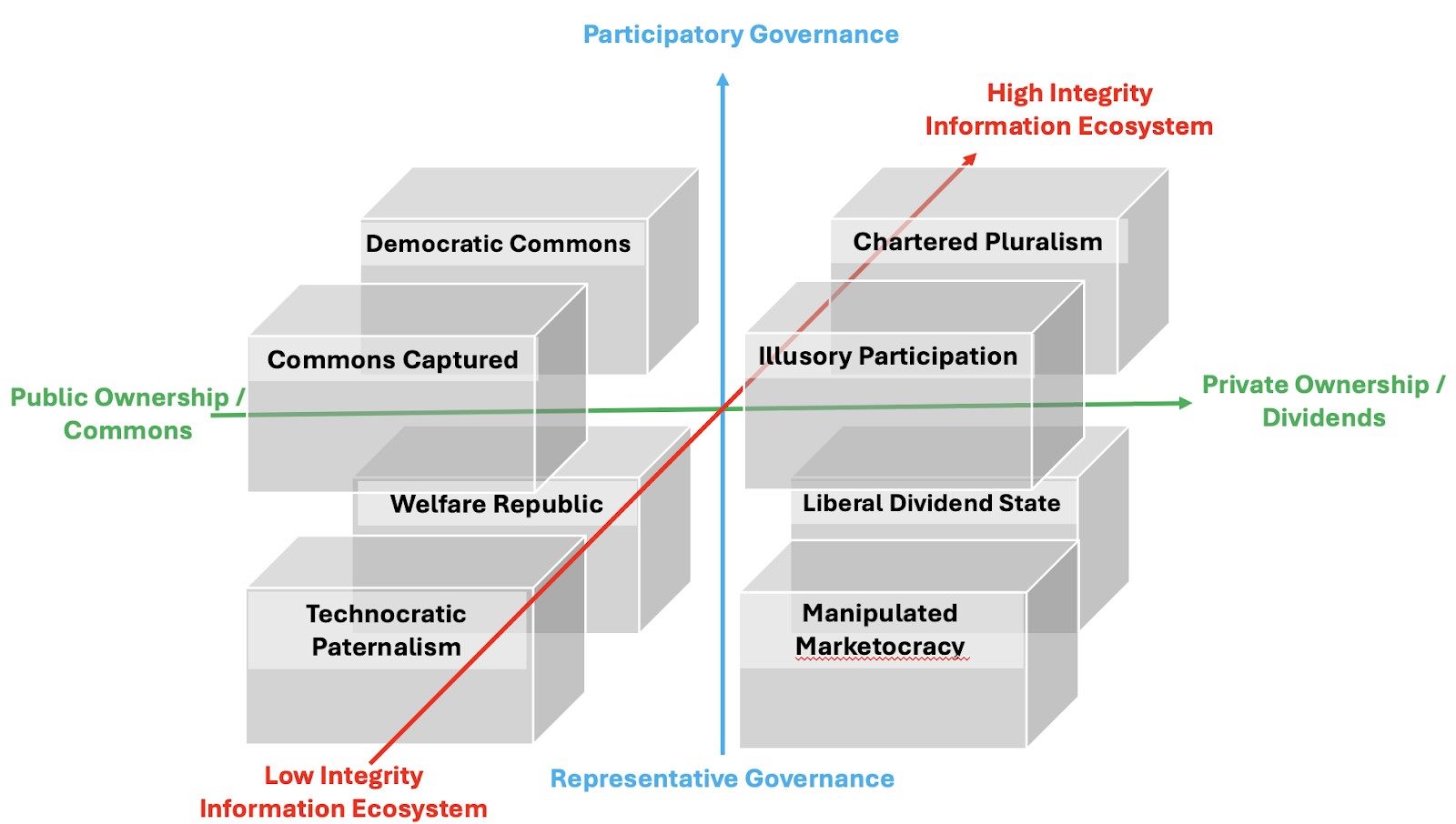
Private economy + Representative governance + Low information integrity
Imagine an exaggerated version of today, where Big Tech and corporate giants run a highly privatized economy, dominated by winner-take-all AI platforms. In this society, politics remains formally democratic, but this is largely illusory because public opinion is steered by constant algorithmic manipulation and propaganda.
The government might still be nominally representative, elections will happen, but as one analysis said, "All that will be left is the ritual and theatre of voting." Meanwhile, social stability is maintained by a basic universal income or maybe frequent "bread-and-circus" distractions.
This scenario is frighteningly plausible if we do nothing. It's essentially a plutocracy-by-algorithm. While it's economically productive, as AI makes lots of goods, it tramples upon human agency and is potentially politically unstable in the long-term. Citizens may eventually realize the emperor has no clothes‚ that there is no real democracy — and rebel — or we slide into authoritarianism.
Related Article: 10 Jobs Most at Risk of AI Replacement (And How to Transition)
Private economy + Representative governance + High information integrity
In this scenario, the market economy stays mostly private and competitive. We don't nationalize Amazon or ban private enterprise, innovation and entrepreneurship continue, but the state heavily redistributes AI's bounty via public dividends (robust UBI, public investments, etc.). Think of it as a "Norwegian oil fund" model but enabled by the profits from AI: government taxes the tech sector or holds equity in AI firms and sends checks to citizens.
Governance remains largely the familiar representative democracy, and importantly, the information sphere is healthy with strong journalism, an educated populace and rules to keep deepfakes at bay. This tries to ensure everyone benefits from the AI-driven wealth, preventing a huge inequality spiral.
It's quite realistic in the near term, politically. However, it might not solve the purpose problem. If people have income but no opportunity to contribute meaningfully, social cohesion and individual fulfilment could erode.
Private economy + Participatory governance + Low information integrity
Here we have a society that, on paper, has moved towards deliberative governance; maybe there are town hall apps, lots of referenda or citizens' assemblies. However, the information integrity is low. That means all those participatory processes are constantly derailed or co-opted by misinformation, troll armies and polarization. Economically, this scenario stays on the market/private side.
Imagine a government launches an online platform for citizens to weigh in on policy but they don't pair it with any disinformation countermeasures. Very quickly, bots and extremist groups could flood it, leading to policy outcomes that are ill-informed. It might give the illusion of democratic empowerment while actually furthering chaos and conspiracies. In the long run, this could discredit participatory democracy. So, this archetype highlights: deliberation without information integrity leads to trouble.
Private economy + Participatory governance + High information integrity
This could be described as a reimagined liberal democracy, one that keeps a market economy but deeply integrates participatory governance, all within a high integrity information space. The term "chartered" reflects the creation of new institutions (perhaps chartered citizen councils, or social charters that set responsibilities for corporations). While "pluralism" implies multiple centers of power offering decentralized and diverse voices.
Picture something like strong civil society with platform cooperatives, neighborhood assemblies feeding into city decisions and multi-stakeholder governance of data or AI. The economy is still largely market-driven, but these markets are shaped by values through democratic input. This is reminiscent of how in medieval times, charters granted rights and set duties. Potentially this could be a very healthy scenario. It's like current liberal democracy, but upgraded.
Many of the governance innovations we discussed push in this direction. Its long-term value is rooted in its potential to preserve the dynamism of markets and personal freedoms, while addressing democracy's accountability problem and tech oversight. The challenge is whether it can tackle huge inequalities and potential mass joblessness; it could be combined with something like the Liberal Dividend State's UBI, to yield an enlightened "Digital Social Charter."
Related Article: How AI Rebuilds the Modern Company: From Hierarchies to Hyperloops
Public economy + Representative governance + Low information integrity
Now we shift to the commons/public economy side, but keep representative governance and low information integrity. This archetype might emerge if the threat of AI-driven collapse pushes a strong central authority to take over much of the economy "for the public good," but without really fixing the flow of information or citizen empowerment.
Think of a scenario where, as jobs disappear, governments nationalize major industries or AI platforms and provide lots of welfare. Power concentrates among a small elite of experts or bureaucrats who say, "Trust us, we'll take care of you." It's "technocratic" because decisions are made by supposed experts supported by AI systems, and "paternalism" because citizens are treated a bit like children who need looking after.
While a commons-based economy could be non-despotic under transparent, democratic control, in a society with low information integrity and weak accountability it is likely to slide into authoritarianism. Such a society can be "efficient" in building infrastructure or rolling out tech, but it utterly lacks the liberal values of free inquiry and individual rights.
Public economy + Representative governance + High information integrity
This combination has a commons/public-leaning economy, representative democracy and high info integrity. You might think of it as a kind of Nordic social democracy on steroids or perhaps New Zealand in a decade or two: the state and cooperatives/non-profits play a big role in providing services and maybe even owning key assets like nationalized AI utilities. The goal of the economy is explicitly public wellbeing.
It's a "Republic," meaning it's still largely a representative democracy, but thanks to a healthy information ecosystem, the electorate is well-informed and holds leaders accountable. Policies are geared toward welfare and community action. This is a scenario where something like Bhutan's GNH or New Zealand's Wellbeing Budget is fully realized at scale.
In many ways this is quite an attractive scenario, especially for those who favor a strong social safety net. Long-term, such a society could be stable and happy, though critics might worry about whether it would remain dynamic or survive competition with other nation states.
Public economy + Participatory governance + Low information integrity
This scenario is a heartbreaker: a commons-based economy with deliberative governance, but low info integrity. It's basically the nightmare of idealism gone awry. Imagine we push power to the people, with lots of cooperative ownership, community-run services and citizen assemblies making local decisions, but the information space is riddled with disinformation.
What happens? Likely, those commons institutions get captured by demagogues or special interests who exploit the confusion. You could end up with local oligarchs, as people in different areas fall for different false narratives. This just underscores that democratizing ownership and governance is not sufficient if you don't also safeguard truth and knowledge. It might be short-lived or transition into something like Technocratic Paternalism.
Public economy + Participatory governance + High information integrity
Finally, the shimmering star on the hill: public/commons economy, deliberative governance, high information integrity. This is arguably the "Democratic Commons" vision that many futurists and activists strive for. It means the core economic resources are managed as commons (owned by communities, cooperatives or held in trust). Governance is deeply democratic at all levels, with citizens actively participating. And our information environment is enlightened.
It sounds utopian in some ways, but is unlikely to be an environment where innovation flourishes. This scenario is basically the opposite of what we have now. However, is this achievable? Possibly in slices. We see glimpses: Wikipedia is a global knowledge commons run democratically with largely accurate information. Some cities using participatory governance or cooperatives widely are inching toward it locally. The Democratic Commons is high in long-term value, but it's sustainable only if people feel ownership and purpose. Unfortunately, in terms of realism, it's the furthest from the status quo.
These eight archetypes aren't destiny; think of them as eight corners of a maze we're collectively living in. The purpose of our 3D cube model is to help us name our choices. Not all corners are equal morally or practically. By sketching even the nightmares, we're reminded that without conscious effort, we could slide there.
Related Article: Can AI Transcend Our Universe? Training Machines on Alternate Realities
 Learn how you can join our contributor community.
Matt works at the intersection of Digital, Business Strategy and Social Impact. He is the author of the book "Digital Liberty," a NED at the UK fintech accelerator FinPact and leads AI Governance at NEOM, a futuristic giga-project in Saudi Arabia. Connect with Matt Stroud: 