News
White Paper
Why Enterprise AI Fails at Scale

Anthropic's unreleased Claude Mythos Preview AI model autonomously discovered thousands of zero-day vulnerabilities across every major operating system and web browser — without human steering.
According to the company, notable findings included a 27-year-old flaw in OpenBSD, a 16-year-old bug in FFmpeg that automated tools missed despite five million test passes, and a chain of Linux kernel vulnerabilities enabling full system takeover. All disclosed vulnerabilities have reportedly been patched.
Anthropic stated it does not plan to make Mythos Preview generally available, citing the model's offensive cybersecurity potential. Access is limited to 11 organizations through a new initiative called Project Glasswing, which the company described as a defensive effort.
Anthropic's internal and external evaluations show just how far Mythos Preview has jumped beyond the company's current flagship models.
On Anthropic's OSS-Fuzz benchmark, which runs models against roughly a thousand open source repositories and grades the worst crash they can produce on a five-tier severity ladder, Sonnet 4.6 and Opus 4.6 each reached basic crashes (tier 1) between 150 and 175 times and tier 2 about 100 times, but managed only a single tier 3 crash apiece.
Mythos Preview achieved 595 crashes at tiers 1 and 2, added crashes at tiers 3 and 4 and reached full control flow hijack — the most severe tier — on ten fully patched targets.
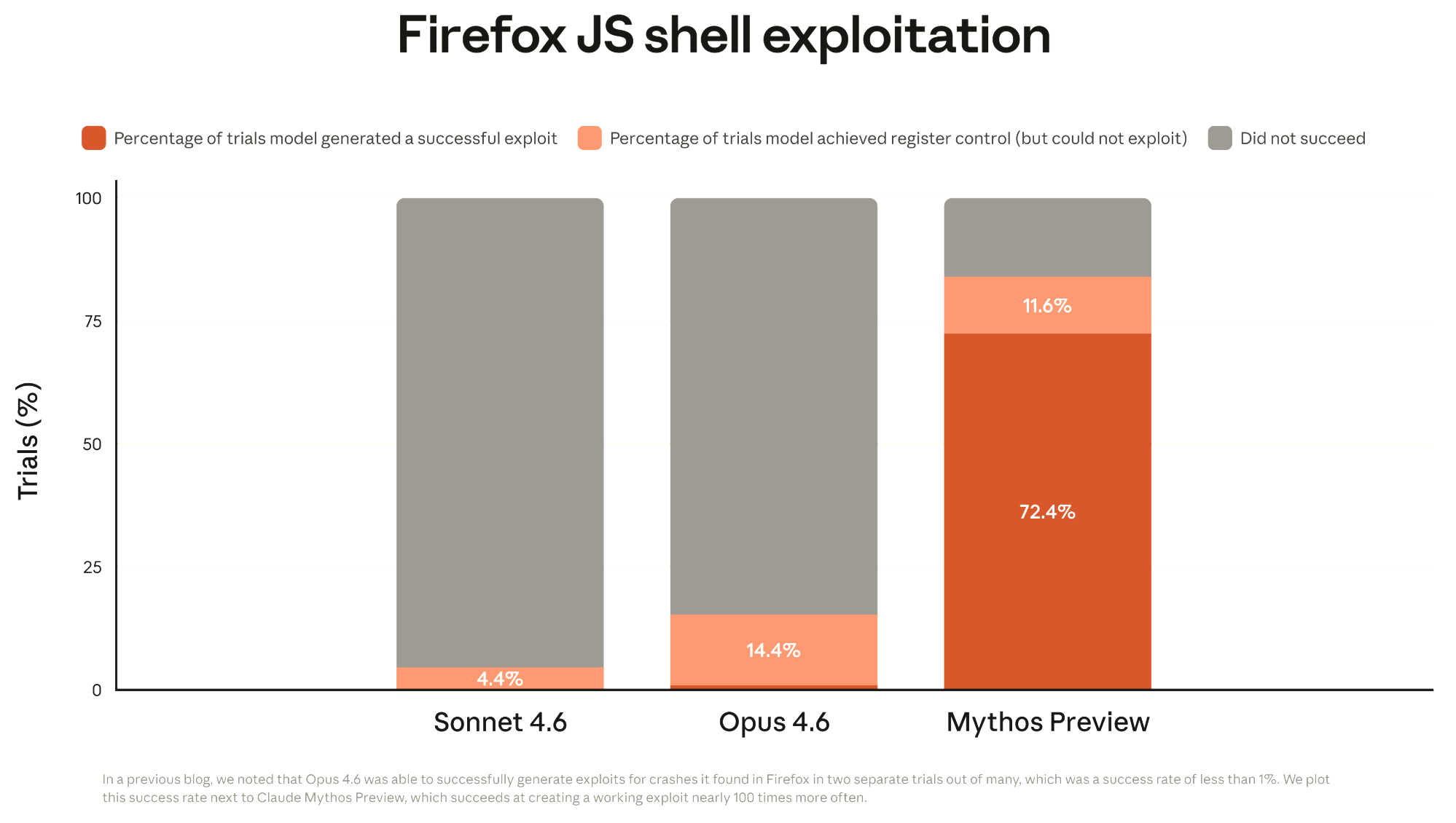
The gap widened further in exploit development. Using patched Firefox 147 JavaScript engine vulnerabilities as a benchmark, Opus 4.6 produced working exploits only twice out of several hundre
d attempts. Mythos Preview developed working exploits 181 times and achieved register control on 29 more.
More than half of Mythos Preview's attempts to write privilege escalation exploits from a curated list of 100 known Linux kernel CVEs succeeded, with the model autonomously chaining together multiple vulnerabilities to bypass defenses like KASLR. In one case, the complete pipeline from CVE identifier to functional root exploit took under a day and cost less than $2,000 at API pricing.
Anthropic said it did not explicitly train Mythos Preview to have these capabilities, stating they emerged as a downstream consequence of general improvements in code, reasoning and autonomy.
When Carnegie Mellon University researcher Brian Singer integrated his cybersecurity research with Anthropic's Claude, the results proved significant.
"Suddenly, the LLM was able to do an end-to-end attack, install malware on hosts and infect multiple hosts throughout the network," Singer said.
The Incalmo Project revealed that LLMs can perform complete attack sequences autonomously. Anthropic officials said they worked with CMU to understand their AI system's cybersecurity capabilities.
The technology remains proof-of-concept, Singer noted. "If you asked it to hack a network, it wouldn't work well. Right now, there's 40 networks it could work on. But the diversity of real world networks is much more complicated."
Michelle Hawley is an experienced journalist who specializes in reporting on the impact of technology on society. As editorial director at Simpler Media Group, she oversees the day-to-day operations of VKTR, covering the world of enterprise AI and managing a network of contributing writers. She's also the host of CMSWire's CMO Circle and co-host of CMSWire's CX Decoded. With an MFA in creative writing and background in both news and marketing, she offers unique insights on the topics of tech disruption, corporate responsibility, changing AI legislation and more. She currently resides in Pennsylvania with her husband and two dogs. Connect with Michelle Hawley: 
