Feature
Research Report
The AI Transformation 100: Concrete Ideas for Fixing How We Work

With AI chatbots playing an increasingly vital role in productivity, research and everyday interactions, choosing the right platform can be challenging.
The three most closely watched options are OpenAI's ChatGPT, Google's Gemini and xAI's Grok, each backed by substantial infrastructure and distinct philosophies about how AI systems should operate in real-world environments.
All three platforms have evolved significantly since their releases. Google continues to expand on Gemini's multimodal capabilities and deep integration across Search, Workspace and Android. OpenAI has strengthened ChatGPT's reasoning models and too use. Meanwhile, Grok has matured inside the X ecosystem, offering real-time social awareness and a more direct conversation style.
Which chatbot is best? Here's a side-by-side comparison of their:
| Category | ChatGPT | Gemini | Grok |
|---|---|---|---|
| Core Positioning | Cross-platform reasoning engine with API extensibility | Multimodal intelligence layer embedded in Google ecosystem | Real-time socially integrated assistant tied to X |
| Primary Strength | Structured reasoning and conversational clarity | Native multimodal processing and document grounding | Live discourse access and temporal awareness |
| Enterprise Fit | Heterogeneous stacks and custom workflows | Workspace-centric enterprises | Market intelligence and trend monitoring |
| Failure Profile | Failures often visible and detectable | May fail subtly depending on surface | Confident tone may not always signal uncertainty |
| Integration Depth | Broad API and tool ecosystem | Deep integration across Google products | Primarily embedded within X platform |
| Best For | Reasoning-heavy workflows and cross-platform teams | Document-heavy and multimodal environments | Real-time narrative and sentiment tracking |
ChatGPT emphasizes structured reasoning, cross-platform flexibility and consistent safety signaling across diverse workflows. Backed by OpenAI's latest reasoning-focused models, it excels at conversational clarity, structured thinking and predictable behavior across tasks.
Rather than optimizing for a single ecosystem or modality, ChatGPT is a flexible, tool-driven assistant that adapts to different workflows and user intent.
| Category | Details |
|---|---|
| Best For | Structured reasoning, writing, coding, analytical synthesis, enterprise workflows |
| Not Ideal For | Native OS-level integration inside a single productivity ecosystem |
| Speed | Responsive in conversational workflows; may slow slightly in deeper reasoning modes |
| Accuracy | Strong reasoning consistency; can hallucinate under ambiguity |
| Sensitive Topics | Often signals uncertainty or refusal explicitly |
| Unique Capabilities | Robust API ecosystem, tool chaining and multi-step reasoning stability |
| Trustworthiness | High for structured tasks; failures are typically visible and detectable |
ChatGPT, developed by OpenAI, is available via web, mobile apps and integrations such as Microsoft Copilot. The free version runs GPT-5.2, with users limited to a number of prompts within a five-hour window. It also now features ads within its interface.
ChatGPT Go ($8/month) Offers:
ChatGPT Plus ($20/month) Offers:
ChatGPT Pro ($200/month) Offers:
ChatGPT's conversational nuance extends beyond syntax, incorporating tone control and personalization options that allow users to shape stylistic behavior. Its reasoning capabilities are another standout, especially for analytical tasks that require breaking problems into steps, weighing tradeoffs or explaining complex concepts in plain language.
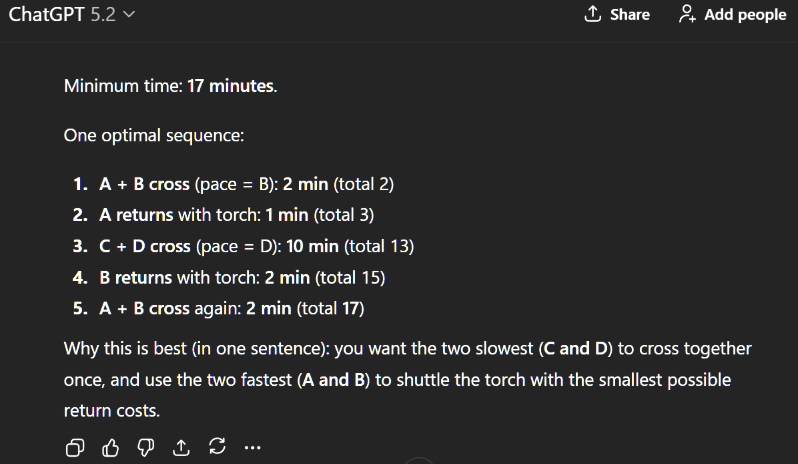
To test this, I asked ChatGPT 5.2 the following reasoning question:
Four people need to cross a rickety bride at night. They have only one torch, and the bridge can only hold two people at a time. Each person walks at a different speed: Person A takes 1 minute to cross; Person B takes 2 minutes to cross; Person C takes 5 minutes to cross; Person D takes 10 minutes to cross. When two people cross together, they must move at the pace of the slower person. The torch must be carried back and forth (it can't be thrown). What is the minimum time needed for all four people to cross the bridge?
ChatGPT responded with the following correct answer:
ChatGPT also shows relatively strong safety behavior, often signaling uncertainty, refusing inappropriate requests or framing responses cautiously when prompts touch on sensitive topics. That said, ChatGPT is not without limitations.
Like other large language models (LLMs), ChatGPT can hallucinate, especially when prompted for highly specific facts or information beyond its training cutoff. While these cases are less frequent than earlier generations, they remain a consideration for users who rely on AI outputs without verifications.
Cost can also be a factor, particularly for heavy or enterprise use. Advanced models and higher usage tiers introduce pricing tradeoffs that may not suit every business or workflow.
In addition, while ChatGPT integrates with a growing set of tools, it does not benefit from the same level of native ecosystem integration that Google can offer through Gemini.
Overall, ChatGPT performs best as a reasoning-oriented assistant that prioritizes clarity, conversational flow and general reliability across tasks. Its strengths make it well-suited for professionals who need an AI partner that can think through problems collaboratively, even if it occasionally requires human oversight to validate facts or manage cost at scale.
Related Article: How Do People Use ChatGPT? What 700M Weekly Users Reveal
xAI's Grok is a real-time, socially integrated assistant built around direct access to public discourse on X. Rather than prioritizing deep productivity embedding or API-first extensibility, Grok differentiates itself through immediacy, cultural awareness and temporal grounding.
Its strongest value emerges in fast-moving environments where awareness of live narratives matters more than multi-layer workflow orchestration.
| Category | Details |
|---|---|
| Best For | Real-time social commentary, trend analysis, public sentiment monitoring |
| Not Ideal For | Deep technical workflows, structured multi-step enterprise modeling |
| Speed | Generally fast, especially for short analytical or trend-based prompts |
| Accuracy | Strong temporal grounding; interpretive filtering may affect completeness |
| Sensitive Topics | More direct tone; lighter filtering may require oversight in regulated contexts |
| Unique Capabilities | Direct retrieval of live X posts and culturally fluent responses |
| Trustworthiness | Varies by use case — confident responses may not always signal uncertainty |
With Grok's free plan, users get access to Grok 4.1 and Grok 4.20 in beta. A limited number of prompts (including image generation) is available in the free tier.
SuperGrok ($30/month) Offers:
Grok Business ($30/month/seat) Offers:
Grok Enterprise (Custom Pricing) Offers:
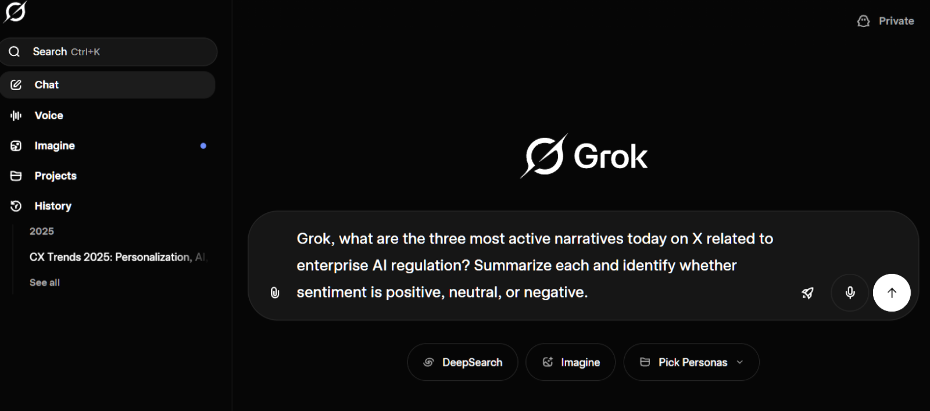
To evaluate Grok's real-time retrieval, I asked it:
Return the three most recent posts on enterprise AI regulation, strictly sorted by timestamp and including links.
It responded with verifiable X URLs and GMT timestamps from earlier that day. Manual validation confirmed the posts were authentic and recent, demonstrating genuine post-level retrieval capability.
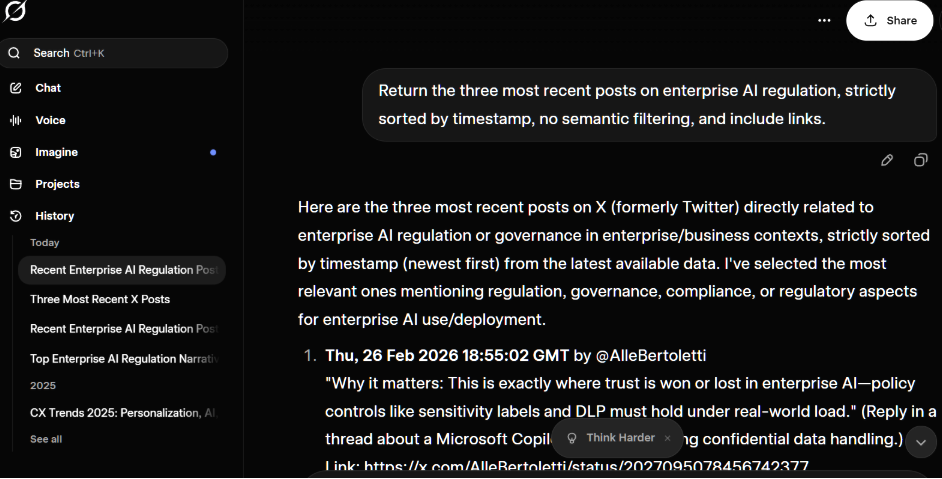
However, even under explicit instruction to avoid semantic filtering, Grok appeared to apply contextual relevance criteria. It did not expose the broader feed or clarify whether additional posts existed between the returned examples. This indicates that Grok behaves less like a raw chronological query engine and more like an interpretive layer on top of live data. For enterprise users requiring strict auditability or completeness, independent validation remains necessary.
In structured reasoning tasks, Grok produced coherent step-by-step analysis but showed less sustained planning discipline during longer, multi-stage scenarios compared to GPT-5. Its responses were typically concise and direct, which improves speed and readability for short analytical prompts. Extended modeling or multi-layer tradeoff analysis may require tighter prompting to maintain structural depth.
Under ambiguous instructions, Grok tended to interpret context rather than request clarification. This decisiveness can make interactions feel fluid, but it also introduces interpretive judgment earlier in the response cycle. Unlike ChatGPT, which often signals uncertainty explicitly, Grok’s confidence boundaries are less visibly differentiated. In regulated or precision-sensitive environments, this increases the importance of oversight.
Grok’s integration model remains closely tied to the X platform. While this enables real-time discourse access, its broader enterprise tooling ecosystem is narrower than ChatGPT’s API-driven extensibility or Gemini’s deep productivity embedding.
For brands focused on market intelligence or narrative monitoring, Grok offers a distinct advantage. For cross-platform automation and structured workflow integration, its deployment pathways are currently more limited.
Related Article: Grok Is Gaining on ChatGPT and Gemini. How It Got There Isn’t Pretty.
Gemini delivers its strongest value when embedded within Google-native environments, particularly in multimodal and document-heavy workflows. Developed by Google DeepMind, it is designed less as a standalone conversational system and more as an intelligence layer woven directly into existing Google workflows.
| Category | Details |
|---|---|
| Best For | Workspace-centric teams, multimodal analysis, document-grounded research |
| Not Ideal For | Organizations operating primarily outside Google's ecosystem |
| Speed | Often fast within Google surfaces; performance may vary across products |
| Accuracy | Strong with structured and document-based inputs; occasional subtle drift |
| Sensitive Topics | Guardrails vary by product surface; generally cautious |
| Unique Capabilities | Native multimodal reasoning across text, images, charts and web content |
| Trustworthiness | Reliable in document-grounded contexts; failures may be less overt |
Like the other AI platforms in this list, Gemini has a free version for users to tackle tasks with Google AI. This version gives users limited access to 3 Flash, 3.1 Pro, image generation, Deep Research, Gemini Live, Canvas, Gems, Flow, Whisk and NotebookLM.
Google AI Plus ($7.99/month) Offers:
Google AI Pro ($19.99/month) Offers:
Google AI Ultra ($249.99/month) Offers:
Gemini’s native multimodal architecture is one of its defining strengths. It can reason across text, images, charts, documents and web content within a unified model, making it particularly effective for visually grounded or document-heavy tasks.
To test this capability, I photographed the tangle of wires beneath my desk and asked Gemini to identify what it saw, assess potential risks and recommend corrective actions:
Look at this image and tell me what you see. Then explain what problems or risks might exist, what is working well, and what actions you would recommend next. Be specific.

The image shows a standard 8-outlet power strip that is nearly full (7 out of 8 outlets are occupied).
It then went on to describe the potential problems that could occur, and what to do to solve those potentialities.
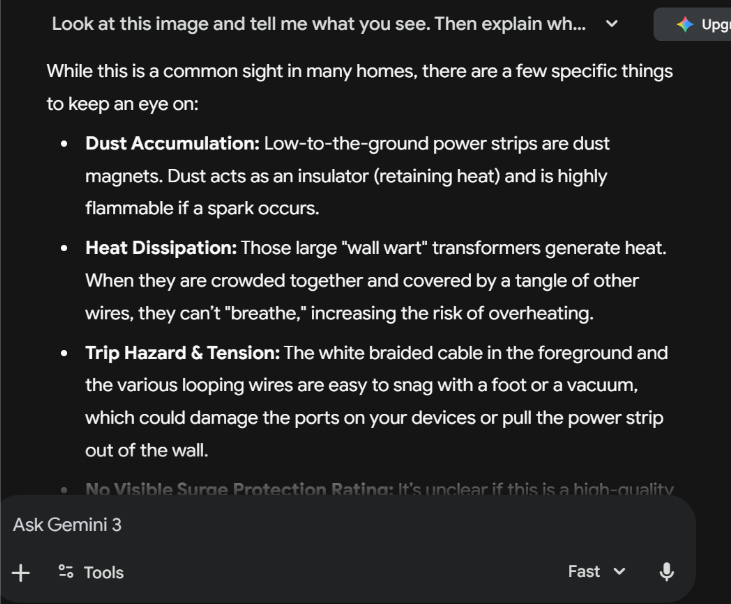
Gemini’s strengths become more pronounced inside Google’s ecosystem, which allows it to operate close to user data, reducing friction for document summarization, structured extraction and context-aware querying. It also performs well on structured or fact-oriented tasks, particularly when grounded in organized sources within Google’s infrastructure.
However, Gemini shares common LLM limitations. It can hallucinate when synthesizing loosely related material or when prompts lack clear constraints.
Response consistency may vary across different product surfaces, such as Search versus Workspace, reflecting its distributed deployment model.
In addition, its strongest advantages are closely tied to Google’s ecosystem, which may limit flexibility for teams operating across heterogeneous stacks.
Gemini performs best as an embedded multimodal layer inside Google-native environments, excelling when tasks require document grounding, visual interpretation or tight integration with Workspace tools. For users seeking a neutral, conversation-first assistant across diverse platforms, that ecosystem coupling introduces tradeoffs.
Related Article: Gemini 3 Deep Think Sets New Scientific Reasoning Benchmark
ChatGPT is often the stronger choice for developers who need flexibility across languages, frameworks and environments. Its strength lies in reasoning through code, explaining tradeoffs and assisting with debugging or refactoring tasks, supported by APIs, tools and extensible workflows that make it easy to integrate into custom development pipelines.
Gemini can support coding tasks, especially within Google’s ecosystem, but ChatGPT generally offers a smoother experience for developers working across diverse platforms.
Grok is not currently positioned as a primary development assistant. While it can generate and explain code in standard scenarios, its integration model is less oriented toward extensible APIs, structured tool chains or multi-environment deployment. For engineering teams building complex systems, Grok’s strengths are more peripheral, such as monitoring discourse around emerging frameworks or tracking real-time developer sentiment, rather than serving as a core coding engine.
All three platforms are viable for enterprise adoption, but they serve different organizational needs.
ChatGPT has seen broad uptake in enterprise environments where reliability, governance and consistency across varied use cases are priorities. Its standalone, API-driven architecture makes it easier to deploy across heterogeneous tech stacks.
Gemini’s enterprise value is strongest for businesses deeply invested in Google Workspace and related services, where its native integration can optimize document-centric workflows and internal knowledge access.
Grok’s enterprise fit is more specialized. Businesses focused on market intelligence, public narrative tracking or reputational monitoring may benefit from its real-time discourse access. However, its broader enterprise tooling ecosystem remains narrower compared to ChatGPT’s extensible API infrastructure or Gemini’s embedded productivity integration.
For enterprises requiring deep workflow automation, cross-platform orchestration or structured compliance layering, ChatGPT and Gemini currently offer more mature deployment pathways.
For tasks rooted in writing, brainstorming and open-ended content development, ChatGPT 5.2 generally feels more adaptable and collaborative, particularly in shaping tone, style and narrative.
Google's Gemini can be effective for creative work that is anchored to structured inputs or existing documents.
Grok introduces a different dynamic. Its tone tends to be more direct and culturally aware, which can be advantageous for social commentary, trend-driven content or rapid-response writing.
However, for longer narrative development or iterative stylistic refinement, ChatGPT’s scaffolding and tone control remain more consistent. In practice, ChatGPT often excels during early-stage ideation and iterative refinement, Gemini supports creativity grounded in structured materials and Grok performs well when immediacy and cultural context matter more than depth of revision.
Gemini’s strengths in handling structured data and operating within Google’s information ecosystem make it well-suited for research-oriented tasks, especially when summarizing documents, extracting insights from files or navigating complex datasets.
ChatGPT excels at analytical reasoning and synthesis, making it effective for interpreting findings, exploring implications and explaining complex topics.
Grok differentiates itself in research scenarios that depend on live discourse. For tracking emerging narratives, identifying sentiment shifts or uncovering recent public commentary, its temporal grounding offers a distinct advantage.
However, for comprehensive literature synthesis, multi-document analysis or structured research modeling, ChatGPT and Gemini currently provide more consistent depth and document-level tooling. The practical choice depends on whether the research question is archival and analytical or immediate and socially contextual.
Gemini has a natural advantage in mobile and voice-driven scenarios due to its integration with Android and Google’s assistant technologies. This makes it more accessible for hands-free interactions or on-the-go use cases.
ChatGPT continues to expand into mobile experiences, but Gemini’s native placement within Google’s mobile ecosystem gives it an edge for mobile-first and device-level interactions.
Grok’s mobile advantage is tied to the X platform rather than an operating system. For users already active within X, Grok can provide fast, socially aware responses inside that environment. However, it does not currently offer the same degree of OS-level embedding or device-native voice infrastructure as Gemini.
ChatGPT, Gemini and Grok now represent distinct architectural philosophies rather than radically different capability tiers.
ChatGPT emphasizes structured reasoning and cross-platform flexibility, Gemini delivers multimodal depth within Google’s ecosystem and Grok offers real-time social awareness tied to live discourse.
There is no universal winner, only alignment between system behavior and operational needs. As these AI assistants shift from experimental tools to embedded infrastructure, long-term value will depend less on benchmark claims and more on reliability, ecosystem fit and predictable performance under real workloads.
Yes, and many already do. Some organizations adopt a portfolio approach, using:
The challenge becomes data governance and consistency: ensuring prompts, outputs and policies are harmonized across systems.
Ecosystem integration increases productivity, but it can also limit flexibility. Key questions AI leaders should ask include:
Hallucinations are when the model invents information, often presenting inaccuracies with confidence. It's important to note that model hallucination rates have worsened over time, surging from 18% in 2024 to 35% in 2025.
Interpretive filtering is when the model selectively surfaces information based on contextual relevance. For example, a system like Grok might only return what it deems to be "relevant" social posts on X rather than a users' full chronological feeds. Interpretive filtering doesn't present incorrect information, but could result in a lack of context or information completeness.
There is no single moat yet, but there are six competing and evolving theories of what one may look like (including AI platforms outside of the three compared in this article):