Feature
Research Report
The AI Transformation 100: Concrete Ideas for Fixing How We Work

AI-generated content is now common across emails, articles, school assignments, product descriptions, social posts, reviews and business reports, while synthetic images, audio and video have become harder to identify at a glance. As generative AI tools improve and AI-influenced language enters everyday writing, detection now requires more than scanning for suspicious words or running text through an automated tool.
This article examines how to evaluate content for signs of AI generation, why automated detection remains unreliable and how to assess trustworthiness without turning AI detection into guesswork.
AI tools have become so sophisticated that it is now very difficult to assess whether content — including text, images, audio and video — is authentic or AI-generated. Early AI-generated content often contained obvious flaws, like distorted hands, warped backgrounds, repetitive phrasing or overly polished writing. Those signs still appear in low-effort outputs, but are no longer reliable as proof of AI involvement.
Written content has become especially difficult to judge, because AI-generated text now overlaps heavily with common business, academic and marketing language. Polished structure, formal phrasing and predictable transitions may appear in both human and AI-assisted writing. At the same time, people increasingly absorb AI-influenced language patterns through emails, blogs, videos, search summaries and workplace content, making vocabulary-based detection less reliable.
The challenge extends beyond text. AI image, video and voice tools have improved enough to create convincing synthetic media that can support scams and misinformation. Meanwhile, modern workflows often blend human and AI contributions together. A document may be outlined by a person, drafted with AI, edited by a human and polished with writing software, making simple labels like “AI-generated” increasingly inadequate.
As a result, AI detection should be treated as a review process rather than a verdict. Instead of searching for one suspicious phrase or visual flaw, reviewers should evaluate source credibility, context, evidence, provenance and overall trustworthiness.
Related Article: The False Economy of AI Content Creation
The strongest way to evaluate possible AI-generated content is to examine its source and context rather than focus on isolated stylistic cues. A credible origin, verifiable sourcing and traceable context often reveal more than whether a piece of writing “sounds” machine-generated.
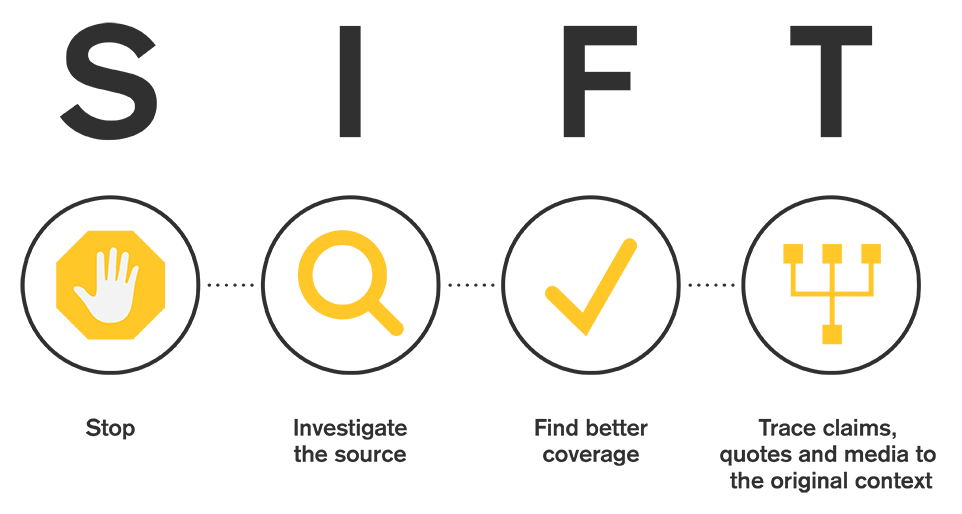
A better approach is to follow the SIFT method, developed by digital literacy expert Mike Caulfield:
Many of the early shortcuts people used to identify AI-generated writing are breaking down as both AI systems and human writing habits evolve. Vocabulary lists, punctuation quirks and overly polished phrasing no longer provide reliable evidence on their own because the patterns increasingly overlap with legitimate human writing.
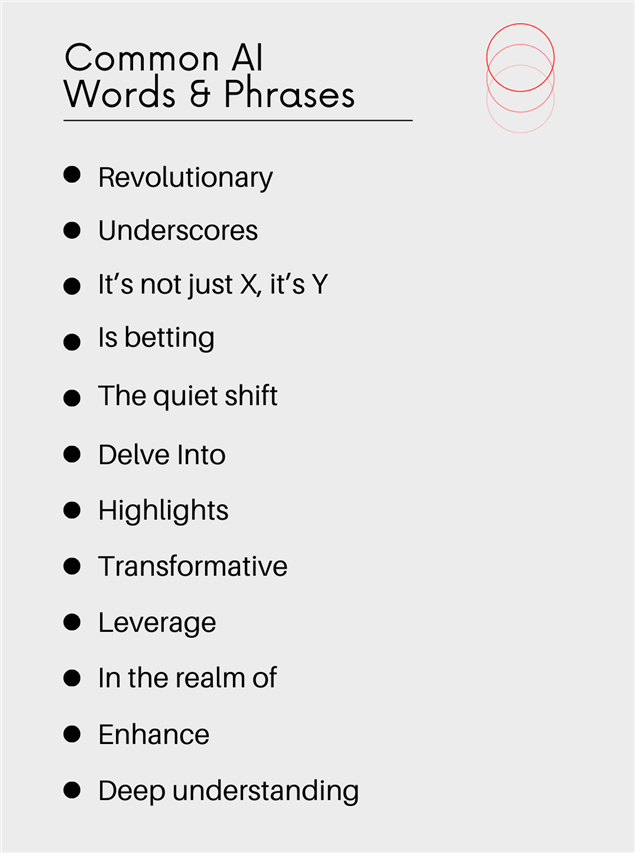
Bob Hutchins, AI researcher and CEO at Human Voice Media, told VKTR, “Those indicators that were once good enough to identify AI generated content, no longer provide adequate information. Word lists are being worked around, and rhythm tests are being hacked in hours. Only the difficult to automate indicators remain viable. Specifically look for lived experience specifics. A specific detail that only a person in the room could have noticed.”
Detecting AI-generated writing is less about finding a single tell and more about recognizing broader patterns. AI-generated text may feel overly even in tone, rely on generic claims, repeat ideas across multiple paragraphs or use examples that feel abstract rather than grounded in real experience.
One of the more revealing patterns in AI-generated writing is not necessarily the wording itself, but the way the content is structured. Machine-generated text often distributes attention evenly across sections, while human writers tend to emphasize ideas unevenly based on interest, experience or editorial judgment.
Weak sourcing remains another warning sign. AI-generated content may reference studies, statistics or expert claims without linking to original sources, or include vague references such as “research shows” without identifying the research itself. In more serious cases, it may contain fabricated citations or distorted summaries of real material.
AI-generated writing can also struggle to express clear human judgment. It may summarize a topic competently while failing to explain tradeoffs, priorities or why an idea matters in a real-world situation. Repetition, overly symmetrical sentence structures and generic conclusions can reinforce those concerns, especially when paired with vague examples or a mismatch with the writer’s usual voice.
The following example, generated by ChatGPT, shows how AI-generated writing can sound polished while avoiding meaningful specificity:
“Businesses looking to remain competitive in today's rapidly evolving digital landscape should strongly consider adopting AI-powered solutions, as these tools offer a wide range of benefits across multiple domains. From automating repetitive tasks and streamlining workflows to enhancing customer experiences and driving data-informed decision-making, AI has the potential to unlock significant value for organizations of all sizes. That said, it is important to note that successful implementation requires careful planning, cross-functional collaboration, and a commitment to responsible and ethical use. By taking a balanced, strategic approach that prioritizes both innovation and inclusivity, businesses can effectively leverage AI to not only improve operational efficiency and boost productivity, but also foster a culture of continuous improvement and position themselves for sustainable long-term growth in an increasingly complex and interconnected world.”
While the passage sounds polished and authoritative, it says very little that is concrete or verifiable. It never explains which businesses should prioritize AI, what tradeoffs matter most, what risks could outweigh the benefits or why one implementation strategy would be more effective than another. Nearly every sentence relies on broad corporate phrasing that could apply to almost any industry or situation. The repetitive structure, vague promises and lack of specific judgment make the writing feel more synthetic than informed.
No single clue proves AI involvement. Human writers can also produce repetitive or overly formal work, while AI-assisted writing may be heavily edited and fact-checked. The stronger approach is to evaluate the overall pattern, including sourcing, specificity, originality, structure.
Related Article: Fighting Deepfakes With Content Credentials and C2PA
No single method can reliably prove whether content was generated by AI. A stronger approach combines automated tools, source checks, contextual review and human judgment.
| Detection Method | What It Can Help Identify | Key Limitation |
|---|---|---|
| AI text detectors | Statistical patterns that may resemble AI-generated writing | Can produce false positives and false negatives, especially with edited or polished writing |
| Source verification | Whether the author, publisher, claim or media file can be traced to a credible origin | Requires time and may be difficult when content spreads through screenshots or reposts |
| Writing-pattern analysis | Generic phrasing, repetition, weak sourcing, vague examples or mismatch with a known author’s voice | Human writing can share the same traits, so patterns should not be treated as proof |
| Reverse image search | Earlier versions of an image, related posts or possible source material | May not work well for newly generated images or heavily altered media |
| Metadata review | File history, creation tools, timestamps or editing details when available | Metadata can be missing, stripped, altered or unavailable on many platforms |
| Provenance signals | Content credentials or other records showing how media was created or edited | Only useful when the content was created or distributed through systems that support provenance |
| Human editorial review | Accuracy, sourcing, context, originality, disclosure and fitness for purpose | Requires judgment and can still be influenced by bias or incomplete information |
While certain words and phrases commonly used by AI may raise suspicion, they're weak evidence on their own. Terms often associated with AI-generated writing also appear frequently in academic, technical, marketing and business content that is actually written by humans.
Language is also contagious. As people read more AI-assisted writing in emails, blog posts, search summaries, social posts and workplace documents, and hear it in AI-generated scripts that accompany videos, some AI-associated phrasing naturally enters everyday writing. A good example of this is the word “moreover,” which, since AI-generated content has become common, has become regularly used by people in text, spoken word and videos.
At the same time, AI models are trained on human language, meaning the relationship moves both ways. AI reflects human writing patterns, and humans increasingly absorb AI-shaped phrasing from the content around them.
Overreliance on vocabulary-based detection can also create false positives. Non-native English speakers, academics and business writers often use formal or highly structured language that may resemble AI-generated content. “Single-word tests harm the wrong individuals," warned Hutchins. "Non-native English speakers typically employ formal vocabulary options that are available to them. Academic writers tend to choose precise vocabulary choices.” As such (another now commonly used AI phrase), it has gotten so that writers are now self-censoring when writing just to avoid sounding like AI.
Rather than focusing on isolated words, reviewers should look for broader patterns such as vague claims, weak sourcing, repetitive structure, shallow analysis and a lack of contextual judgment. Even then, those signals should prompt closer review, not automatic conclusions. The more important question is whether the content is accurate, specific, verifiable and useful.
You've likely seen plenty of platforms and products that promise the ability to detect AI written content, a tool that often provides a score, such as "This content is 10% likely to be written by AI."
AI text detectors can serve as one signal in a broader review process, but they should not be treated as proof that content was generated by AI. These tools look for statistical language patterns such as predictability, repetition and sentence structure. Still, human writing can share those traits, especially in academic, technical, legal and non-native English contexts.
False positives remain one of the biggest concerns. A detector that incorrectly flags human writing as AI-generated can damage academic records, undermine credibility or unfairly penalize writers whose work appears highly polished or structured. False negatives are also common because AI-generated text can be edited, paraphrased or blended with human writing until automated systems struggle to identify it reliably.
Even as AI detection platforms continue improving, many reviewers still encounter inconsistent results when evaluating real-world content that has been lightly edited, rewritten or blended with human input. OpenAI retired its own AI text classifier in 2023 because of its low rate of accuracy, and that decision remains a useful cautionary example. Some businesses continue experimenting with AI detection tools despite concerns over reliability, especially when trying to reduce reputational risks tied to inaccurate or generated content.
For businesses, publishers and educators, detector results should justify closer review rather than prompt automatic conclusions. Human judgment, source verification, citation review and direct discussion with the writer remain more reliable than automated scores alone.
Spotting AI-generated images has become more difficult as image models improve, but human review can still help when it focuses on consistency, context and physical plausibility rather than relying on older giveaways alone. Distorted hands, warped faces and malformed text may still appear in weaker AI-generated images, but newer systems handle anatomy, text and lighting far better than earlier models.
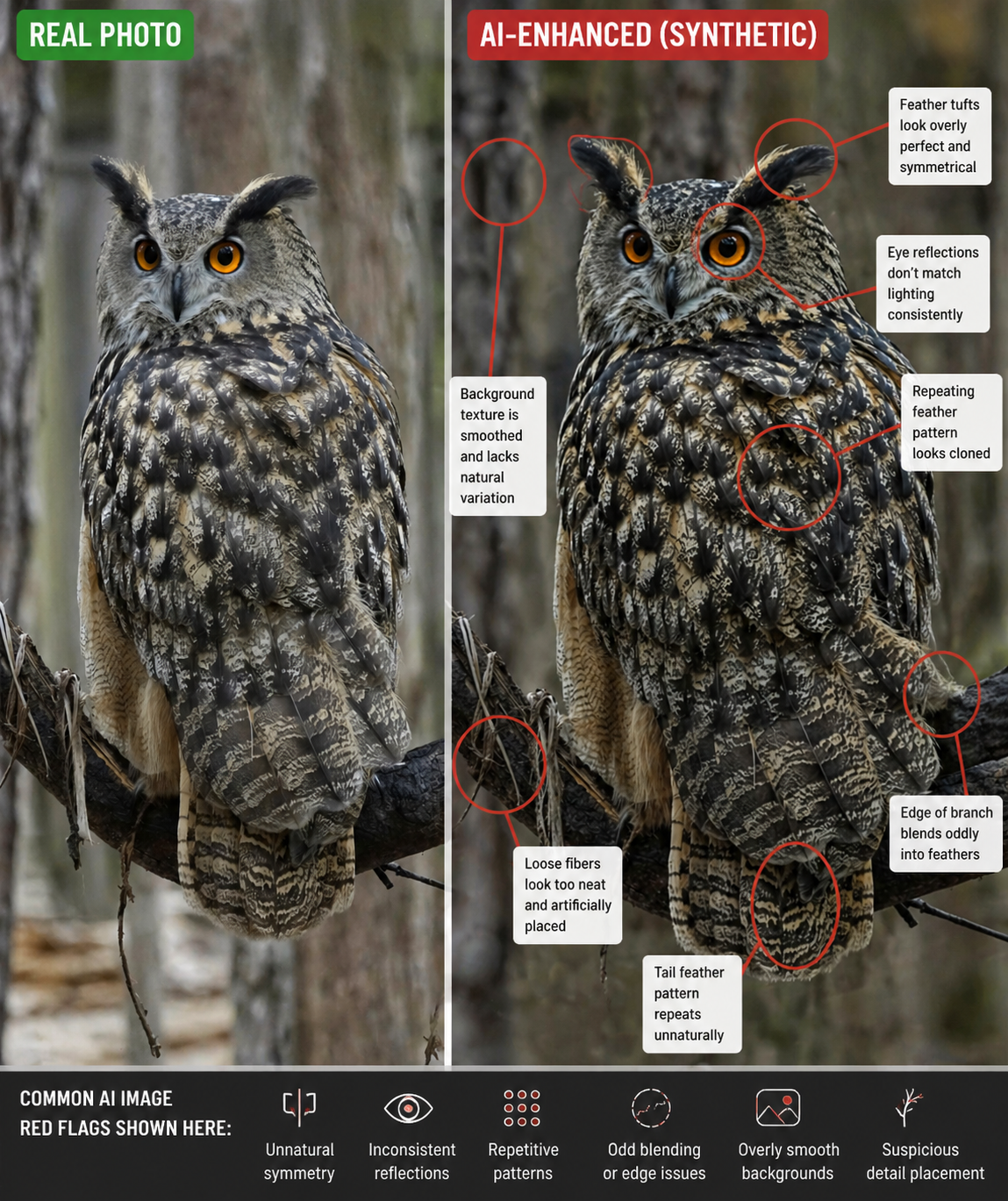
More reliable clues often appear in overlooked details. Background signs, logos, reflections, jewelry, eyeglasses and small objects may contain inconsistencies. Reflections may not match surrounding objects and elements in the background may blend together unnaturally. Lighting and shadows should also remain physically consistent across the image.
Context matters as much as visual inspection. Reviewers should ask whether the image comes from a credible source, whether the original file or photographer can be identified and whether a reverse image search reveals earlier versions or supporting coverage. A convincing image with no clear origin or credible sourcing deserves closer scrutiny.
At the same time, real photographs can also contain blur, compression artifacts or unusual lighting, and people have been adding effects to images long before AI came into the picture, which means visual clues alone should not be treated as definitive proof of AI generation.
AI-generated video and audio raise the stakes because they can imitate people in ways that feel immediate and emotionally convincing. A written claim may invite skepticism, but a realistic voice clip or video can provoke a reaction before viewers stop to verify whether it is authentic.
Real-world incidents have already demonstrated the danger.
During the 2024 US election cycle, for instance, AI-generated robocalls mimicking President Joe Biden circulated during primary season, while deepfake videos and cloned voices have also been used in executive impersonation scams and fraudulent financial requests.
Research found that deepfakes are growing at a dizzying pace — from 500,000 in 2023 to approximtely 8 million in 2025. And in a study of people attempting to detect deepfakes from real content, only 0.1% of participants could correctly identify all fake vs. real media.
Detection is difficult because even legitimate media can contain compression artifacts, poor lighting or awkward edits. Still, some warning signs remain useful. In video, look for mismatched lip movement, inconsistent shadows, unnatural facial expressions, warped hands or unstable backgrounds. In audio, synthetic voices may contain odd pacing, flattened emotion and inconsistent breathing patterns. Unusual pronunciation is a particularly common tell with AI-generated audio and video.
Context is critical, especially as voice cloning and AI-generated video become more convincing. A surprising clip involving a public figure, executive, coworker or family member should be verified through trusted sources before being believed or shared.
The risks are already real. AI voice cloning has been used in impersonation scams, while AI video can spread misinformation or create a false narrative during fast-moving events. The stronger defense is to combine technical review with source verification, including checking where the media originated, whether credible outlets confirmed it and whether the full context is available.
Watermarking and provenance tools are becoming more important as AI-generated content becomes harder to identify manually. Google DeepMind’s SynthID, for example, embeds digital watermarks into AI-generated or AI-edited content so that it can later be identified by detection tools. Google has expanded SynthID across formats, including images, audio, text and video, and introduced a SynthID Detector portal for identifying content created with Google AI tools.
Watermarking and provenance tools can strengthen content verification, but they work best as part of a broader review process that also includes source checks and human judgment.
| Approach | How It Works | Where It Helps | Where It Falls Short |
|---|---|---|---|
| Watermarking | Embeds a detectable signal into AI-generated or AI-edited content | Can help identify content created by participating AI tools | May not survive editing, screenshots, paraphrasing or use of tools that do not watermark content |
| Provenance systems | Attach verifiable records showing how content was created, edited or distributed | Can provide stronger evidence of origin and editing history | Depend on adoption by platforms, publishers, software vendors and device makers |
| Metadata checks | Review file information such as timestamps, software used or edit history | Can provide useful clues when original files are available | Metadata can be stripped, altered or missing from shared files |
| Platform labels | Show when a platform identifies or labels content as AI-generated or AI-edited | Can alert users before they share or trust questionable content | Labels may be inconsistent, incomplete or absent across platforms |
| Source verification | Traces content back to the original author, outlet, post, file or event | Helps verify claims, quotes, images, audio and video in context | Can be difficult when content is reposted without attribution |
| Human review | Evaluates accuracy, context, intent, sourcing, quality and disclosure | Brings judgment to cases where technical signals are incomplete | Can be subjective unless supported by clear policies and evidence |
These systems can strengthen verification efforts, especially when platforms, publishers and AI vendors support common standards. Visible labels, metadata records and cryptographic credentials can provide stronger evidence than visual inspection alone.
But these systems remain limited. Watermarks may only apply to content created with participating tools, while metadata and provenance records can be stripped during editing, recompression or reposting. Text can also be rewritten or blended with human writing, making provenance harder to track across workflows and platforms.
Technical systems such as watermarking and provenance standards may strengthen verification efforts, but shouldn't be considered definitive proof. Source verification, citation checks, editorial review and contextual analysis remain essential for evaluating trustworthiness.
Generative AI has created a new trust problem: authentic content can now be dismissed as fake. This is often called the “liar’s dividend,” where the existence of AI-generated media gives people a way to deny real evidence by claiming it was generated with AI.
For written content, this can unfairly damage students, journalists and professionals whose work appears polished, structured or similar to AI-assisted writing. A student may be accused of cheating because their writing improved, a journalist’s reporting may be dismissed as synthetic or an employee may deny writing a real message by claiming it was fabricated.
The problem becomes especially dangerous when suspicion replaces evidence. AI detection should not rely on instinct alone, particularly in high-stakes situations involving education, journalism or workplace disputes. Reviewers should instead examine supporting evidence such as drafts, metadata, document history, citations, communication records and corroborating sources.
As AI-generated content becomes more common, trust will depend increasingly on transparent review processes rather than subjective impressions, detector scores or assumptions that are based on writing style alone. Businesses, schools and publishers need clear standards for disclosure, verification and dispute resolution so that efforts to identify AI-generated content do not unfairly punish legitimate work.
Related Article: AI Literacy Is the New Must-Have Workplace Skill
The strongest defense against AI-generated misinformation is not a single detector or watermark system, but stronger habits around source verification, contextual review and editorial judgment.
As AI-assisted content becomes harder to distinguish from human-authored work, businesses, schools and publishers need clear standards for disclosure, verification and review rather than relying on suspicion or automated scores alone. Detection tools and provenance systems may help, but accountability, transparency and human judgment remain essential for determining whether content is trustworthy.
The distinction matters because “AI-generated” is often too blunt a label for modern workflows.
Look for:
Trustworthy content usually shows judgment: what matters, what is uncertain, what changed, who is affected and why the reader should care.
Scott Clark is a seasoned journalist based in Columbus, Ohio, who has made a name for himself covering the ever-evolving landscape of customer experience, marketing and technology. He has over 20 years of experience covering Information Technology and 27 years as a web developer. His coverage ranges across customer experience, AI, social media marketing, voice of customer, diversity & inclusion and more. Scott is a strong advocate for customer experience and corporate responsibility, bringing together statistics, facts, and insights from leading thought leaders to provide informative and thought-provoking articles. Connect with Scott Clark: 