News
Guide
Is AI Making Your Organization More Productive or More Dependent?

Anthropic launched Claude Fable 5 on Tuesday, making its most capable AI model generally available while restricting some high-risk uses through new safety controls.
The company also introduced Claude Mythos 5, a more open version of the same underlying model that will initially be limited to cyberdefense partners and critical infrastructure providers through Project Glasswing, Anthropic’s government-backed security initiative. Anthropic said Mythos 5 has the “strongest cybersecurity capabilities of any model in the world.”
Fable 5 is available today through the Claude API and on select Claude plans. Mythos 5 will remain restricted, with Anthropic planning to expand access through trusted programs for cybersecurity organizations and some life sciences researchers.
"These are the strongest results of any Claude model we’ve had the opportunity to test. Claude Fable 5 is a clear step forward on agentic coding and prototyping."
- Matt Colyer
Director of Product, Developers, Figma
Claude Fable 5 and Claude Mythos 5 are based on the same model. The key difference is access control.
Fable 5 includes safeguards designed to reroute sensitive requests to Claude Opus 4.8, Anthropic’s next-most-capable generally available model. The company said those fallbacks apply to some cybersecurity, biology, chemistry and model distillation queries.
The safeguards trigger in less than 5% of sessions on average. When the classifiers flag a request, users will be told that Claude Opus 4.8 is handling the response instead.
Mythos 5, by contrast, lifts some of those safeguards for approved users. It will first be available to existing Claude Mythos Preview users, with Anthropic reportedly working with the US government to expand that access over time.
The company said it also plans to open a trusted access program for biology users, giving some biomedical researchers access to Mythos-class capabilities with biology and chemistry safeguards removed but cyber protections still in place.
Related Article: Anthropic's Most Dangerous AI Reportedly Accessed by Unauthorized Group Days After Launch
| Model | Who Gets Access | Key Difference | Primary Use Case |
|---|---|---|---|
| Claude Fable 5 | General users, API customers and select subscription plans | Includes safeguards that reroute some sensitive requests to Claude Opus 4.8 | Broad enterprise use, coding, analysis, vision and long-context work |
| Claude Mythos 5 | Project Glasswing partners and approved trusted-access users | Same underlying model, but some safeguards are lifted for vetted users | Cyberdefense, critical infrastructure protection and select research use cases |
"At the highest effort, Claude Fable 5 reflects on and validates its own work. For us, that’s what makes highly autonomous operations possible — the extra thinking pays for itself."
- Yusuke Kaji
GM, AI for Business, Rakuten
Anthropic described Fable 5 as its strongest model across several enterprise and research tasks, including:
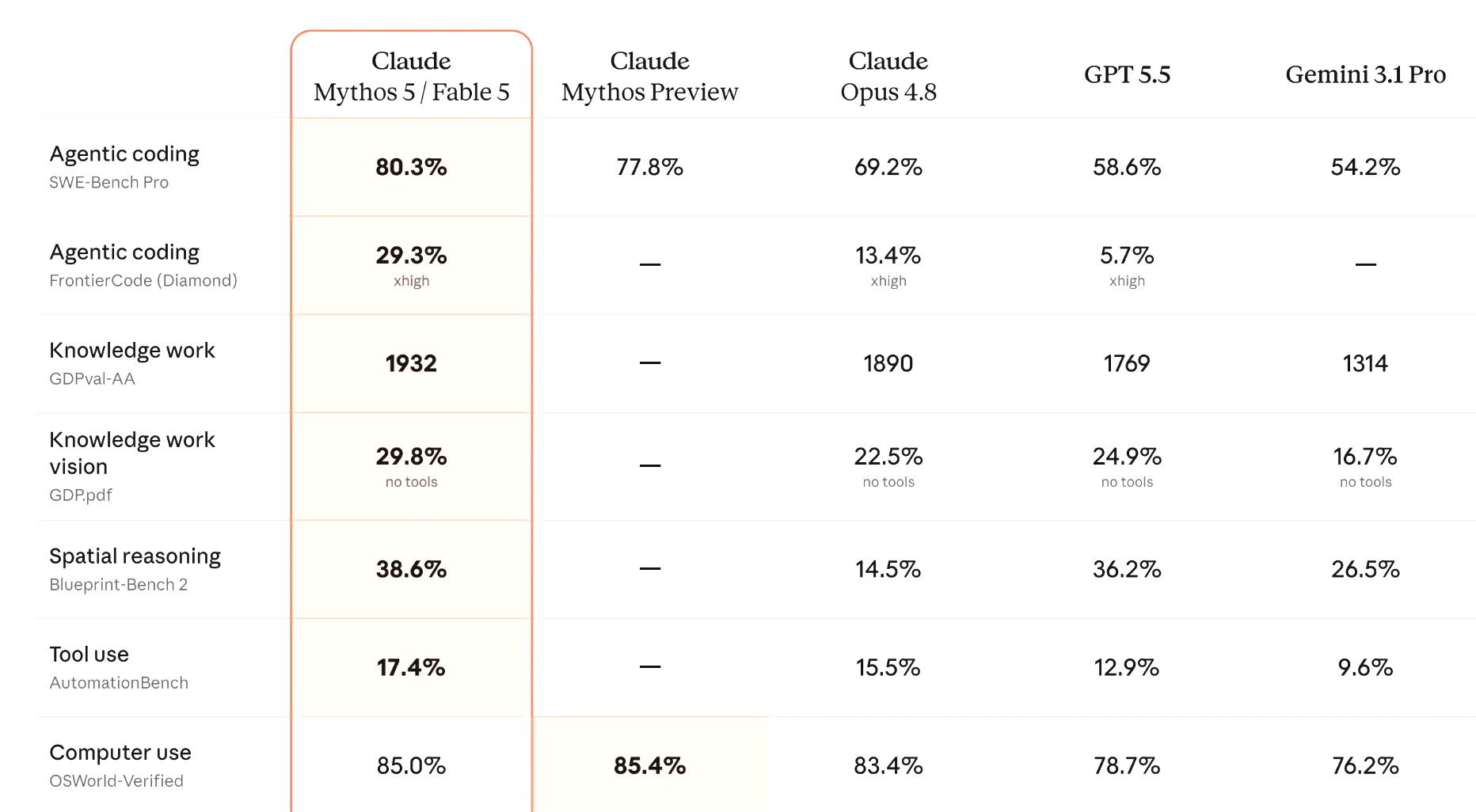
In early testing cited by the company, Stripe used Fable 5 to complete a codebase-wide migration in a 50-million-line Ruby codebase in one day, work Anthropic said would otherwise have taken a team more than two months. Fable 5 also reportedly outperformed other frontier models on Cognition’s FrontierCode evaluation, which measures whether models can complete difficult coding tasks while meeting production-code standards.
The model showed gains in finance and analytical reasoning. On Hebbia’s Finance Benchmark, the company said Fable 5 posted the highest score of any model tested, with improvements in document reasoning, chart and table interpretation and problem solving.
Anthropic also emphasized Fable 5’s vision capabilities, saying the model can extract precise data from scientific figures and rebuild web app source code from screenshots. In one internal demonstration, Fable 5 completed Pokémon FireRed using only raw game screenshots, without the additional maps or game-state tools previous Claude models needed.
Anthropic acknowledged that Fable 5’s safeguards are conservative and will sometimes block harmless requests.
According to the company, it prioritized releasing the model safely and quickly, even if that meant broader restrictions at launch. In biology and chemistry, for example, Anthropic said most related requests will temporarily fall back to Opus 4.8 due to concerns that advanced AI systems could provide meaningful uplift to well-resourced malicious actors.
Fable 5 includes expanded safety classifiers designed to detect jailbreak attempts and other misuse. According to Anthropic, an external bug bounty produced no universal jailbreaks after more than 1,000 hours of testing, though it also acknowledged that completely preventing such jailbreaks is likely impossible.
The launch also comes with a new data retention policy for business customers using Fable 5, Mythos 5 and future models at similar or higher capability levels.
Anthropic said it will require 30-day retention for all traffic on Mythos-class models, including both first-party and third-party surfaces. It will purportedly not use that data to train Claude models or for non-safety purposes.
The retention policy is meant to help identify complex attacks, detect jailbreaks that unfold across multiple requests and reduce false positives in its safeguards.
For enterprises, that policy may become a key adoption consideration, particularly in regulated industries where data retention, vendor access and model logging are already under scrutiny.
Related Article: Anthropic Files for IPO, Jumps Ahead of OpenAI in Race to Public Markets
Claude Fable 5 and Claude Mythos 5 are priced at $10 per million input tokens and $50 per million output tokens, less than half the price of Claude Mythos Preview, though higher than Claude Opus 4.8.
Developers can access Fable 5 through the Claude API using claude-fable-5.
For subscription customers, access will be phased. Anthropic said Fable 5 will be included at no extra cost on Pro, Max, Team and seat-based Enterprise plans from June 9 through June 22. Beginning June 23, users on those plans will need usage credits to access Fable 5 unless Anthropic extends the included-access window.
The company said it plans to restore Fable 5 as a standard part of subscription plans once capacity allows.
Claude Mythos 5 remains restricted to Project Glasswing partners and approved trusted-access users.