News
Guide
Is AI Making Your Organization More Productive or More Dependent?


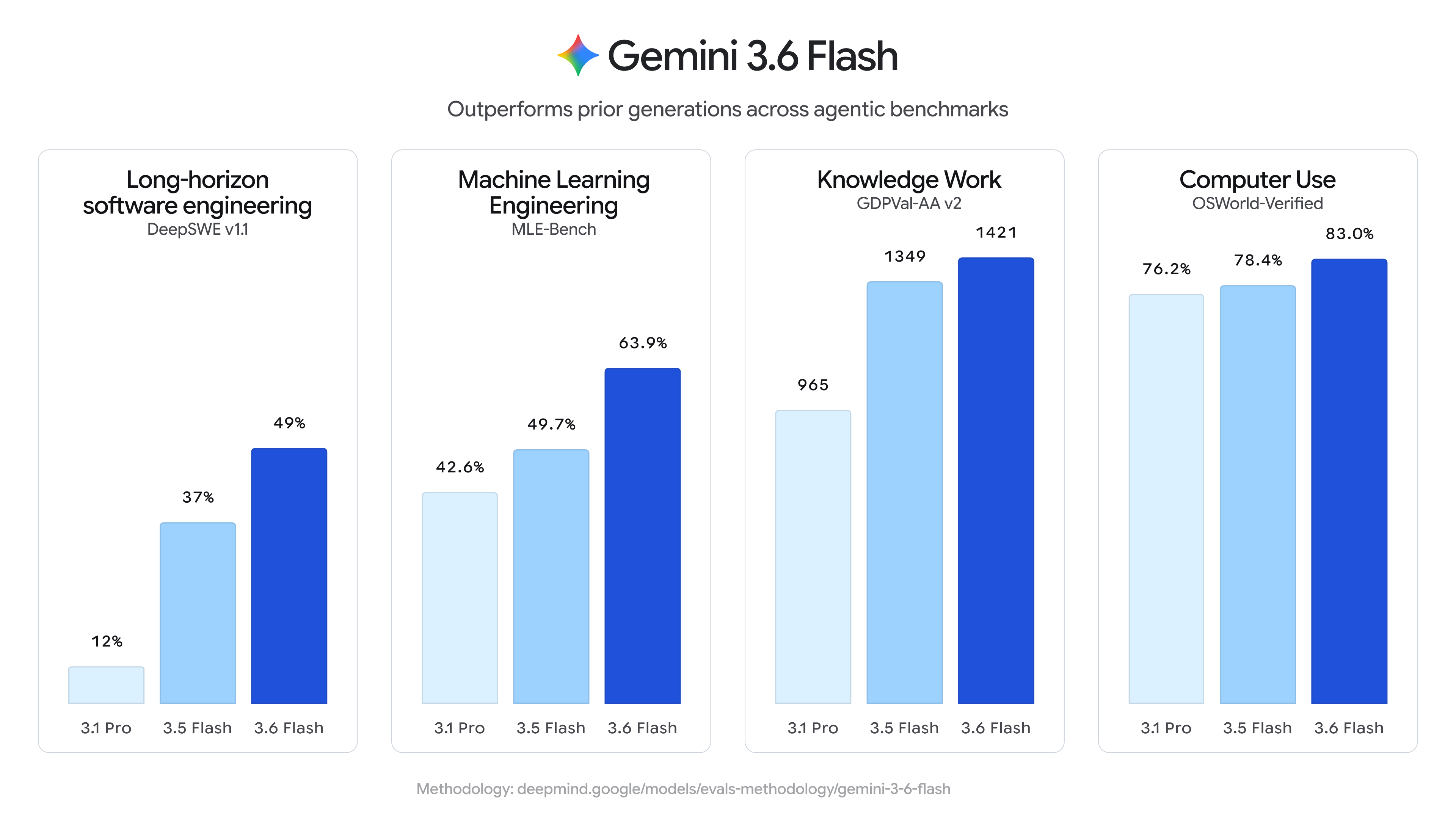
Google launched three new Gemini models on Tuesday — 1.6 Flash, 3.5 Flash-Lite and 3.5 Flash Cyber. The new models offer improved token efficiency, lower latency and more reliable performance for production AI agents.
The releases build on the Gemini 3.5 Flash foundation and respond to developer feedback, according to Google.
| Model | Key Capabilities | Cost |
|---|---|---|
| Gemini 3.6 Flash | Stronger coding & knowledge work, 17% fewer output tokens compared to 3.5 Flash, fewer reasoning steps & tool calls | $1.50/1M input tokens & $7.50/1M output tokens |
| Gemini 3.6 Flash-Lite | Designed for low-latency tasks & tasks where high throughput is critical, such as developer workflows, agentic search, document processing | $0.30/1M input tokens & $2.50/1M output tokens |
| Gemini 3.5 Flash Cyber in CodeMender | Fine-tuned for finding and fixing cybersecurity vulnerabilities | Requires CodeMender |
For enterprises, Gemini 3.6 Flash and 3.5 Flash-Lite are available in the Gemini Enterprise Agent Platform. 3.6 Flash is also available in the Gemini Enterprise App.
For developers, 3.6 Flash and 3.5 Flash-Lite are in the Gemini API via Google AI Studio and Android Studio. 3.6 Flash is also available in Google Antigravity.
Gemini 3.6 Flash and 3.5 Flash-Lite are also available to anyone via the Gemini app, with 3.5 Flash-Lite rolling out in Google Search.
In addition to the new models, Google announced that Gemini 3.5 Pro is now testing with partners and will launch broadly when ready. The tech giant has confirmed it’s begun pre-training Gemini 4, describing it as its “most ambitious pre-training run yet.”
Google Cloud Next '26 in April delivered around 260 announcements spanning Vertex AI agent tools, new TPUs and expanded Nvidia partnerships against an $80 billion cloud run rate.
The company also launched the Universal Commerce Protocol to address fragmented infrastructure blocking agentic AI, and Google Antigravity added Agent Skills support for portable AI agent capabilities.
Regulatory pressure remains a significant overhang for the tech company. A US federal judge barred Google from exclusive search deals in September 2025, with compliance triggered in May 2026. The European Court of Justice separately upheld the record €4.1 billion Android antitrust fine in July 2026, exhausting Google's appeals.