News
Guide
Is AI Making Your Organization More Productive or More Dependent?
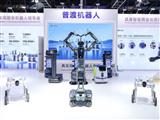

Pudu Robotics publicly demonstrated its new PUDU D7 semi-humanoid robot at the World Artificial Intelligence Conference, held from July 17–20 in Shanghai. The company shared plans to expand from specialized service machines into more adaptable industrial robots.
During the conference, the robot autonomously walked through the company’s booth while guiding Pudu’s four-legged D5 robot and avoiding people in its path. Attendees could also pose for photographs taken from the robot’s perspective.
The demonstration aimed to show how robots with different physical designs could coordinate inside the same environment, the company said.
Pudu described the D7 as an industrial-grade semi-humanoid robot intended for manufacturing, warehousing and retail environments.
Unlike fully humanoid robots that replicate the entire human form, semi-humanoid systems generally combine humanlike manipulation capabilities with a body optimized for stability or a particular working environment.
According to a separate Pudu Robotics technology announcement, the D7 is designed to perform tasks such as:
The robot supports payloads of up to 14 kilograms — or about 31 pounds — and can operate at heights of up to 2 meters, or approximately 6.6 feet.
Pudu did not announce pricing, customer availability or a commercial release date for the D7.
The D7 is part of Pudu’s “One Brain, Multiple Embodiments” strategy, through which specialized, quadruped, semi-humanoid and humanoid robots share components of the same underlying AI and software architecture.
The company’s three-layer robotics platform includes:
| Layer | Function |
|---|---|
| Robot body | Provides different physical designs for specific environments and tasks |
| PuduAgent OS | Connects AI models, robot skills, memory and safety controls |
| PuduFM | Helps robots perceive environments, plan tasks and execute physical actions |
Pudu said the shared architecture could allow capabilities developed for one robot type to be reused across other machines and operating environments.
The company is positioning specialized robots for repetitive and standardized work, semi-humanoid robots for more complicated commercial and industrial settings and humanoid robots for less structured collaboration with people.
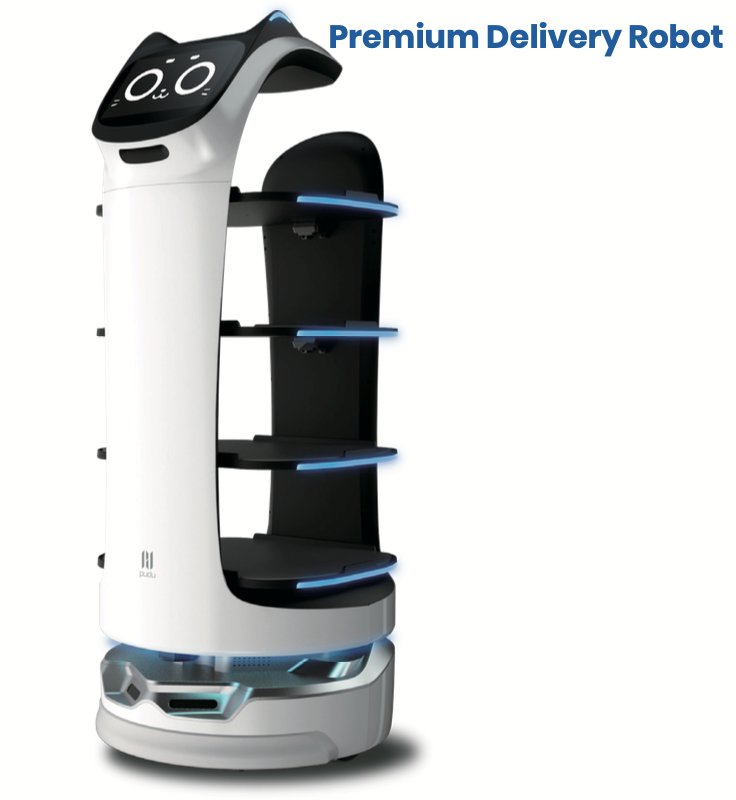
Pudu also displayed several of its established commercial robots at WAIC, including its BellaBot delivery robot, T300 industrial delivery robot and MT1 Max and CC1 Pro cleaning robots.
Its D5 quadruped robot navigated an obstacle course containing sand, gravel, steps and slopes designed to recreate conditions found in locations such as industrial parks and power substations. Pudu said the D5 can reach speeds of up to 5 meters per second.
The company said it has shipped more than 130,000 robots across over 85 countries and regions. Its machines are deployed in hospitality, retail, manufacturing, warehousing, health care, real estate and other commercial environments.
Pudu also said it raised nearly $150 million in April, bringing its valuation above $1.5 billion and its cumulative funding to more than $300 million.