News
Guide
Is AI Making Your Organization More Productive or More Dependent?


Cursor has officially launched Cursor Router, an intelligent model routing layer designed for teams and enterprise organizations that want high-grade AI coding performance without a massive price tag.
The tool classifies every developer request before selecting which AI model handles it — factoring in query complexity, context and domain. The result being frontier-level output quality at significantly reduced token spend.
Cursor Router is currently available for Teams and Enterprise plans across desktop, web, iOS, CLI and SDK.
Rather than locking developers into a single "daily driver" model — something Cursor says roughly 60% of its users currently do — Router acts as a real-time classifier trained on over 600,000 live coding requests.
Each incoming request is analyzed across several dimensions:
Simple tasks get routed to cost-efficient models. UI work goes to the model with the strongest design sense. Complex, multi-step problems land on frontier reasoning models.
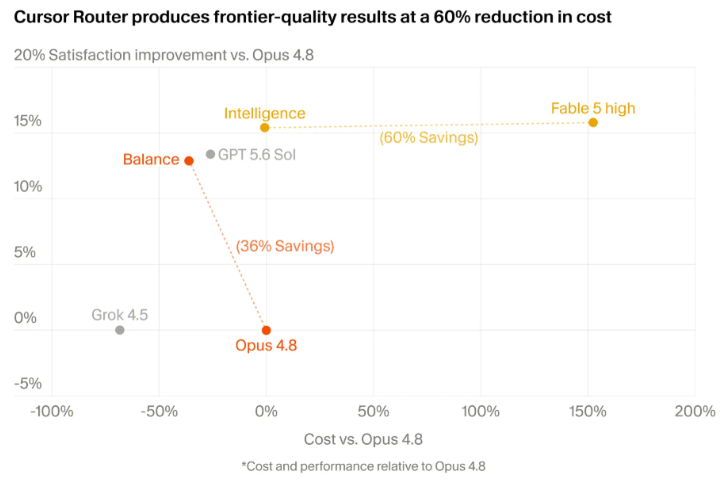
Admins and developers can choose from three optimization profiles:
| Mode | Mode | Cost Profile |
|---|---|---|
| Intelligence | Matches the most powerful frontier models | ~60% cheaper than equivalent single-model routing |
| Balance | Comparable to popular daily-driver models | ~36% lower cost than top-tier alternatives |
| Cost | Strong baseline quality | Maximum token-spend savings |
Enterprise admins can control rollout per team, restrict available modes and block or allow specific underlying models.
Cursor validated Router through large-scale online A/B tests. The company measured two primary signals: user satisfaction (whether developers accepted output or had to correct it) and keep rate (how much generated code remained in the codebase over time).
During early access with dozens of enterprise customers, three high-volume accounts with thousands of developers saw 30-50% cost reductions on auto-routed requests compared to running everything through a single premium model.
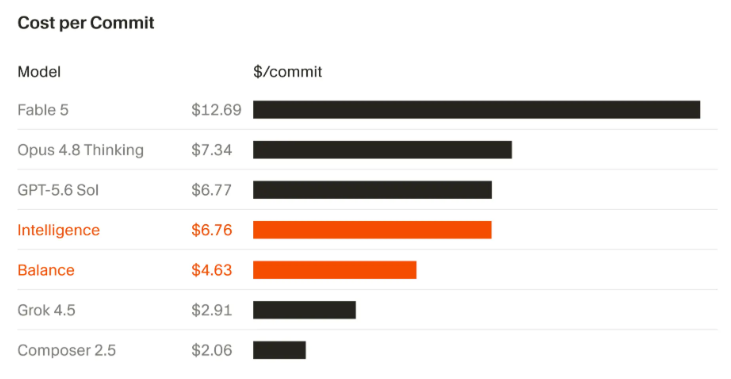
On a per-commit basis, Router's Intelligence mode produced commits at $6.76 each, while its Balance mode came in at $4.63. By comparison, competing approaches using individual frontier models cost between $7.34 and $12.69 per commit.
Router is part of a wider efficiency strategy at Cursor. The company also highlighted dynamic tool calling, which avoids loading all tool descriptions into every prompt. Instead, models look up tools only when needed, keeping common operations fast and trimming unnecessary token usage.