News
Research Report
The AI Transformation 100: Concrete Ideas for Fixing How We Work
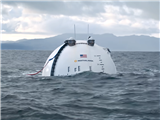
An Oregon startup wants to turn the open ocean into a new source of power for artificial intelligence.
Panthalassa, a public benefit corporation based near Portland, said Monday it raised $140 million in a Series B funding round led by Peter Thiel, the PayPal co-founder and prominent technology investor. The financing will help the company complete a pilot manufacturing facility and prepare for the deployment of its next generation of ocean-based energy and computing systems.
Today we're announcing @_panthalassa’s $140M Series B, led by Peter Thiel, with participation from John Doerr and many other incredible investors. The mission: unlock the ocean as another planetary-scale energy resource for humanity. First stop: compute. pic.twitter.com/uNO2hehyEf
— Garth Sheldon-Coulson (@garthsc) May 4, 2026
The company is developing floating platforms that generate electricity from ocean waves and use that power directly at sea to run AI computing workloads. Rather than transmitting electricity back to land, Panthalassa plans to place compute infrastructure where the energy is produced, cooling the hardware with cold seawater and transmitting data through low-Earth-orbit satellites.
The news comes amid growing concern across energy and tech sectors, with AI’s appetite for electricity rising faster than traditional infrastructure can easily accommodate. Data centers, electric vehicles, building electrification and industrial systems are all adding pressure to power grids. Panthalassa’s pitch is that the ocean can become another large-scale energy resource, particularly for workloads that do not need to be physically located near population centers.
“We’ve built a technology platform that operates in the planet’s most energy-dense wave regions, far from shore, and turns that resource into reliable clean power. We’re now ready to build factories, deploy fleets, and provide a sustainable new source of energy for humanity.”
— Garth Sheldon-Coulson
Co-Founder & CEO, Panthalassa
Wave energy has long attracted interest as a potentially vast renewable resource. But the sector has struggled to reach commercial scale, in part because of the cost and complexity of building infrastructure that can survive harsh ocean conditions and move electricity from offshore systems to customers on land.
Panthalassa is trying to avoid some of those constraints. Its systems are designed to operate far offshore, in areas with dense wave energy, and use the electricity locally for compute. That could reduce the need for undersea transmission lines, substations and other grid-connected infrastructure that have made wave power difficult to commercialize.
The company’s technology combines wave energy generation, propulsion, autonomous operations and computing. Its floating systems are built around large buoy-like structures that convert wave motion into power. The company has also emphasized autonomous deployment and fleet operations, suggesting it envisions many units operating together rather than a single large offshore installation.
The first market is AI inference, the process of running already-trained AI models to generate outputs. That work can be energy-intensive but, in many cases, does not require the same physical proximity to users or enterprises as other computing functions. Panthalassa says its systems would send data through low-Earth-orbit satellites, allowing compute to happen offshore while still connecting to customers on land.
“The future demands more compute than we can imagine,” Thiel said in a statement. “Extra-terrestrial solutions are no longer science fiction. Panthalassa has opened the ocean frontier.”
Related Article: As AI Strains Resources, Data Centers Look Beyond the Surface
Founded in 2016, Panthalassa has spent nearly a decade developing and testing its technology. The company has built several prototypes, including Ocean-1, Ocean-2 and Wavehopper, which were deployed in sea trials in 2021 and 2024.
It is now preparing to deploy its Ocean-3 pilot series this year. Commercial systems are planned for 2027.
The new funding will support the buildout of a pilot manufacturing facility near Portland, a critical step if the company is to move from one-off prototypes to larger-scale production. Panthalassa has grown to 120 employees, with a team that includes workers from aerospace, software, naval architecture, manufacturing, research institutions and the military.
Sheldon-Coulson previously worked as a senior investment associate at Bridgewater Associates. Brian Moffat, the company’s co-founder and chief innovation officer, developed a wave energy system for Spindrift Energy before helping launch Panthalassa.
The company has described its broader mission as unlocking the ocean as a planetary-scale energy resource. Its first commercial focus, however, is compute — a market where demand is rising quickly and customers are already searching for new power sources.
Panthalassa is not alone in pursuing wave energy. In the Pacific Northwest, Seattle-based Oscilla Power and C-Power, an Oregon State University spinout, are also working on ocean energy systems. Globally, wave energy companies that have raised more than $100 million include Sweden’s CorPower Ocean and the United Kingdom’s Marine Power Systems.
What differentiates Panthalassa is its decision to pair wave power with offshore AI computing. That approach ties the company not only to the renewable energy market, but also to the booming demand for data center capacity.
The strategy also arrives as technology companies and investors are increasingly focused on the physical limits of AI expansion. Chips, land, water and electricity have all become bottlenecks. Data center developers are seeking new locations (including space) and new energy sources, from nuclear power to geothermal energy to natural gas-backed sites.
Panthalassa's investors suggest broad interest across venture capital, technology and industrial sectors. New participants in the Series B round include John Doerr, TIME Ventures, SciFi Ventures, Susquehanna Sustainable Investments, Hanwha Group, Fortescue Ventures, Future Positive, WTI, Nimble Partners, Super Micro Computer, Sozo Ventures, Dylan Field, Planetary VC, Leblon Capital, Resilience Reserve, Portland Seed Fund and the Intrepid Oregon Fund.
Returning investors include Founders Fund, Gigascale Capital, Lowercarbon Capital, Unless and WovenEarth. Panthalassa has now raised $210 million in total, according to a company spokesperson.
Related Article: AI Has a Marketing Problem: Nobody Wants the Data Center Nearby
The promise of wave-powered AI systems is clear: clean energy, offshore cooling and compute capacity that does not compete directly with land-based power users. But the path to commercialization remains difficult.
Ocean hardware must withstand saltwater, storms, corrosion and remote maintenance challenges. Satellite connectivity must be reliable. Customers must be willing to run certain AI workloads offshore. And Panthalassa must show that its systems can produce power cheaply and consistently enough to compete with other energy options.
Still, the timing may work in the company’s favor. AI demand has pushed data center energy use into the center of corporate strategy and public policy debates. If Panthalassa can prove its systems work at commercial scale, it could offer a new path for AI infrastructure: not bigger campuses on land, but distributed fleets at sea.
Michelle Hawley is Editorial Director of VKTR, where she covers AI disruption, enterprise technology and the leaders shaping what comes next. Connect with Michelle Hawley: 
