Editorial
Research Report
The AI Transformation 100: Concrete Ideas for Fixing How We Work


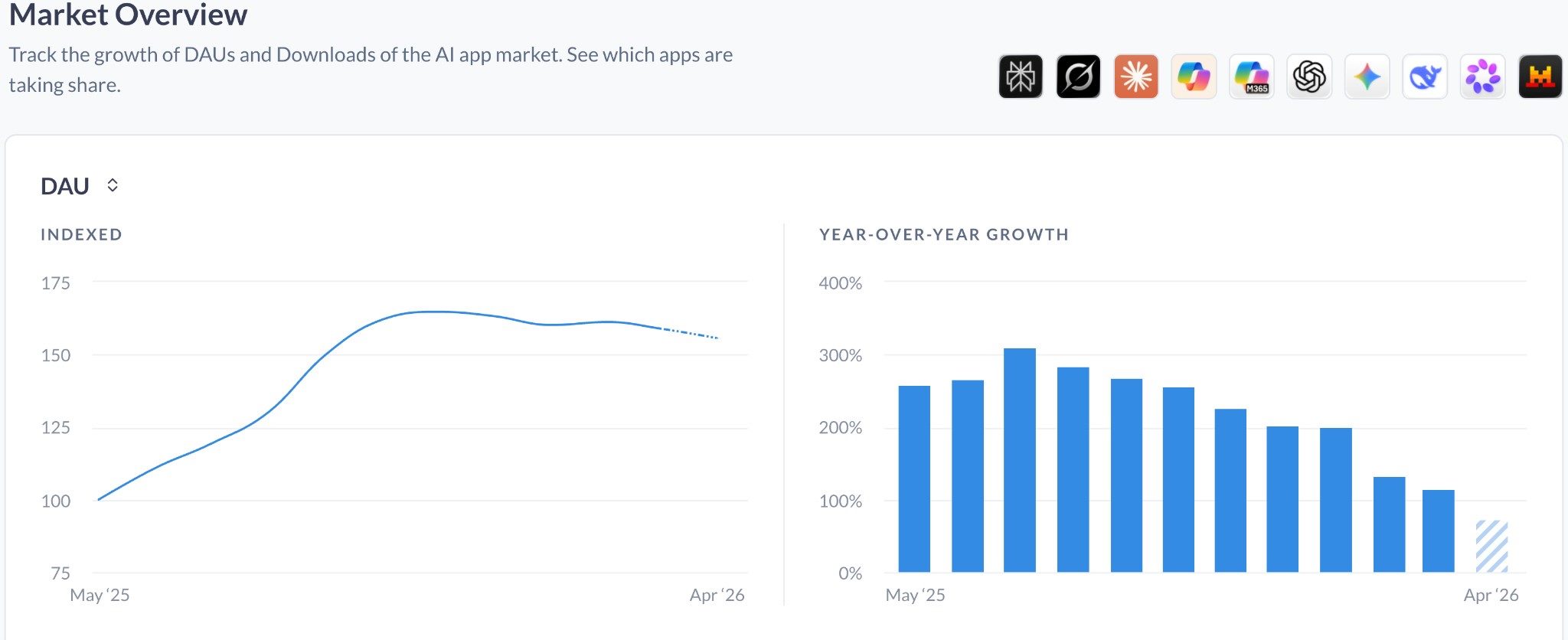
After the chaos settled down though, the bigger, underlying story baked into the numbers got almost no attention: Consumer AI might be plateauing.
Editor's note: Key questions surrounding the slowdown in consumer AI adoption and the continuing rise of enterprise AI.
Yes. ChatGPT continues to grow and remains the dominant consumer AI product, but recent reports suggest its growth rate is slowing compared to earlier expectations.No. AI infrastructure spending and enterprise adoption continue growing rapidly. The slowdown mainly reflects challenges in finding long-term mainstream consumer use cases.Agentic AI and coding-focused AI tools are seeing strong adoption. Enterprise applications tied directly to workflows and productivity are currently outperforming most consumer-facing AI apps.Consumer AI growth appears to be slowing because many applications still rely heavily on novelty rather than sustained daily value. While tools like ChatGPT remain popular, broader chatbot engagement has flattened.Enterprise AI delivers measurable operational benefits in areas like coding, healthcare, legal work and customer support. Companies continue investing heavily because AI improves productivity and efficiency.
Generative AI’s current moment began with a consumer application in ChatGPT, but the technology is still struggling to find its true form in consumer apps, and even ChatGPT’s torrid growth seems to be ebbing. OpenAI, according to the Journal’s report, failed to hit its goal of 1 billion active ChatGPT users by the end of 2025 and may not even be there today (it reported 900 million weekly active users this February). Among chatbots as a whole, daily active user growth has flatlined, according to third-party analytics companies like Apptopia.
“If we include April, DAUs have fallen for 4 out of the past 5 months,” Adam Blacker, director of public relations at Apptopia, told me.
While enterprise generative AI apps are taking off in the legal field, medicine, software development, and elsewhere, the corresponding consumer breakout hasn’t materialized. ChatGPT’s widespread use is certainly an exception, but the technology otherwise hasn’t translated to the series of consumer hits many anticipated at the outset. There is no mainstream generative AI companion, fitness app, life coach, or fantasy adventure game, for instance.
Consumer AI’s bumpy progress compared with enterprise’s boom was put in stark contrast in late-April’s big tech earnings reports. If your company owned infrastructure supporting enterprise AI, you were sitting pretty. Amazon reported 28% growth in its Amazon Web Services division, a jump from the 17-18% quarters it had turned in recently. “The last time we saw growth at this clip, AWS was roughly half the size,” Amazon CEO Andy Jassy said. Google Cloud Platform, meanwhile, grew 63% and Microsoft Azure grew 40%.
The consumer side of tech earnings was a different story. Meta told investors it would spend even more money in its pursuit of "personal superintelligence" than anticipated (up to $145 billion this year) and the market punished it, cutting it 8.5% one day late last month.
Apple, the notorious AI "failure," felt none of the pain after its consumer products, including the iPhone and MacBook Neo, delivered stellar results. Apple, for the moment, seems wise to have forgone a massive investment in foundational model training in service of building a little-wanted consumer application.
Related Article: Before You Scale AI in Customer Experience, Fix These 5 Things
A comparison of where momentum is building — and where it may be slowing.
| Category | Current Trend | Key Signal |
|---|---|---|
| Consumer AI apps | Growth slowing | Daily active user growth flattening across chatbots |
| ChatGPT adoption | Still massive but cooling | OpenAI missed aggressive active-user targets |
| Enterprise AI | Rapid acceleration | Cloud infrastructure growth surges at Amazon, Google and Microsoft |
| AI infrastructure spending | Expanding aggressively | Big tech continues raising AI investment commitments |
| Mainstream consumer AI apps | Limited breakout success | Few enduring consumer AI experiences beyond chatbots |
| Agentic AI tools | Growing quickly | Coding-focused AI applications show strong adoption momentum |
To date, consumer AI has surged mostly through novelty. ChatGPT’s Studio Ghibli moment created a surge of interest — turning many new users on to the power of generative images — but the excitement ultimately faded. OpenAI’s enhanced voice mode for ChatGPT also created a spike in users, but the company still has work to do for that feature to reach its potential.
This doesn’t mean the AI moment is running out of steam. New agentic apps like Codex and Claude Code are booming in adoption. Anthropic is on track to make more than $30 billion this year on the back of Claude’s coding capabilities.
And OpenAI’s latest GPT-5.5 model doubled Codex’s revenue in less than a week. Perhaps these "super apps" will grab the public’s attention and become as standard as a phone or a laptop. But for the time being, the consumer slowdown is curious.
 Learn how you can join our contributor community.