News
White Paper
Why Enterprise AI Fails at Scale

Google is betting that fragmented commerce infrastructure will bottleneck the agentic AI era — and wants its new protocol to be the fix.
On Jan. 11, 2026, the tech giant unveiled the Universal Commerce Protocol (UCP), an open-source standard designed to power AI-driven agentic commerce. According to Google, the protocol establishes a common language for consumer surfaces, businesses and payment providers to connect.
UCP was developed in collaboration with Shopify, Etsy, Wayfair, Target and Walmart, with endorsements from more than 20 global partners including Adyen, American Express, Best Buy, Mastercard, Stripe, The Home Depot and Visa.
The protocol aims to address what Google describes as an "N x N integration bottleneck" that forces businesses to build custom connections for every consumer surface. UCP collapses this complexity into a single integration point while supporting the full commerce lifecycle from discovery to order management.
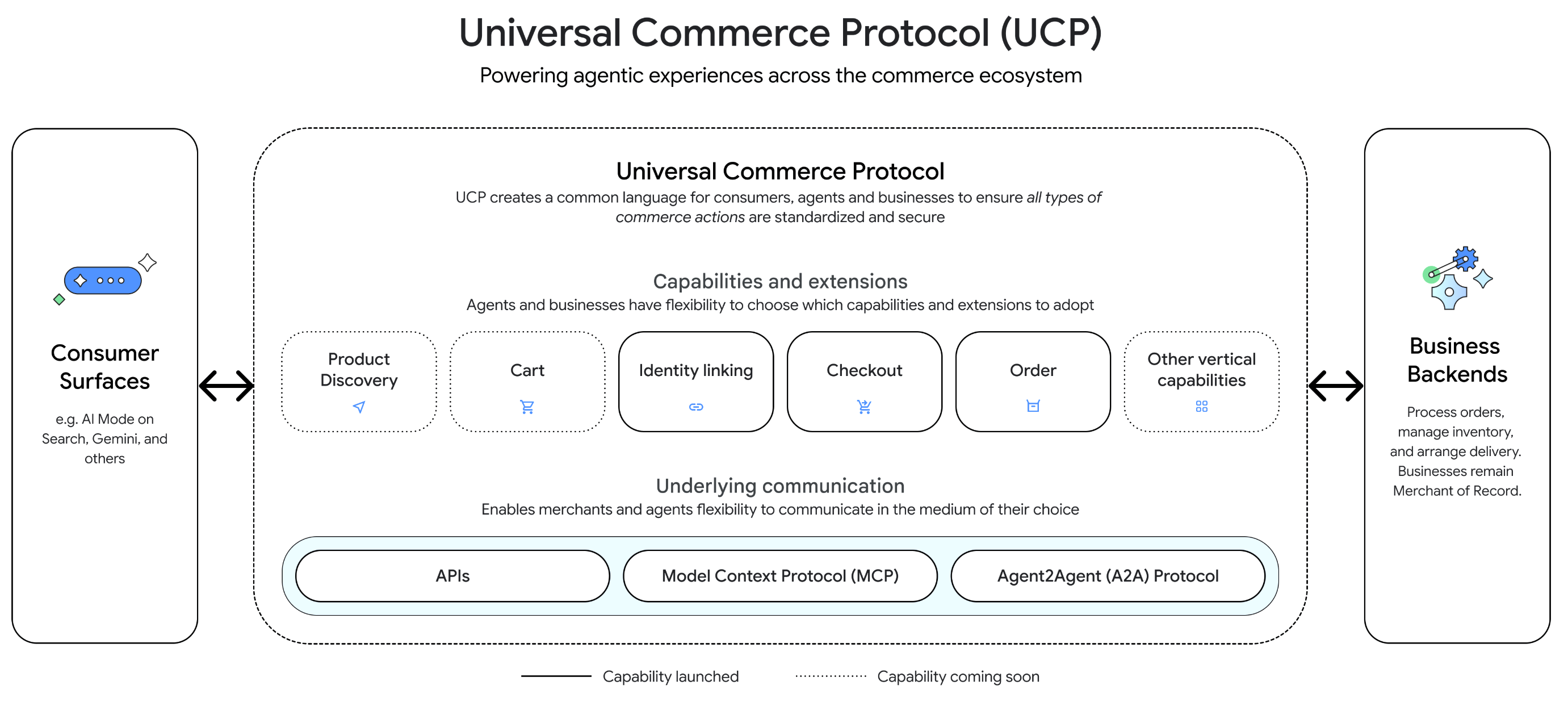
The commerce ecosystem faces steep technical hurdles in achieving seamless, AI-driven agentic commerce. While OpenAI's Agentic Commerce Protocol represents one industry attempt to address these barriers, obstacles persist across infrastructure, governance and user experience.
Research from Pega and Savanta found 68% of IT leaders identify legacy systems as blocking modern tech adoption. Some 88% worry that technical debt allows nimbler competitors to advance faster.
AI effectiveness depends on clean, structured and trustworthy data. Without proper data foundations, even ambitious agentic commerce strategies fail, regardless of tool sophistication.
Data privacy and security remain pressing concerns as autonomous systems handle sensitive customer information. The "black box" nature of AI decision-making creates accountability challenges, particularly in finance and healthcare.
The growing gap between powerful agentic AI frameworks and consumer-ready interfaces represents a significant adoption barrier. Organizations struggle to translate sophisticated AI agent capabilities into seamless customer experiences.
Related Article: Is Your Data Good Enough to Power AI Agents?
Google asserts UCP provides multiple integration options and security features for the commerce ecosystem.
| IPC Component | What It Enables |
|---|---|
| Universal Commerce Protocol | Open-source standard for AI-driven agentic commerce journeys |
| Multi-Protocol Integration | Supports APIs, Agent2Agent (A2A) and Model Context Protocol (MCP) |
| Embedded Checkout Option | Allows retailers to maintain customized checkout experiences |
| Modular Payment Handler | Enables interoperability across diverse payment providers |
| Tokenized Payments | Provides cryptographic proof of user consent for authorizations |
According to Google, with UCP, businesses and agents can choose the services they want to support and expose the capabilities corresponding to them. An example of how to set up and use UCP is:
According to Tobi Lutke, Shopify CEO, "[Universal Commerce Protocol] is open by default, so platforms and agents can use UCP to start transacting with any merchant. Major retailers are already using it." He added that Shopify merchants, powered by UCP, will also be able to sell in Google AI Mode and the Gemini app.
Google currently offers a UCP playground for those who want to explore an interactive demo and walk through a complete Universal Commerce Protocol checkout flow step-by-step.
Google reversed course dramatically in 2025, with its stock rising 68% to reach a $3.8 trillion market cap. The company transformed from AI laggard to competitive force, posting its first $100 billion quarter. Google DeepMind's Gemini 3 family of models now rival Claude and ChatGPT atop performance leaderboards.
Google Cloud generated $15.15 billion in Q3 2025, a 35% year-over-year increase, with both Anthropic and OpenAI signing major deals to run workloads on Google's infrastructure.
Regulatory scrutiny remained constant, with a US federal judge barring Google from exclusive search deals in September 2025.
Related Article: Moats or Myths? How OpenAI, Anthropic and Google Plan to Stay on Top
Founded in 1998, Google delivers products and services for consumers, businesses and developers. Key offerings include Search, YouTube, Maps, Android, Google Ads, Google Cloud Platform, Google Workspace and AI services, including Gemini.
Michelle Hawley is an experienced journalist who specializes in reporting on the impact of technology on society. As editorial director at Simpler Media Group, she oversees the day-to-day operations of VKTR, covering the world of enterprise AI and managing a network of contributing writers. She's also the host of CMSWire's CMO Circle and co-host of CMSWire's CX Decoded. With an MFA in creative writing and background in both news and marketing, she offers unique insights on the topics of tech disruption, corporate responsibility, changing AI legislation and more. She currently resides in Pennsylvania with her husband and two dogs. Connect with Michelle Hawley: 
