News
White Paper
Why Enterprise AI Fails at Scale

Enterprises want to own their AI, not just rent it. At least, that’s what Mistral is arguing with its latest debut: Mistral Forge.
According to company officials, Forge bridges the gap between generic AI and enterprise-specific needs by allowing organizations to train models on internal documentation, codebases and operational records.
Initial partners include ASML, DSO National Laboratories Singapore, Ericsson, European Space Agency, Home Team Science and Technology Agency (HTX) Singapore and Reply.
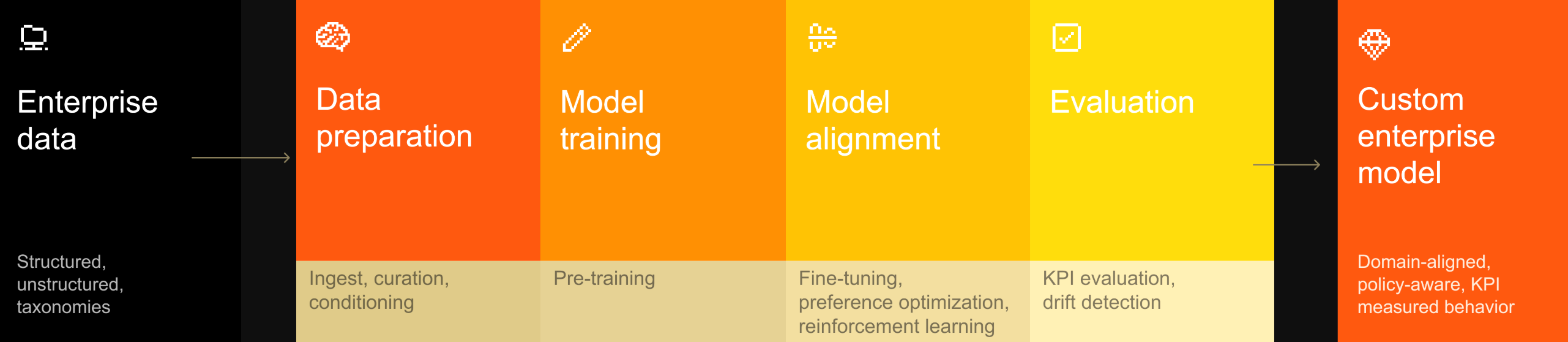
According to Mistral, Forge supports multiple training approaches and model architectures, including fine-tuning for domain-specific tasks.
| Key Feature | How It Works |
|---|---|
| Domain Alignment | Customized pipelines that integrate proprietary datasets, ontologies and decision frameworks |
| End-to-End Training | Train models across the full lifecycle, including pre-training, synthetic data generation and post-training with reinforcement learning |
| Production-Grade Evaluation | Evaluation frameworks tailored to enterprise KPIs |
| Infrastructure Flexibility | Deploy in the environment matching your risk profile without handing over control to a single cloud vendor |
| Security and Governance | Strict data isolation, controlled training pipelines and auditable customization workflows |
AI models perform best when trained on data reflecting their intended use. Proprietary datasets from customer interactions and industry sources produce precise, actionable outputs that competitors can’t easily replicate.
BloombergGPT is a good example of this. Trained on financial news, regulations and industry data, the model outperforms general AI in finance-related tasks like risk assessment and market analysis.
This pattern holds across industries. In healthcare, tools like Path AI innovate cancer diagnosis by analyzing pathology slides with accuracy that rivals human pathologists. In manufacturing, domain-trained models can predict equipment failures before they occur.
The common thread: general-purpose models trained on public data don’t understand a company’s proprietary processes, validated procedures or internal documentation, and that gap directly affects whether AI delivers value.
The market is responding accordingly. Gartner predicts the domain-specific AI market will reach $131 billion by 2035.
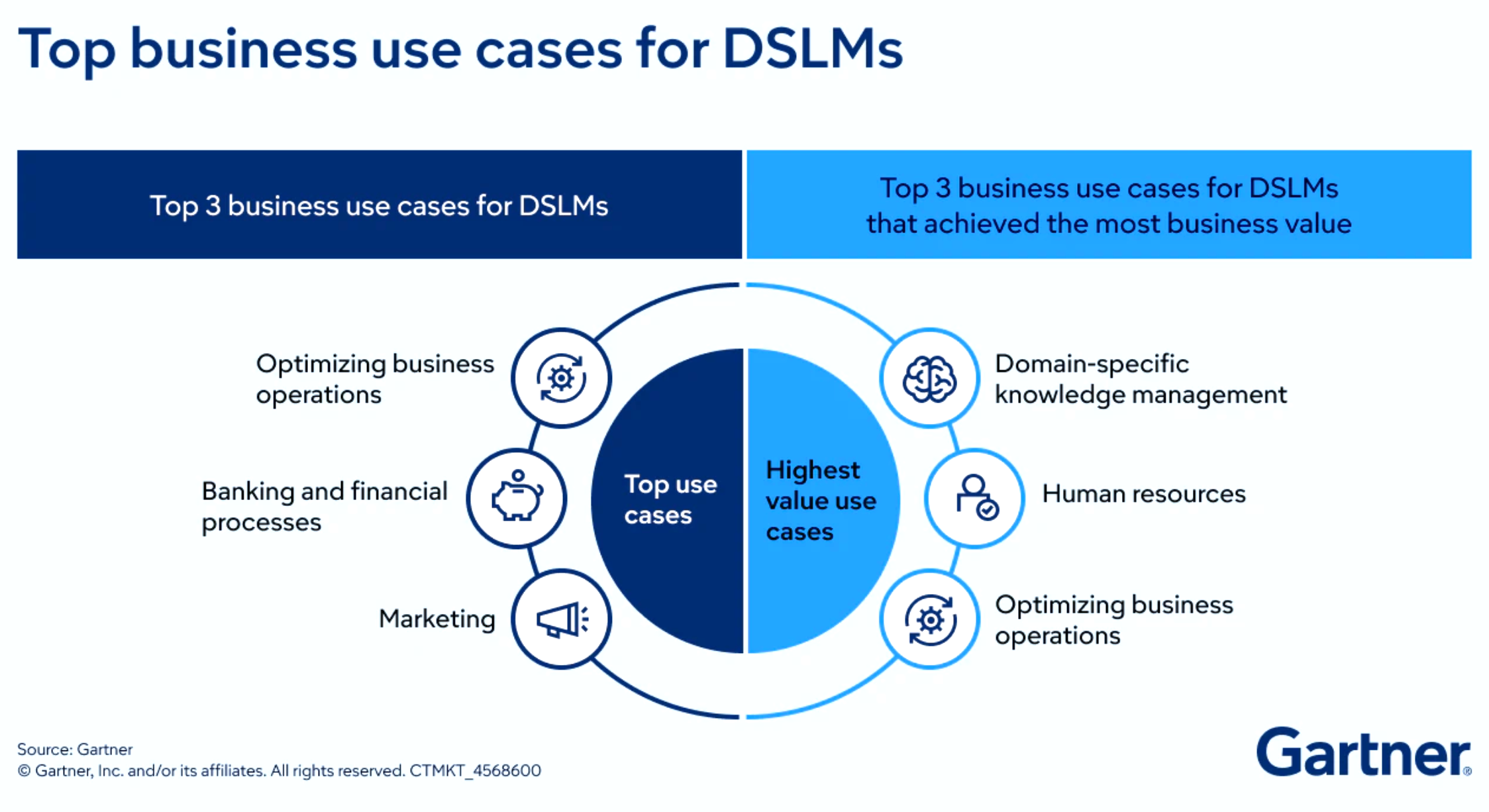
Mistral claims Forge can be applied across multiple types of enterprise workflows, including:
As AI further embeds itself into core business operations, enterprises that control their own models will hold a compounding advantage over those dependent on third-party systems. Proprietary training data is, by nature, a moat. It reflects years of institutional knowledge, operational decisions and customer relationships that no off-the-shelf model can replicate.
For Mistral, Forge is as much a positioning move as it is a product launch. The AI company is making a clear argument that the next wave of enterprise AI adoption won’t be won by whoever has the biggest model, but by whoever makes it easiest for organizations to own the intelligence layer of their business.
Michelle Hawley is an experienced journalist who specializes in reporting on the impact of technology on society. As editorial director at Simpler Media Group, she oversees the day-to-day operations of VKTR, covering the world of enterprise AI and managing a network of contributing writers. She's also the host of CMSWire's CMO Circle and co-host of CMSWire's CX Decoded. With an MFA in creative writing and background in both news and marketing, she offers unique insights on the topics of tech disruption, corporate responsibility, changing AI legislation and more. She currently resides in Pennsylvania with her husband and two dogs. Connect with Michelle Hawley: 
