Editorial
White Paper
Why Enterprise AI Fails at Scale

The era of "browsing" is officially ending. We are entering the age of "delegating." Consumers are no longer just using AI to summarize emails or create funny images. They’re utilizing AI for shopping too, whether to simply shortcut product research or to automate the drudgery of the weekly food-shop.
This shift is now visible, not to mention measurable: during the 2025 holiday season, Adobe reported that traffic driven to seller sites by generative AI surged by 693.4% — and this referred traffic is actually buying.
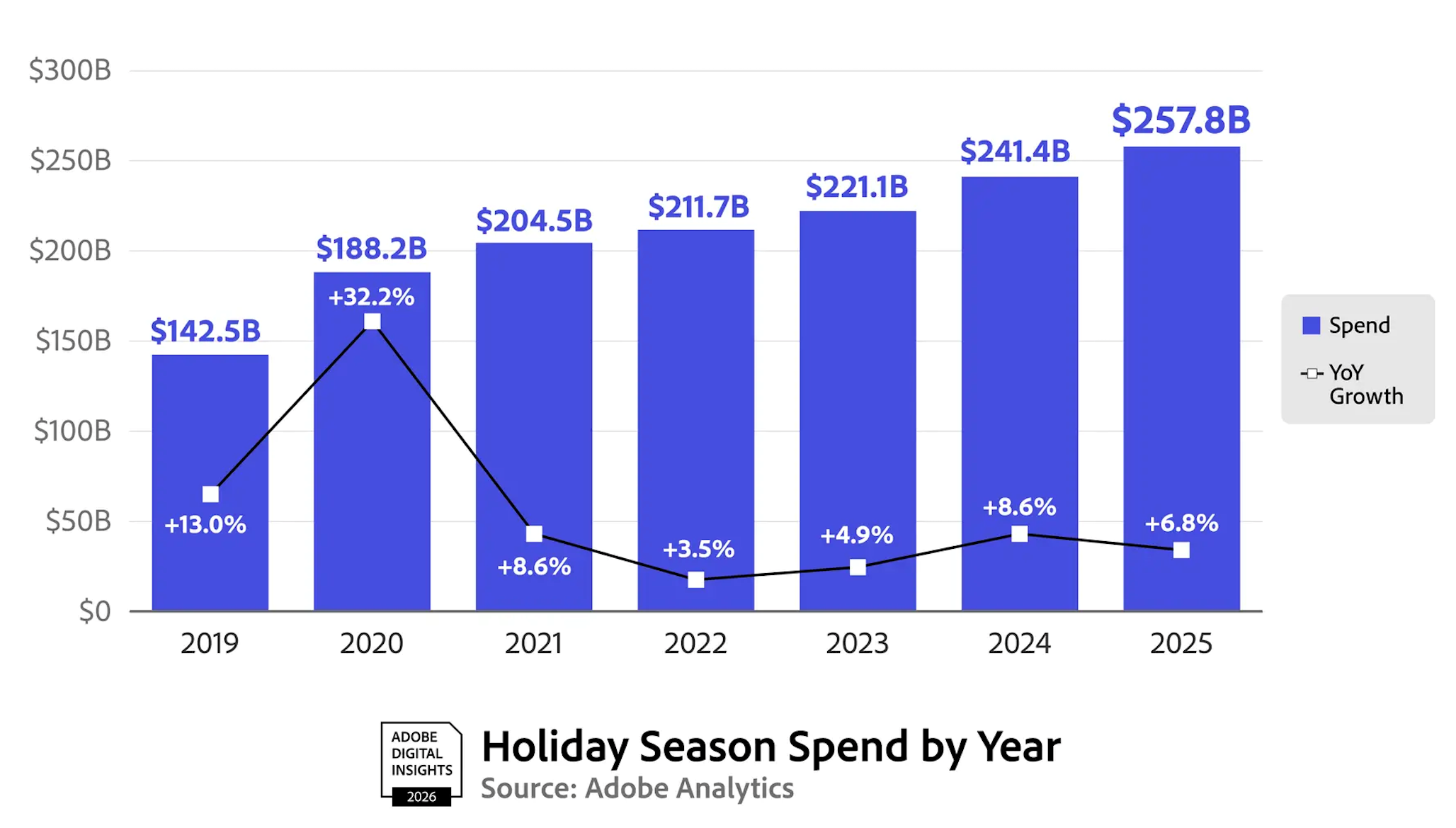
In addition, Salesforce reported that AI chatbots and agents drove $67 billion in global sales during Cyber Week alone, and influenced around 20% of all purchases.
For marketers, this is a fundamental rewiring of the P&L. According to analysis from Roth Capital, the industry is entering a "death of clicks" phase, where organic traffic to retailer sites is projected to decline by 30%, and paid traffic by 10 to 15%. As transactions move upstream into AI answer engines and to AI agents, the traditional shopping funnel from ad to purchase (search or view, then click, then visit, then buy) is collapsing into a single, autonomous action.
Google's recent announcement of the Universal Commerce Protocol (UCP) — an open standard for data and transaction processing co-developed with retail giants like Shopify, Walmart and Target — makes this shift clear. UCP creates a "common language" that allows AI agents to complete transactions across different platforms without human intervention.
In a world where machines make the purchasing decisions, catchy headlines and glossy visual ads are, arguably, irrelevant, because you cannot influence a bot with a clever display ad.
To survive the death of clicks, what can brands do? They need a data layer to feed agents.
Related Article: OpenAI vs. Google: Two Visions for the Future of Agentic Commerce
For more than 20 years, the internet’s ecommerce social contract was simple: platforms like Google aggregated demand and then “sold” that high-intent traffic to retailers via pay-per-click ads or favorable organic search rankings. The Universal Commerce Protocol fundamentally breaks this model.
According to the new specifications released at the National Retail Federation, UCP allows AI agents to handle not just discovery, but the entire cart-to-confirmation flow across different shopping surfaces. This means transactions are moving upstream: the entire purchase funnel is compressing. For retailers, this creates a paradox: traffic to sites will drop, but conversion should increase. While organic traffic to retailer sites is projected by Roth Capital to decline by 30%, the shopping “visit" is instead being replaced by a “committed checkout” by an agent.
Importantly, Google has designed UCP so that the retailer remains the Merchant of Record (MoR). This is a key concept, because while merchants may lose the site visit, after a transaction is completed, they retain the customer data, fulfillment, customer service responsibilities and, of course, the revenue.
All of this means that the battle is no longer about getting the user to a store. Instead, retailers must ensure their store can both be found, as well as operate autonomously, inside the agent so that it can automatically complete transactions.
"If an AI can’t understand your data, it can’t buy from you."
- Stephan Ritter
Director, Deloitte Consulting
If an AI agent cannot "read" product information, the product is invisible. Unfortunately, many retailers are drowning in data debt, relying on messy product feeds with inconsistent information or incomplete fields.
The UCP standard changes the requirements for visibility. Simply using the old Google Merchant Center feed will no longer cut it. UCP adds to it by introducing dozens of new machine-readable product attributes, including use case descriptions, accessory compatibility info, acceptable substitutions, themes (e.g., “good for an outdoor picnic”) and lists that provide answers to expected questions a customer might ask. In this new era, as Deloitte’s Stephan Ritter noted, "If an AI can’t understand your data, it can’t buy from you."
A merchant’s product feed is effectively now a customer-facing storefront (and the “customers” are actually agents working for human customers).
The implication is that retailers must audit their product catalogs immediately to ensure they are clean, structured and robust enough for agents to consume and be able to decide on.
Related Article: AI Shopping Is Here — Here's What Retailers Can Do About It
With Adobe reporting that 7x year-over-year pop in GenAI-driven traffic during the holidays in 2025, the consumer adoption curve for AI-assisted shopping hasn’t just gone “up and to the right,” it’s vertical! Meanwhile, these moves in the agentic commerce space means it’s no longer theoretical. Given Google’s massive scale, its developments around UCP could mean adoption rapidly accelerates there too.
With agentic commerce looming, the retailers that fail to modernize their data risk simply becoming backend warehouses for front-end bots. The retail innovators that do master the protocol will be better positioned to make sure that when the bot buys the groceries, it buys their brand.
 Learn how you can join our contributor community.
Tristan Barnum oversees the marketing and client success teams at Wildfire, a customer loyalty and rewards company based in Solana Beach, California. Prior to Wildfire, Barnum co-founded two startups — Tellient, an analytics platform built for the internet of things, and Switchvox, to serve the rapidly growing SMB market for VoIP phone systems. Connect with Tristan Barnum: 