Editorial
White Paper
Why Enterprise AI Fails at Scale

Every enterprise facing a GenAI initiative eventually arrives at the same question: Should metadata be created by humans or AI?
It's the wrong question.
The organizations asking it are trapped in a false dichotomy. They assume they must choose between the accuracy of human judgment and the speed of machine processing. Meanwhile, their content backlog grows and their AI initiative stalls waiting for "clean data."
The answer isn't human or AI. It's human and AI, but in the right combination, for the right tasks and with the right feedback loops.
Pure manual doesn't scale. Pure AI isn't accurate enough. The hybrid model gives you both scale and accuracy.
This isn't a compromise; it’s an optimization that uses the strengths of each approach to produce a system that is better than either one alone. The organizations that figure this out will tag 100,000 documents in the time their competitors spend arguing about methodology.
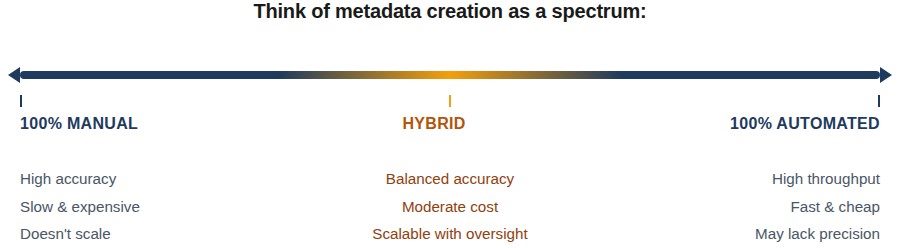
At the manual extreme, humans read every document, apply expert judgment and tag with nuanced understanding of business context. The quality can be excellent when humans do it. (But humans are notoriously inconsistent when tagging due to different interpretations of the content and tags, fatigue, subjective judgement and so on). The problem is, they rarely do. Faced with 100,000 documents, manual tagging becomes a theoretical aspiration rather than an operational reality.
At the automated extreme, AI processes documents at machine speed, applying consistent rules across the entire corpus. The throughput is impressive. But AI makes mistakes humans wouldn't, such as missing context, misclassifying edge cases and applying tags that are technically correct according to the stated rules, but semantically wrong.
Neither extreme works for enterprise GenAI. Manual can't handle the volume. Automated can't handle the nuance. But somewhere along that spectrum is a sweet spot where AI does what it does well and humans do what they do well.
Finding that sweet spot is the game.
Research from the International Data Corporation (IDC) validates this hybrid approach: organizations using AI-assisted metadata creation with human oversight achieve 94% accuracy at scale, compared to 76% for pure automated approaches and 89% for pure manual (when manual is actually completed — which it rarely is at enterprise scale).
Related Article: Beyond GPUs: Why Frontier Labs Are Now Racing to Secure Human Expertise
Not all metadata tasks are created equal. Some are perfect for AI, and some require human judgment. Most benefit from collaboration between the two. Here's how to think about the division:
The pattern is clear: AI handles volume and consistency. Humans handle judgment and context. The hybrid model combines both.
Implementing a workflow for the hybrid approach should follow a consistent pattern. The specific tools used may vary, but the workflow should follow the steps described below:
AI processes the entire document corpus, performing:
Time required: Seconds per document. A corpus of 100,000 documents processes within a few days, rather than years, as would be required for an entirely manual review.
Output: Every document has provisional metadata — not perfect, but a foundation to build on.
Humans don't need to review everything. They should review strategically:
For each reviewed document, humans:
Time required: 1-2 minutes per document. With selective review, humans touch perhaps 10-20% of total content.
This is where the magic happens — and where most organizations fail.
Track everything:
Use tracking metrics to improve the metadata outcomes as follows:
Result: AI gets better over time. The 85% accuracy in month one becomes 90% in month six and 93% in month twelve. Human review effort decreases as AI quality increases.
Without the feedback loop, the organization is challenged with a static system that never improves. With it, an adaptive system learns from every human decision.
Related Article: The 5-Level Content Operations Maturity Model: Where Are You on the Path to AI-Ready?
Let's do the math on a real scenario: 100,000 documents requiring metadata for a GenAI knowledge base.
Reality check: This never happens. The project gets scoped down, perhaps because documents may take longer than the estimated 5 minutes each to review. The timeline slips, corners get cut and the organization ends up with partial coverage and inconsistent quality. The theoretical cost is $400K+. The actual cost is often higher because of rework, delays and opportunity cost.
The multiplier: The hybrid approach costs roughly 4% of manual review, while delivering comparable or better quality.
But cost isn't the only factor. Consider the following other advantages of hybrid reviews:
Consistency: AI applies the same rules to document 1 and document 100,000. Humans get tired, distracted and inconsistent. By document 50,000, manual tagging quality has drifted and typically has degraded significantly.
Completion: The hybrid approach actually gets done. The manual approach gets abandoned, scoped down or stretched over years and the content becomes stale.
Speed to value: Two months to a working GenAI system versus two years. The business value of that 22-month acceleration dwarfs the direct cost savings.
It might seem that the quality of human-generated metadata would be uniformly better than the automated approach. However, AI-assisted metadata is often better than pure human metadata.
How is that possible?
Consistency: AI never has a bad day. It doesn't skip fields because it's rushing to a meeting. It doesn't interpret taxonomy terms differently from one day to another. Consistency enables findability in ways that deeper insights cannot.
Pattern recognition: AI sees connections across 100,000 documents that no human could hold in working memory. It identifies emerging topics, clusters related content and surfaces relationships that humans would miss simply due to cognitive limitations.
Completeness: AI fills every field for every document. Manual approaches inevitably leave gaps — fields skipped, documents missed, backlogs that never get processed. Incomplete metadata is often worse than imperfect metadata.
AI lets humans catch what matters: When humans aren't exhausted from tagging thousands of routine documents, they bring fresh attention to the edge cases, compliance risks and strategic decisions that actually require human judgment.
The hybrid model doesn't just reduce costs. It improves quality by deploying human attention where it creates the most value.
Organizations that succeed with hybrid metadata follow consistent patterns:
Tasks like basic extraction, initial classification and bulk tagging are AI tasks. Don't waste human cognition on work that machines handle better. Every hour a human spends extracting author names from document properties is an hour they're not spending on judgment calls that actually need their expertise to resolve.
Not all content is equal. A customer-facing FAQ needs more scrutiny than an internal meeting note. A compliance-sensitive policy needs human validation; a routine status report probably doesn't. Define review tiers based on content risk and visibility.
For routine content, review a random 5-10% sample to monitor AI quality. If the sample shows problems, investigate and retrain. If the sample looks good, trust the system. Statistical quality control works for manufacturing; it works for metadata too.
The value of using feedback to improve the metadata process cannot be overemphasized. Track whatever changes humans make. Then feed the corrections back to AI training. Measure accuracy over time to see if it is improving. Adjust confidence thresholds based on data. The feedback loop is what transforms a static tool into an improving system.
The biggest implementation mistake is to make human review as hard as manual tagging. Support human review with judicious use of AI. Consider the following pointers:
The goal is to review AI’s work, not to duplicate it. Every friction point in the review interface costs time, quality or both.
A healthcare documentation provider needed to tag 180,000 clinical documents for their new GenAI-powered research assistant. Initial estimates for manual tagging: 18 months and $720,000.
Using the hybrid approach:
Results:
The key insight: AI handled volume while humans handled judgment. Neither could have achieved this result alone.
For organizations ready to move from theory to practice:
The organizations that treat hybrid metadata as a one-time project miss the point. It's an operational capability that improves over time, but only if you build the feedback mechanisms that enable learning.
Related Article: From Siloed to Composable: Why Componentized Information Architecture Wins
The debate between manual and automated metadata is a false choice. The question isn't which approach to use — it's how to combine them effectively.
AI handles volume, consistency and pattern recognition. Humans handle judgment, context and edge cases. Together, they achieve what neither can alone: accurate metadata at enterprise scale.
The organizations that figure this out will have AI-ready content while their competitors are still deciding what to do. They'll spend 4% of the cost as compared to purely manual processing and will get better results. They'll deploy human expertise where it matters instead of wasting it on mechanical tasks.
Pure manual doesn't scale. Pure AI isn't accurate enough. The hybrid model is the only approach that actually works for enterprise GenAI.
The question isn't whether to adopt it. The question is how fast you can implement it.
 Learn how you can join our contributor community.
Seth Earley is the founder and CEO of Earley Information Science, a professional services firm working with leading brands. He has been working in the information management space for over 25 years. His firm solves problems for global organizations with a data/information/knowledge architecture-first approach. Earley is also the author "The AI-Powered Enterprise," which outlines the knowledge and information architecture groundwork needed for enterprise-grade generative AI. Connect with Seth Earley: 