Editorial
White Paper
Why Enterprise AI Fails at Scale

For a long time, the conversation about AI has been about what jobs will disappear. That was the wrong way to look at it.
The real change isn't about a binary choice between employment and obsolescence. It's about a re-architecting of work itself, a "Great Sorting" that places a new, non-negotiable premium on a core human capability I call HALO: Human Adaptability, Lifelong Optimization. I’m seeing it happen already. On one side are jobs that are becoming interconnected with AI, the Cognitive Stream. On the other are jobs that AI can’t touch because they exist in the physical world, the Physical Stream.
Success in either stream, and the ability to navigate between them, will be defined by one's capacity for HALO. The skills, the value and the way we manage people in each stream are completely different. And most companies aren't prepared for what that means.
This is where all the new jobs you've started hearing about live. It’s work that happens on a screen, and it’s less about having a specific technical skill and more about your ability to direct and work with AI systems.
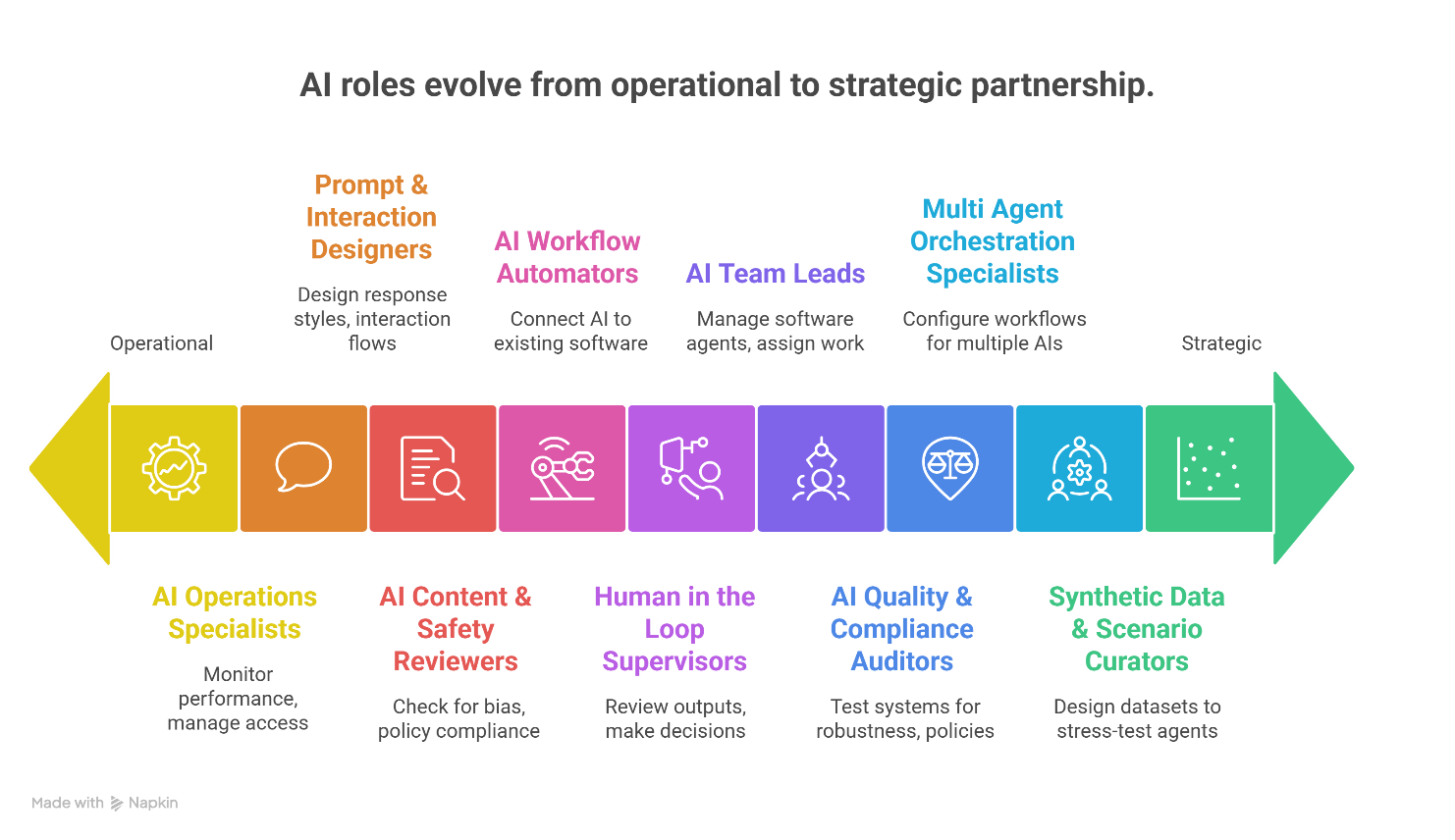
In the next year, the roles emerging are practical and immediate.
Within two years, as AI becomes more deeply embedded in teams and systems, the roles become more strategic.
Five years from now, this becomes the new architecture for knowledge work, with AI as a long-term partner.
This stream is about guiding intelligence. The value is in your judgment, your direction and your ability to ask the right questions.
Related Article: 3 Work Roles in the AI Era: Innovators, Operators and Translators
The second stream of work is where human hands, presence and trust still matter most. AI can’t do these jobs because it doesn’t have a body and can't be in a specific place at a specific time.
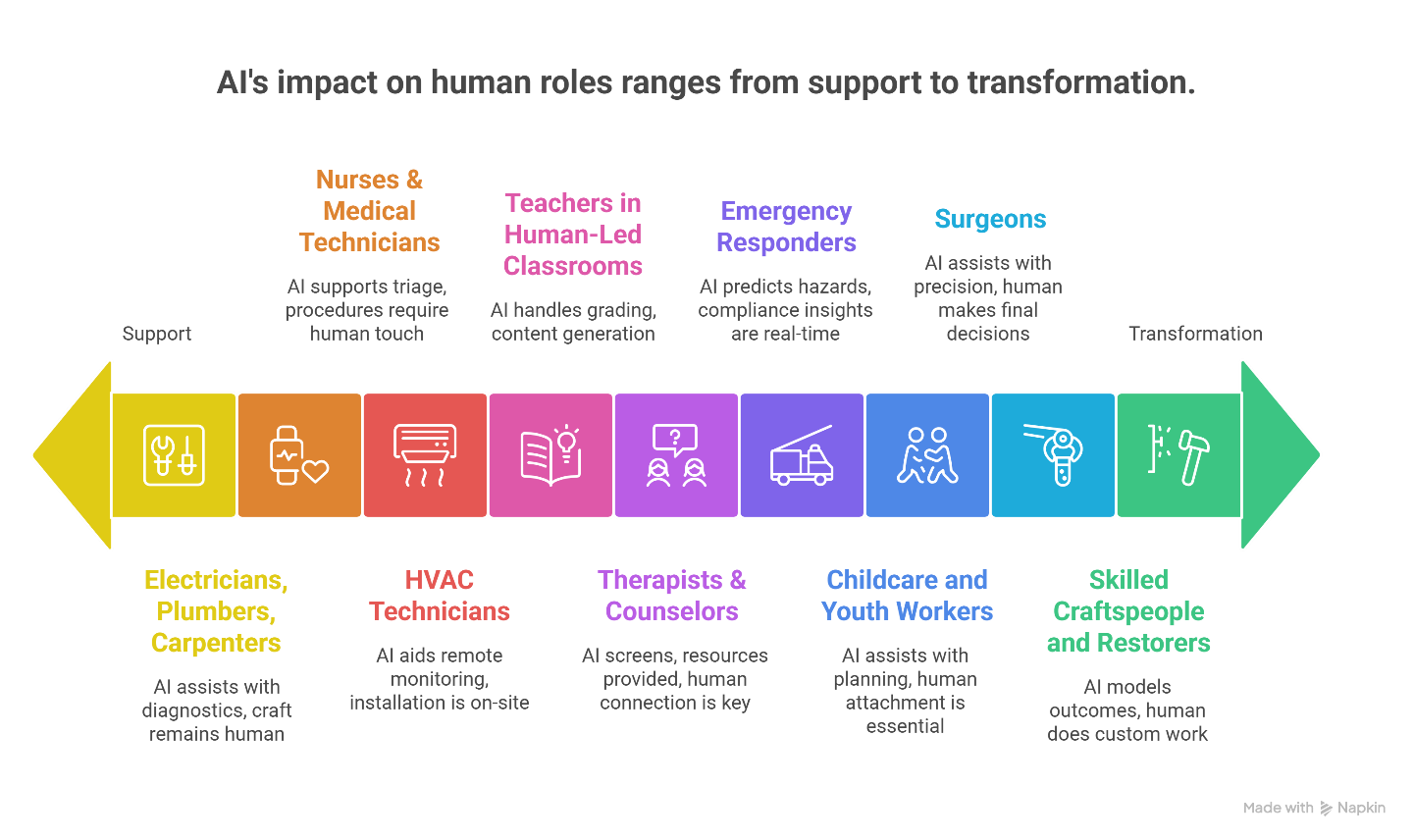
Near-term stable and hands-on. In the next year, this is straightforward.
The skilled trades are busy, and we need Electricians, Plumbers and Carpenters for site-specific repair, construction and code compliance. You can't email an AI to fix a leaky pipe; while AI may assist with diagnostics and planning, the actual wiring, repair and craft remain human.
We also need Nurses & Medical Technicians to provide hands-on care. AI supports documentation, triage and pattern recognition, but a person must be there to perform procedures and comfort a patient.
Similarly, HVAC Technicians stay essential for on-site installation and complex fault-finding, using AI mainly for remote monitoring and basic troubleshooting.
Stable but more hybrid. Within two years, these roles stay solid because they are built on trust or regulation.
Instruction remains human-anchored, so we will still need Teachers in Human-Led Classrooms, with AI handling grading, practice and some content generation.
We’ll need Therapists & Counselors because people require human connection for healing, with AI supporting note-taking, screening and providing psychoeducation resources.
On the ground, Emergency Responders like firefighters and EMTs will act on the scene, supported by AI-based routing and hazard prediction, while Skilled Trades Supervisors coordinate crews and safety using real-time insights from AI.
Finally, Childcare and Youth Workers remain central, as human presence, attachment and trust cannot be automated, even as AI assists with scheduling and planning.
Persistently human, transformed by tools. Five years from now, even with advanced robotics, this stream holds because the human element is a feature, not a bug.
You’ll have a human Surgeon leading procedures where they make the final decisions, while robotics and AI handle precision and intra-operative guidance.
You’ll have Skilled Craftspeople and Restorers doing high-end custom work, using AI for design options and material planning.
Legal Advocates and Trial Lawyers will handle courtroom advocacy and negotiation, while AI drafts documents and models potential outcomes.
In the field of discovery, Scientists and Principal Investigators will choose the research questions and interpret the significance of findings, while AI accelerates literature review and experimentation.
Finally, Caregivers for the Elderly will remain a core human profession, where empathy and touch are supported — but not replaced — by AI and robotics assisting with monitoring, lifting and logistics.
This stream is about physical skill and human presence. The value is local, tangible and built on trust.
The problem isn't in either of these streams. The most dangerous place to be is in the middle: the traditional office job that isn't quite physical but also isn't about directing advanced AI. This is where the sorting gets messy.
Many of these roles will become hybrid jobs. A project manager will use an AI for scheduling. A lawyer will use an AI for research. But this is also where companies will be tempted to use AI to consolidate roles, so one person can do the work of three. Without a clear plan, this middle ground is where people will get squeezed.
Related Article: 10 Jobs Most at Risk of AI Replacement (And How to Transition)
The old way of thinking about a career path or a single, unified workforce is over. You are now managing two different kinds of talent that create value in two different ways. The person who manages AI agents needs a different kind of support than the person fixing an HVAC system. They need different training, different tools and probably different pay structures.
The job of a leader is to recognize that this sorting is happening and to start building an organization that can handle it. The old map doesn't work anymore. The real job is figuring out what the new one looks like.
These substantiate my claims that AI will affect 80–90% of businesses by 2030, that task‑level automation and hybrid human-AI roles are emerging and that reskilling and the creation of new AI‑related roles are needed rather than pure net job loss.
World Economic Forum
McKinsey & Company
Other Research and Commentary
 Learn how you can join our contributor community.
Dr. David Priede, Ph. D., is the director of operations, advanced technologies and research at Biolife Health Center and is dedicated to catalyzing progress and fostering healthcare innovation. Connect with David Priede: 