News
White Paper
Why Enterprise AI Fails at Scale

Isara, a startup building infrastructure that allows thousands of AI agents to communicate and divide complex tasks, has closed a $94 million funding round at a $650 million valuation. OpenAI led the investment in the nine-month-old company, joining Amity Ventures, Michael Ovitz and Stanley Druckenmiller.
The San Francisco-based company was founded in June 2025 by Eddie Zhang, a former OpenAI AI safety researcher who previously held a visiting research position at MIT, and Henry Gasztowtt, a computer science student at Oxford University — both 23 years old.
The two had co-authored a paper at ICML 2024 exploring how AI systems could cooperate to improve policymaking, the intellectual foundation on which Isara is built. Since founding, the company has hired approximately twelve researchers from Google, Meta, and OpenAI.
The core problem Isara aims to solve isn't about making a single AI smarter. It's about making many AIs work together.
The startup is building the underlying architecture that allows different AI agents to align goals, exchange data and divide tasks across complex industrial processes — functioning, as the founders describe it, like a well-coordinated team rather than isolated tools. In one early demonstration, thousands of agents coordinated to forecast the price of gold.
Unlike existing multi-agent frameworks such as LangChain, CrewAI and AutoGen, which largely operate in isolation, Isara's ambition is to build swarms of agents capable of collaborating on problems no single model can handle alone.
The startup is initially targeting investment firms with predictive modeling software, with biotechnology and geopolitical analysis identified as secondary markets. The longer-term goal, as reported by the WSJ, is to train these agents to collaborate on challenges such as tracking geopolitical shifts or forecasting economic trends, the kinds of high-stakes, data-dense problems where coordinated AI could offer a genuine edge over traditional approaches.
Isara is part of a broader surge in so-called "neolab" AI research startups attracting significant investor attention. Investors have directed $2.5 billion toward five such startups in just over a month.
That interest coincides with rapid growth in the underlying market. The AI agent market is projected to grow at a CAGR of 46.3%, expanding from $7.84 billion in 2025 to $52.62 billion by 2030.
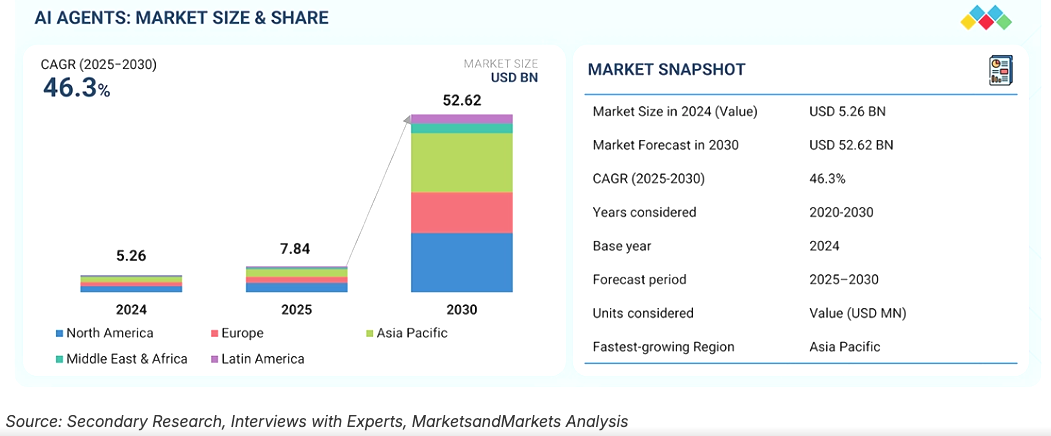
Demand for multi-agent systems specifically has surged: Gartner reported a 1,445% increase in multi-agent system inquiries between Q1 2024 and Q2 2025. The firm also projects that by the end of 2026, 40% of enterprise applications will include task-specific AI agents, up from less than 5% in 2025.
Rather than building another AI model or interface, Zhang and Gasztowtt are focused on the coordination layer — the protocols and architecture that determine how AI agents communicate, divide labor and operate at scale. If that infrastructure becomes widely adopted, the applications built on top of it across finance, biotechnology and geopolitical analysis could be substantial.
For now, Isara has the funding, the talent and a clear thesis. The harder task is proving the technology delivers at the scale the valuation implies.
Michelle Hawley is an experienced journalist who specializes in reporting on the impact of technology on society. As editorial director at Simpler Media Group, she oversees the day-to-day operations of VKTR, covering the world of enterprise AI and managing a network of contributing writers. She's also the host of CMSWire's CMO Circle and co-host of CMSWire's CX Decoded. With an MFA in creative writing and background in both news and marketing, she offers unique insights on the topics of tech disruption, corporate responsibility, changing AI legislation and more. She currently resides in Pennsylvania with her husband and two dogs. Connect with Michelle Hawley: 
