News Analysis
White Paper
Why Enterprise AI Fails at Scale

OpenAI has launched GPT-5.2, calling it its strongest model yet for professional tasks.
The model suite, which already began rollout to paid ChatGPT users and is available immediately through the API, introduces improvements in speed, accuracy, long-context reasoning, coding, vision and tool use.
According to OpenAI, GPT-5.2 is designed to support "professional knowledge work" and more reliably handle complex projects that stretch across many steps, tools and files.
OpenAI claims GPT-5.2 outperforms industry professionals on a majority of tasks in GDPval, an evaluation covering 44 occupations across nine major sectors of the US economy. Expert judges found the model beat or tied top professionals on 70.9% of comparisons.
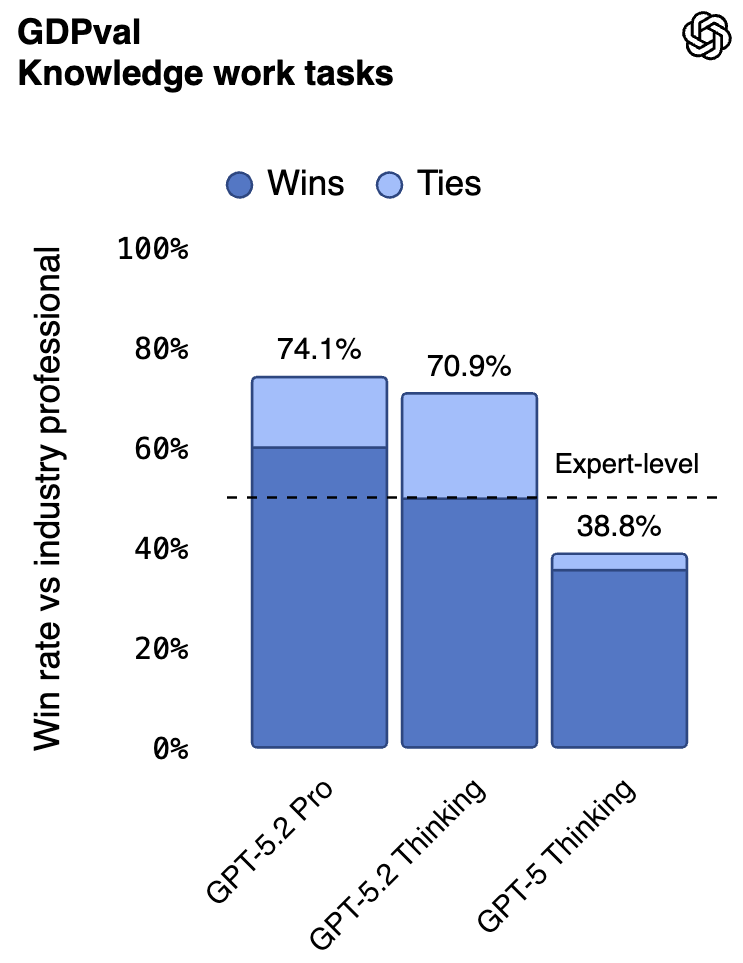
The tasks mirrored real-world outputs, such as:
One GDPval judge reportedly described a top-scoring output from the model as "an exciting and noticeable leap in output quality," comparing it to work produced by a staffed professional team.
GPT-5.2 also completed tasks more than 11 times faster and at less than 1% of the cost of human experts, based on historical benchmarks provided by OpenAI.
Related Article: Why OpenAI’s First-Mover Advantage Is No Longer Enough
The company reported sizable gains in software engineering. On SWE-Bench Pro — a benchmark that challenges models to fix real bugs in multi-language repositories — GPT-5.2 Thinking scored 55.6%. It also reached 80% on SWE-Bench Verified, which is its strongest score to date.
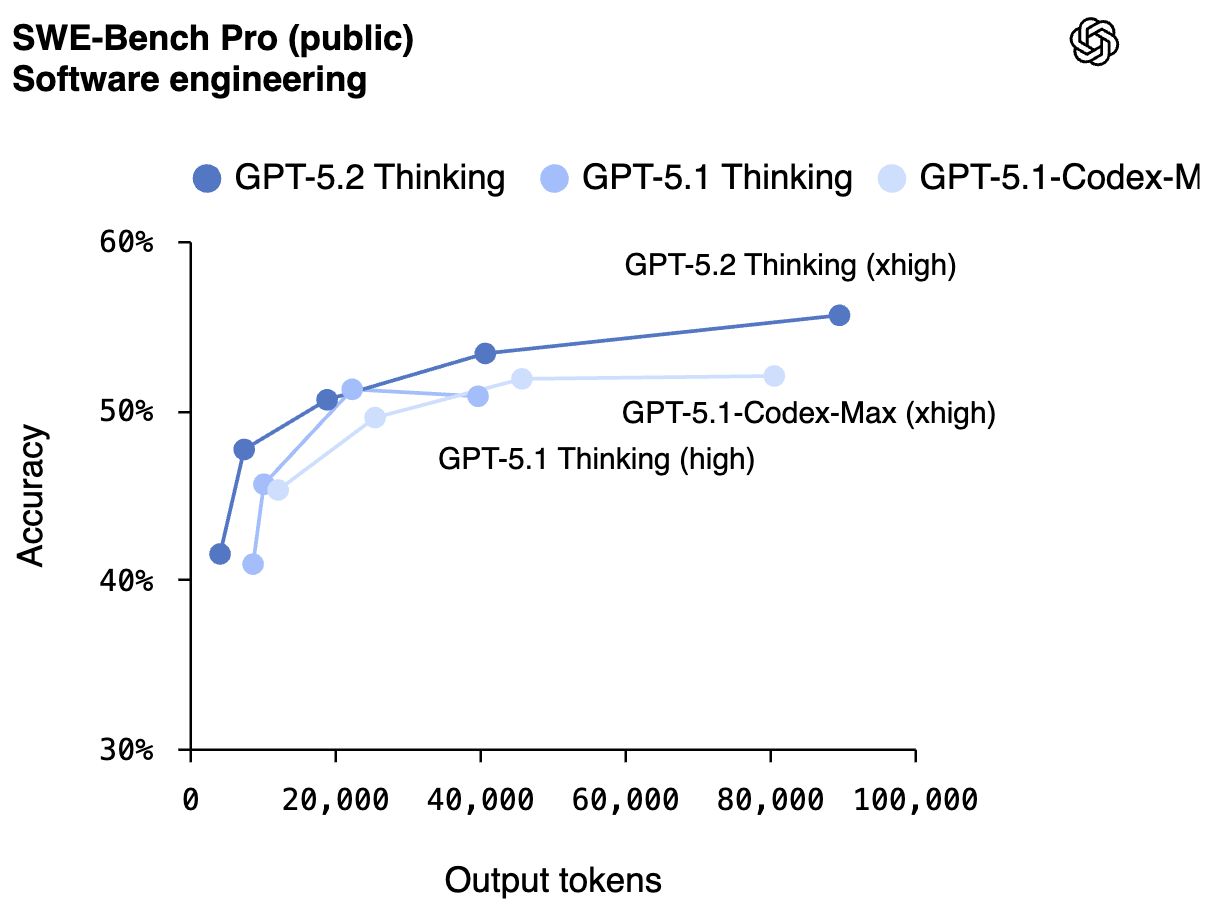
Early testers cited improvements in interactive coding, code reviews, bug finding and unconventional UI development. The latest model is also described as significantly stronger at front-end engineering tasks.
Across everyday use cases, the model makes fewer factual mistakes. In internal testing on de-identified ChatGPT queries, GPT-5.2 responses with errors were 30% less common than GPT-5.1, according to OpenAI.
GPT-5.2's biggest leap appears to be in long-form analysis. On OpenAI's long-context evaluation MRCRv2, the model achieved near-perfect accuracy when handling documents that stretch up to roughly 256,000 tokens (information density longer than most books).
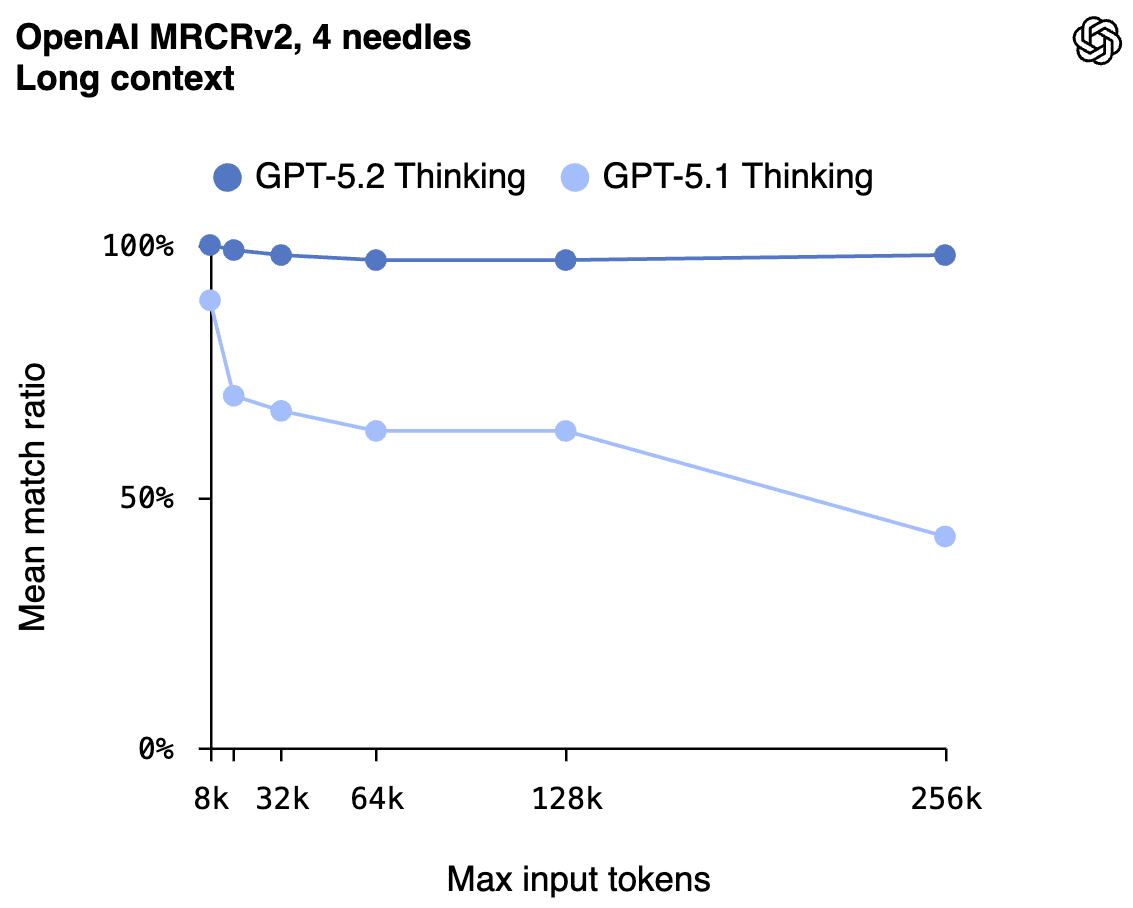
This advancement allows the model to analyze and synthesize long contracts, research papers, transcripts and multi-file projects while maintaining coherence across hundreds of thousands of words.
OpenAI also introduced a new compact responses endpoint that extends the model's usable context window even further for tool-heavy or deeply nested workflows.
Related Article: Disney Invests $1B in OpenAI, Becomes First Major Licensing Partner for Sora
GPT-5.2 reportedly cuts errors rates nearly in half on scientific chart interpretation and improves its ability to understand professional software screenshots. According to OpenAI, the model demonstrates a better grasp of spatial layout within images, which remains a key factor for interpreting dashboards and technical diagrams.
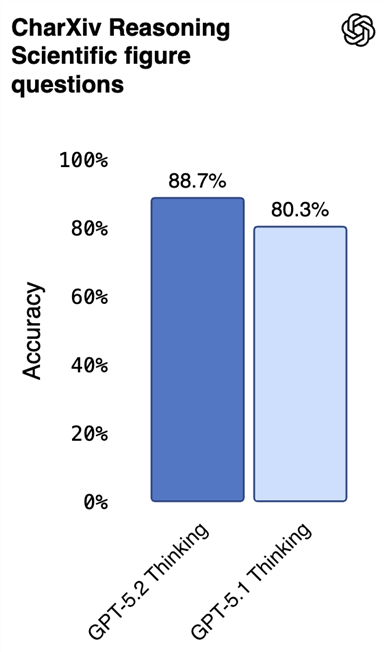
The new model also shows dramatic gains in multi-step tool use. On Tau2-bench Telecom, which assesses tool-driven customer-support workflows, GPT-5.2 Thinking reached 98.7% accuracy. Even at minimal reasoning settings for latency-sensitive cases, the model outperformed GPT-5.1 and GPT-4.1.
Companies including Notion, Box, Shopify, Zoom, Harvey, Databricks, Hex and Triple Whale participated as early testers. Several reported that GPT-5.2 enabled more reliable “mega-agent” workflows, i.e., single agents coordinating more than 20 tools for end-to-end tasks.
"GPT-5.2 is highly effective at tool-calling: Zoom AI Companion's meeting-scheduling success increased by 10% and performance on our internal multi-hop question-answering benchmark improved by 3.5%."
- X.D. Huang
Chief Technology Officer, Zoom
Triple Whale CEO AJ Orbach said GPT-5.2 allowed the company to collapse a fragile, multi-agent system into one agent that is “faster, smarter, and 100x easier to maintain.”
Box CTO Ben Kus said GPT-5.2 delivered major gains for his company, claiming that complex document extraction is faster compared to previous models, with a 31% reduction in latency. He added, "we’ve seen a 76% boost in reasoning accuracy for legal tasks, an industry where precision is critical."
ChatGPT users will see GPT-5.2 in three options:
OpenAI says GPT-5.2 should feel “more structured and more reliable,” with clearer explanations and stronger performance on tasks that require reasoning. GPT-5.1 will remain available for three months before being sunset from ChatGPT’s paid plans.
While ChatGPT subscription prices remain the same, token prices in the API rise slightly compared to GPT-5.1.
OpenAI noted that due to greater token efficiency, achieving a given quality level may cost less overall despite the higher per-token price.
Related Article: OpenAI’s 6 AI Primitives Set the Stage for the Agent Era
OpenAI emphasized that GPT-5.2 is part of an ongoing series of releases. The AI company said it’s working on issues including model over-refusals and plans to introduce a Codex-optimized version in coming weeks.
For now, GPT-5.2 stands as OpenAI’s clearest attempt to turn AI into a day-to-day professional co-worker.
Michelle Hawley is an experienced journalist who specializes in reporting on the impact of technology on society. As editorial director at Simpler Media Group, she oversees the day-to-day operations of VKTR, covering the world of enterprise AI and managing a network of contributing writers. She's also the host of CMSWire's CMO Circle and co-host of CMSWire's CX Decoded. With an MFA in creative writing and background in both news and marketing, she offers unique insights on the topics of tech disruption, corporate responsibility, changing AI legislation and more. She currently resides in Pennsylvania with her husband and two dogs. Connect with Michelle Hawley: 
