Feature
Guide
Is AI Making Your Organization More Productive or More Dependent?


LAS VEGAS — Jensen Huang, CEO of $4.91 trillion AI company Nvidia, took the stage today at Adobe Summit at the Venetian Resort in the desert with a big message for the SaaS world: Agentic is here. Agentic is now. And it will elevate your brand experiences and creative abilities.
Huang's presence alongside Adobe CEO Shantanu Narayen on Monday, April 20 comes at a pivotal moment: Adobe is pivoting from "digital experience" and "customer experience management" to "customer experience orchestration" — the main theme anchoring its news this week, including the unveiling of Adobe CX Enterprise Coworker.
It's an agentic world. And it's here to stay.
"I think my entire vocabulary of Photoshop is probably 7% of its capabilities," Huang told the packed audience at the Venetian. "Now I have an agentic system that I can put in front of it, and an agentic system that Adobe could create for me that allows it to understand my intentions and fully realize the capabilities of Photoshop, fully represent, fully utilize Premier."
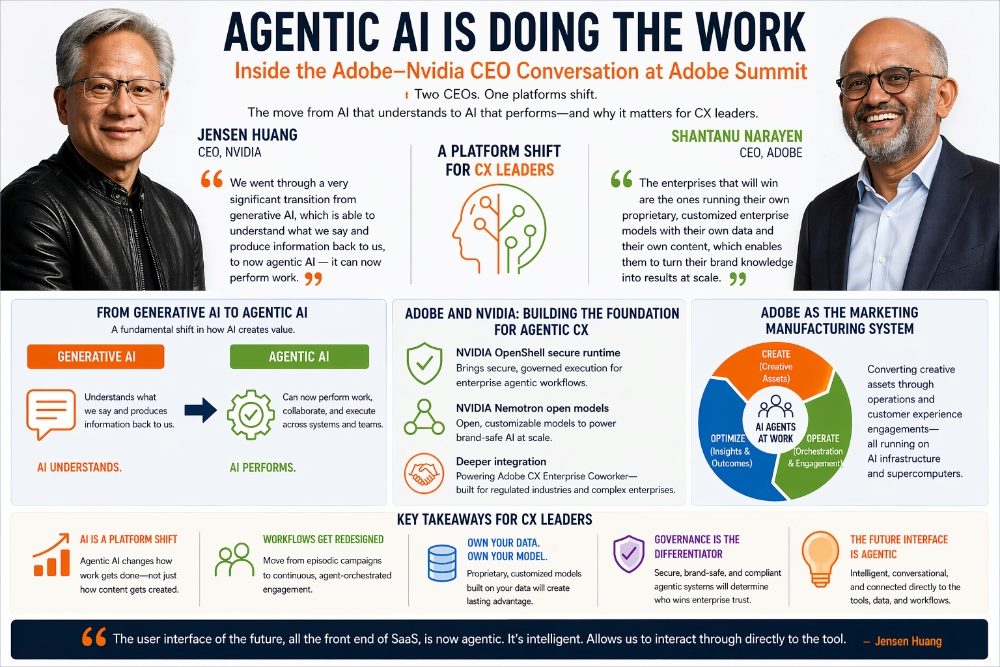
"And so," Huang continued, "the user interface of the future, all the front end of SaaS, is now agentic. It's intelligent. Allows us to interact through directly to the tool. ... I think it's just a higher level utilization of tools, and in a lot of ways. For what I would say for 99.9% of the creators of the world, this is going to elevate your art, no question."
For digital customer experience leaders parsing what any of this means for their organizations, the Huang-Narayen exchange could be seen as a sustained argument for why agentic AI is a platform shift, on the order of the internet and cloud before it.
Here's the thing, though: With all that power and innovation on stage at Adobe Summit, the lunch before may have been more telling. Some of those folks on the ground floor here in the gambling mecca want to know what this all means for creating digital customer experiences.
And where to place their bets, exactly.
Madison Collier, marketing operations manager at Boston-based Crunchtime, asked what agentic even means when discussing the themes of Adobe Summit.
Not in a "I never heard of it" way, but what does it mean for my marketing team and my customers?
"I keep seeing that word everywhere," she said, "but I want to know what it means."
Talk about a paradox. What is the real value of AI on building and orchestrating digital customer experiences, and how do companies like Adobe enable the magic to happen?
Because, it seems, most of us still have questions, challenges and wonder about AI impact with things like answer engine optimization (AEO). No question, traffic to LLMs is growing, and rapidly.
But how do enterprises get a piece of that puzzle and actually see real brand value?
"Being that SEO is sort of dying out now because of the Gen AI stuff, it's like what do we do?" asked David Wallace, senior web and brand designer for AdvancedMD. "It's a whole new world."
And Wallace wonders: Do I take 20 years of SEO experience and throw it away? They have advice from AEO consultancies, but that didn't move the needle beyond the basic advice of "do FAQs," "get in Reddit" and "get in Wikipedia."
Related Article: Jensen Huang: Mastering Life and Leadership on the Razor's Edge
Back to that powerhouse CEO duo on stage here at Adobe Summit. Huang drew a sharp line between generative AI — systems that understand and produce information — and the agentic era now underway, in which AI performs work. For CX leaders who have been watching the AI hype cycle with appropriate skepticism, it was a useful framing.
"We went through a very significant transition from generative AI, which is able to understand what we say and produce information back to us, to now agentic AI — it can now perform work. It's collaborating with me and collaborating with all of our engineers and supporting us in all these different ways. And so finally, for the very first time, AI is producing work. That's another way of saying AI is finally valuable."
- Jensen Huang, CEO
Nvidia
That distinction carries real weight for marketing and CX teams that have spent the past two years experimenting with AI copilots and content generation tools. The move from AI-as-assistant to AI-as-coworker — the exact language Adobe is now baking into its product naming — represents a different operational bet. It is about redesigning who — or what — executes the workflow.
"People love AIs that know it all, but in the final analysis, what you pay for is work done," Huang said.
Related Article: AI Agents Are Leaving the Chat Window — and CX Leaders Are on the Hook
Narayen and Huang were not simply sharing a stage for optics. The two companies announced deeper integration work at Summit, including Adobe's partnership with Nvidia to embed the NVIDIA OpenShell secure runtime and NVIDIA Nemotron open models into the CX Enterprise Coworker platform — a combination Adobe is positioning toward regulated industries requiring governed, brand-safe agentic workflows. The companies deepened their partnership this week at Adobe Summit.
From Huang's vantage point, Adobe is becoming something more than a software vendor. He described it plainly: Adobe is becoming "the marketing manufacturing system" — converting creative assets through operations, through customer experience engagements — all running on AI supercomputers and infrastructure. For CX leaders, that framing positions Adobe not as a suite of marketing tools but as a factory floor for the agentic enterprise.
Narayen reinforced the point from the enterprise side, arguing that the brands positioned to win are those running their own proprietary, customized AI models — trained on their own data, shaped by their own content.
"The enterprises that will win," he said, "are the ones running their own proprietary, customized enterprise models with their own data and their own content, which enables them to turn their brand knowledge into results at scale."
Huang also offered a pointed observation about brand precision in the agentic era. Generative AI can approximate a forest or a mountain in the background of a campaign — but the product itself, the brand artifact at the center of it, must be exact. The digital twin — the precise, ground-truth representation of a brand's assets — is the starting point that cannot be negotiated away. That's a practical consideration for any CX or marketing leader thinking about how brand governance works inside an agentic content pipeline.
A quick breakdown of the most important points from Jensen Huang and Shantanu Narayen's keynote conversation at Adobe Summit 2026.
| Theme | What It Means | Why It Matters |
|---|---|---|
| Agentic AI performs work, not just knowledge | Huang drew a clear line between generative AI — which produces information — and agentic AI, which executes work. "What you pay for is work done," he said. | CX leaders should pressure-test vendor AI claims against this standard. The question is no longer what the platform knows — it's what it does. |
| The front end of every SaaS platform is now agentic | Huang argued that the user interface of every software platform is being rebuilt around agentic interaction — directly, through an agent, or in collaboration. | Evaluating martech and CX platforms now means evaluating the agentic layer, not just the feature set or integration checklist. |
| Brand precision is non-negotiable in agentic pipelines | Huang said generative AI can approximate a background, but the brand artifact at the center of any campaign must be exact — grounded in a precise digital twin. | Brand governance inside an agentic content pipeline requires structural investment in digital asset management. Approximate is not acceptable at the brand level. |
| Physical AI is the next frontier | Huang made the case that computing has never truly been applied to the physical world — and vision-language-action models now make it possible to move from sensory input directly to action. | For CX leaders in retail, healthcare and logistics, physical AI extends orchestration beyond digital channels into real-world customer environments. |
| Winning brands run proprietary AI models | Narayen argued that enterprises positioned to win are those training AI on their own data and content — turning brand knowledge into personalized results at scale. | Model access alone is not a competitive advantage. Differentiation comes from proprietary data, brand context and governance built into the AI layer. |
| Agents expand capacity, they don't eliminate jobs | Huang cited radiologists and Nvidia's own engineers: AI assistance drives demand up, not down, because faster execution enables more work and more complexity requiring human judgment. | CX and marketing teams should plan for higher throughput and expanded scope — and redesign the operating model to absorb new capacity rather than simply automate existing tasks. |
Huang's advice to enterprises on AI transformation was direct and notably free of hedging. "You never want to be too early, but you definitely can't afford to be late," he said. "I'm almost certain, dead certain, that your organizations are going to find it surprisingly amazing relative to what happened last year."
He backed that urgency with a concrete example from his own company. At Nvidia, he said, 100% of software engineers are now supported by agents — and they are busier than ever, not displaced. Experimentation cycles are faster. More ideas get tested. The volume of work expands to meet the new capacity. He drew the same parallel to radiologists: when AI made scan analysis superhuman, demand for radiologists went up, not down, because faster analysis meant more patients, more throughput and more complexity requiring human judgment.
For CX teams, the implication is the same. Agents handling execution volume frees practitioners to focus on strategy, governance and brand stewardship — if the operating model is rebuilt to support it. That last clause is the hard part, Forrester analyst Joe Cicman told us when talking about Adobe's roadmap.
Huang painted a future in which content is no longer retrieved but generated — in real time, in context, in the customer's language, tuned to their precise interests at that moment. "Every single one of us will enjoy the internet completely differently," he said. "Every one of us will enjoy our brands differently because (content) is generated for us in real time."
In order for that future to happen, Huang said, we still need to have a grounded first principle of truth: the truth of our brands, the truth of our design, the truth of our original artifact.
"And then it needs to run on a factory, and this factory goes creatives, operation, marketing, customer engagement," he said. "I'm not an expert in marketing, but these are kind of the phrases I think you guys use, but that's the process. That's the process that I see my marketing team goes through. And by the way, Nvidia marketing is built on Nvidia, built on Adobe, and that factory in the future will include AI supercomputers, which means that's part of the reason why we're working so closely together. Adobe is going to be the marketing manufacturing system in a lot of ways, converting creative assets all the way through operations, through customer experiences, engagements, but that entire foundation will run on AI factories and AI supercomputers."