News
White Paper
Why Enterprise AI Fails at Scale

CES 2026 once again turned Las Vegas into a hub for groundbreaking consumer technology, featuring a range of devices and concepts that aim to improve daily life. This year’s event highlighted advancements in AI, sustainability and design, focusing on tools that integrate more easily into modern life.
In this article, we'll explore the most buzz-worthy technologies that have captured the attention of attendees and set the stage for the future of consumer electronics.
This year, CES signals a shift from spectacle to substance, with AI, ambient computing and emotionally aware tech moving closer to everyday use.
Kinsey Fabrizio, president of the Consumer Technology Association (CTA), recently stated that "At its core, CES 2026 is driven by the human desire for meaningful, face-to-face connection to get business done.”
For customer experience leaders, CES 2026 reinforces a shift that has been building for several years: the future of CX is increasingly shaped at the product and platform level, not just through campaigns or channels. Innovations across ambient AI, deployable intelligence and context-aware devices point to a world where the digital experience platform (DXP) becomes less about orchestration dashboards and more about embedded, real-time decisioning across products, interfaces, and environments.
This evolution has direct implications for how organizations think about digital customer experience platforms, customer experience management, and even customer journey maps. As AI moves closer to the moment of use — whether in vehicles, wearables, or smart environments — static journey maps give way to adaptive, context-driven experiences that respond dynamically to customer behavior. That shift favors composable architectures, including headless CMS platforms and headless DXP models, that allow experience logic to travel wherever the customer interaction happens.
CES 2026 also underscores how agentic CX is emerging as a practical reality. Rather than waiting for explicit input, AI systems increasingly anticipate needs, coordinate actions, and personalize experiences in real time. For CX leaders, this raises the bar on personalization and customer trust, making transparency, reliability and governance as critical as innovation.
CES 2026 marks a clearer shift from polished demos to AI that’s actually built for real use cases, showing technology that has graduated from concept to products people and businesses can start using, not just marveling at.
As AI matures, the conversation at CES is increasingly about how intelligence is expressed through products and services, not just where it exists under the hood. Brian Yamada, chief innovation officer at VML, said that he sees the shift playing out in how brands are thinking about AI’s role in experience design. “AI, not just being an ingredient, but starting to more dramatically change and impact the experience layer [of a] product, service, brand, or company,” Yamada said.
This aligns with what’s showing up across the show floor, where AI is increasingly embedded into routing, interfaces, and workflows rather than being positioned as a standalone feature.
Another defining signal from CES 2026 is how quickly agentic AI is moving from theory to execution. Across products and platforms, vendors are no longer showcasing isolated AI tools, but coordinated AI agents capable of taking initiative, making decisions and acting across systems with minimal human intervention. These AI agent use cases — from contextual assistance to autonomous coordination — reflect a broader maturation of generative AI within enterprise environments.
Under the hood, many of these systems rely on advances in large language models, retrieval-augmented generation, and selective fine-tuning to ground responses in real-world data rather than treating intelligence as a black box. CES 2026 conversations also highlighted growing interest in how agents communicate with one another through emerging approaches like Agent2Agent interaction and standardized frameworks such as the model context protocol, enabling more reliable orchestration across complex digital experience ecosystems.
For CX leaders, this shift introduces new expectations around capability and accountability. Designing effective agentic systems increasingly depends on skills such as prompt engineering, including techniques like persona prompting and disciplined reasoning patterns, even as some vendors experiment with looser, exploratory approaches like vibe coding. As a result, interest in agentic AI certifications and prompt engineering certifications is growing, signaling that experience teams will need deeper technical fluency to guide AI responsibly.
CES 2026 also reflects a more sober tone in enterprise AI news, with open discussions around governance, transparency, and workforce impact. As AI agents take on more operational responsibility, concerns about AI job loss sit alongside optimism about productivity and augmentation. The common thread is that machine learning and generative systems are no longer experimental — they are becoming foundational infrastructure for the future of customer experience.
Showcased at CES 2026, Kardome’s Cognition AI highlights a more pragmatic approach to voice interfaces, focusing on reliability in the real-world conditions where voice systems often struggle.

Rather than relying entirely on cloud-based processing, the system handles everyday interactions directly on the device and activates cloud models only when deeper reasoning is required. Combined with Kardome’s Spatial Hearing AI, the approach reflects a broader industry shift toward low-latency, privacy-conscious voice interfaces that feel less scripted and more natural, particularly in vehicles, smart homes and shared environments.
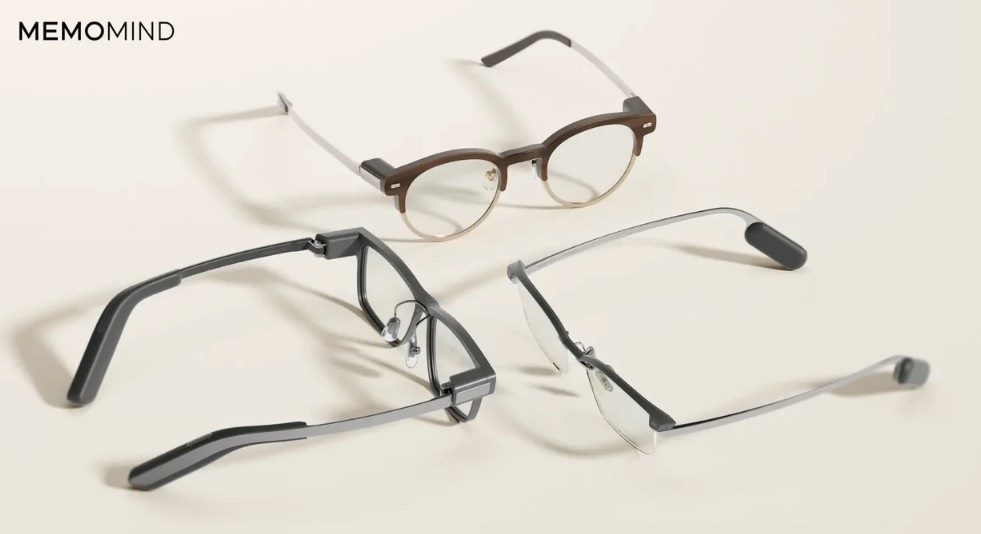
Another standout at CES is XGIMI MemoMind AI glasses, a new family of AI-enhanced wearable eyewear designed to look and feel like normal glasses while delivering contextual AI support on the go.
MemoMind uses a multi-LLM system to dynamically select the right model for tasks such as translation, reminders and note-taking, prioritizing task relevance and responsiveness over always-on computation. The focus on comfort and discrete design moves beyond bulky prototypes toward AI that fits into everyday life without demanding constant attention.
A notable example of AI moving into real-world deployment comes from Ford, which used CES 2026 to unveil its own in-vehicle AI assistant. Rather than positioning the assistant as a generic chatbot, Ford framed it as a vehicle-native interface designed to handle navigation, climate control, vehicle diagnostics, and contextual driver assistance through natural language.
The emphasis was less on novelty and more on reliability, with Ford highlighting how the assistant integrates directly with vehicle systems instead of relying on phone-based mirroring. The announcement reflects a broader shift toward AI that is embedded into high-stakes environments, where accuracy, context and customer trust matter more than conversational flair.
One of the quieter but more telling shifts at CES 2026 is the continued experimentation with AI devices designed to operate without a traditional screen. Rather than competing directly with smartphones, these products aim to reduce visual dependency altogether, positioning AI as something that listens, responds, and assists without demanding constant attention.
Razer’s Project AVA offers another take on ambient AI, positioning intelligence as a presence that observes and responds rather than constantly demanding interaction. Introduced at CES 2026, Project AVA is designed to sit in the background, using audio and visual context to understand what a user is doing and offer assistance when it is relevant.
While initially framed around gaming and performance, the broader implication is an AI assistant that operates without a traditional screen, responding to environment and behavior instead of app-based prompts. Project AVA reflects a growing belief across the show floor that ambient AI can be most effective when it quietly augments activity, stepping in only when guidance or insight adds value.
Among the more notable announcements is ORAION from MyTelligent, a wearable, voice-first AI assistant designed to clip onto clothing and operate largely in the background. The device focuses on quick interactions such as information retrieval, reminders, translation and contextual assistance, all without requiring users to pull out a phone or glance at a display.
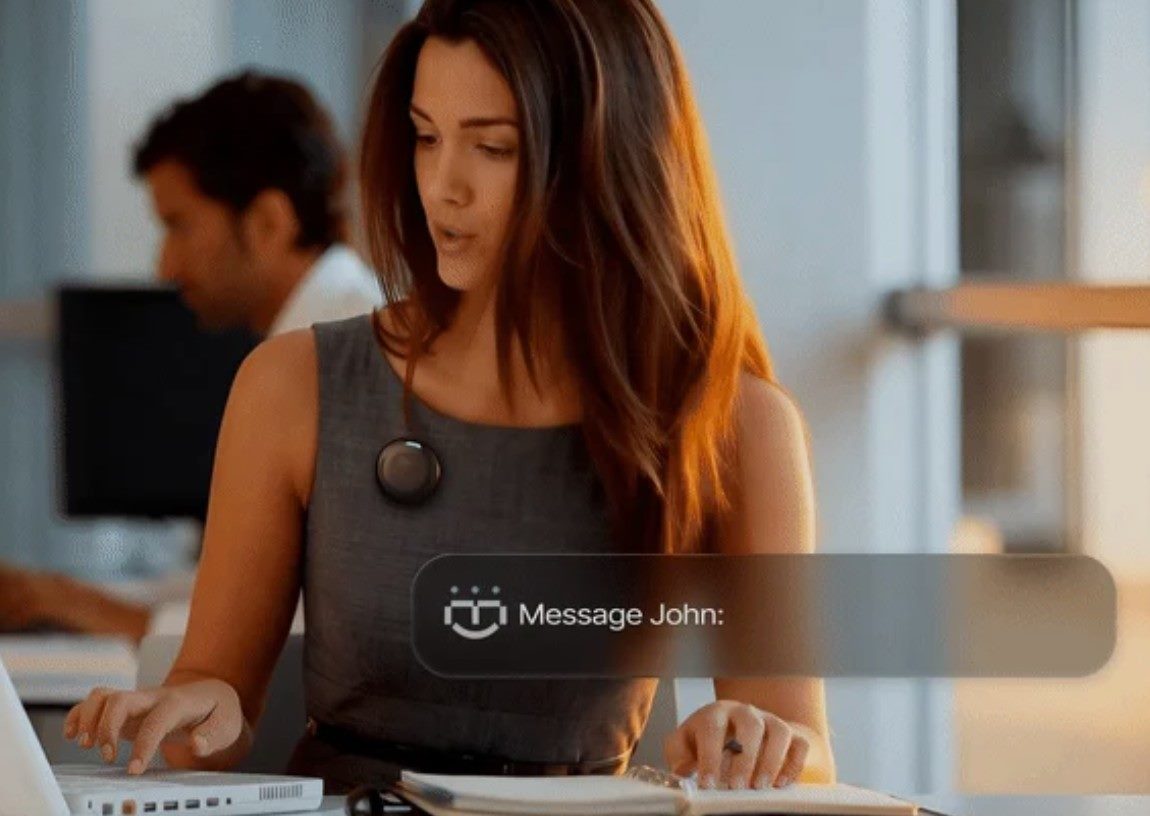
While still early, ORAION reflects a broader push toward AI that prioritizes presence and immediacy over visual engagement, a recurring theme across this year’s show floor.
Another emerging example of screenless AI is the Pebble Index 01, a wearable AI ring designed to capture short voice notes and contextual inputs throughout the day. Rather than responding in real time, the device quietly records and organizes information for later AI-assisted review, positioning itself as an ambient memory layer rather than an always-on assistant.
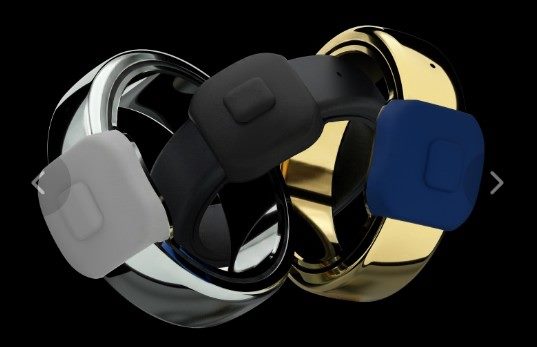
Reminiscent of the Java ring of the 1990s, the approach reflects a growing belief that AI does not need to interrupt users to be valuable. By minimizing active interaction and visual engagement, the Pebble ring reinforces a broader CES 2026 theme: intelligence that works in the background, supporting cognition without competing for attention.
Augmented reality and spatial computing were once positioned as sweeping replacements for screens, smartphones, and even reality itself. At CES 2026, that concept has narrowed. Instead of grand visions, vendors are emphasizing specific, constrained use cases where spatial interfaces can provide value without overwhelming users or demanding constant immersion.
Across CES 2026, AR vendors increasingly emphasized situational, task-specific usage rather than persistent visual overlays. Lightweight AR tools showcased at the show focused on short, glanceable interactions such as translation, contextual prompts, and note capture, reflecting a growing recognition that comfort, social acceptability, and battery life are as critical as visual capability.
Rather than positioning AR as a continuous interface, these designs frame it as a tool that appears only when needed, signaling a more operationally viable phase for everyday adoption.
Another notable development comes from Lenovo and Motorola, which introduced Qira, a cross-device AI assistant designed to work consistently across smartphones, tablets, PCs and wearable devices. Rather than anchoring the experience to a single form factor, Qira is positioned as a unifying intelligence layer that follows users across contexts, adapting to how and where they work.
The focus is less on immersive interfaces and more on continuity, enabling tasks, information access and assistance to persist across devices without forcing users to re-engage or reconfigure workflows. By emphasizing integration and device-agnostic intelligence over spectacle, Lenovo and Motorola are signaling a more grounded path for ambient and contextual computing to scale across everyday workflows.
Beyond enterprise headsets and smart glasses, CES 2026 also featured lightweight AR collaboration tools from vendors such as Asus and Xreal that emphasize constrained, task-specific use cases. These devices focus on short-duration interactions such as remote assistance, visual annotations and guided workflows rather than persistent immersion.
These tools signal a more operationally viable phase for AR adoption, where success is measured by task clarity and real-world utility rather than visual impact. The shift reinforces the idea that spatial interfaces are most effective when they complement existing workflows instead of attempting to replace them.
CES 2026 continues to blur the line between functional automation and emotionally aware technology, as vendors explore how AI can engage users in more personal, situational and supportive ways. Rather than positioning robots and companions as novelties, this year’s announcements emphasize presence, responsiveness and assistive value, particularly in home and care-oriented contexts. As AI becomes more context-aware and embedded into environments, some vendors are also exploring how intelligence can take on a more assistive, emotionally responsive role.
Samsung’s AI Companion Vision, framed under its broader “AI Living” strategy, reflects a shift away from single-purpose companion devices toward intelligence that is distributed across the home. Rather than centering the experience on a dedicated robot, Samsung positioned AI as a contextual layer that understands user behavior, environment, and routine across connected devices.
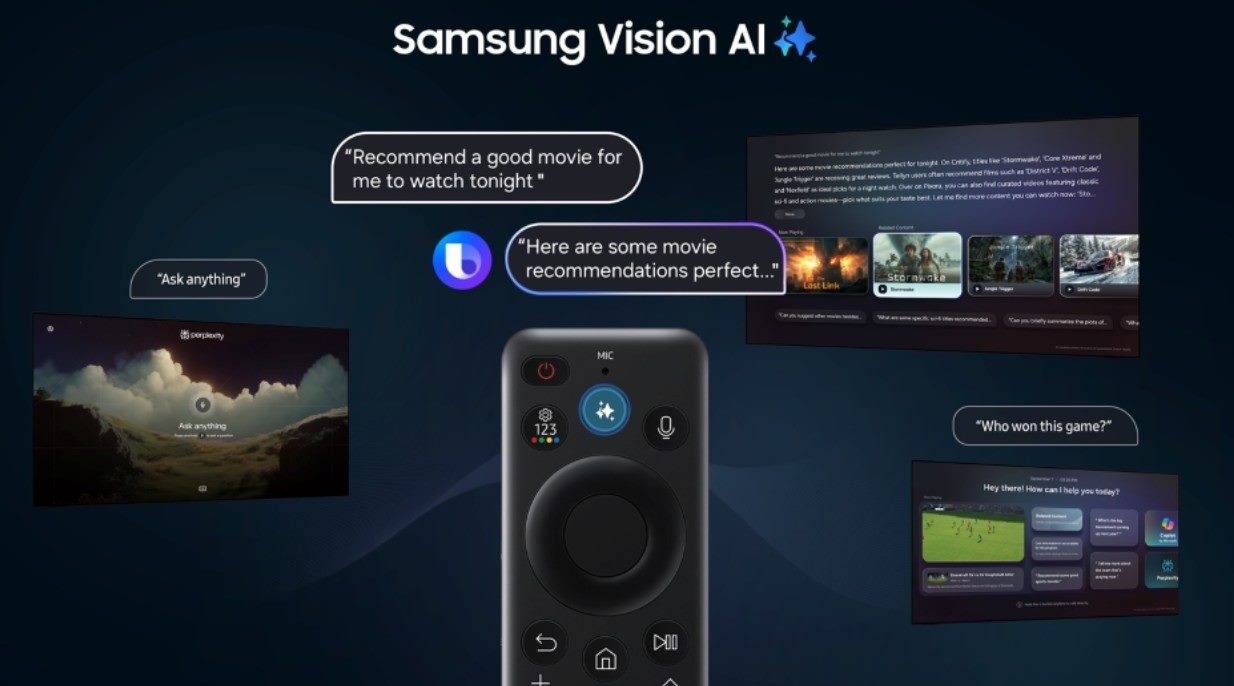
The approach emphasizes presence and responsiveness over personality, with AI designed to anticipate needs, coordinate devices, and adapt over time without requiring constant prompts. By focusing on ambient awareness, a common theme at CES 2026, rather than a standalone companion form factor, Samsung signals a more scalable path toward emotionally aware technology that integrates naturally into everyday life.
This year, the Hyundai Boston Dynamics Atlas robot made its first public grounded appearance, demonstrating fluid, human-like motion and laying out plans for real-world deployment in industrial settings as early as 2028.
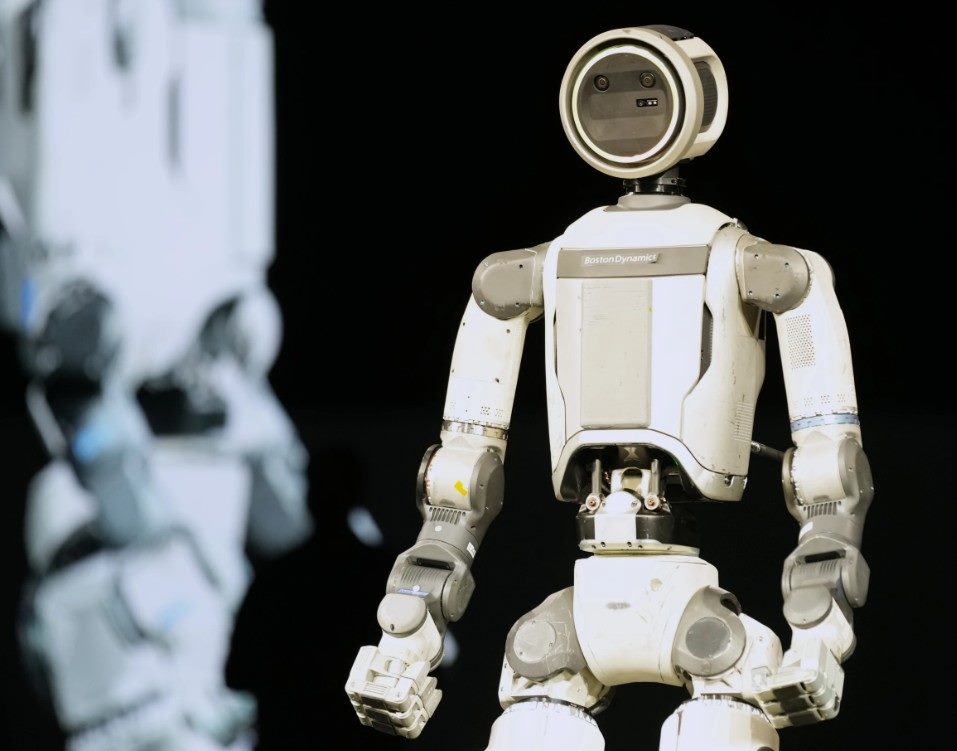
The Atlas reveal and associated partnerships with AI labs highlight how embodied intelligence is no longer just a research showcase; it’s moving toward integration with manufacturing, logistics, and automation workflows where physical action combines with sophisticated perception and decisioning.
While some of the most eye-catching demos at CES 2026 revolve around AI companions and spatial interfaces, a quieter but arguably more consequential shift is happening in smart home, health, and assistive technologies. Rather than introducing entirely new categories, many vendors are refining existing systems with AI that works behind the scenes, focusing on reliability, accessibility, and everyday usefulness.
One example that stands out is Bosch’s Cook AI, an intelligent kitchen system designed to adapt cooking processes in real time. Cook AI combines sensors, appliance data and agentic AI-driven decisioning to adjust temperature, timing, and preparation steps based on what’s happening in the kitchen, rather than following rigid presets.

While framed as a consumer convenience, the product reflects a broader trend toward AI systems that interpret context and act autonomously without requiring constant user input, a model that increasingly defines mature smart home experiences.
Related Article: Agentic AI and Marketing: The Death of the Traditional Funnel?
CES 2026 reveals how emerging technologies are quietly reshaping customer experience expectations, moving CX from visible features to embedded infrastructure.
| Innovation Area | What Showed Up at CES 2026 | Core CX Lesson | What CX Leaders Should Do |
|---|---|---|---|
| Deployable AI Systems | AI embedded into products, workflows and devices rather than demo showcases | Reliability now defines experience quality | Design for failure states, resilience and trust—not AI visibility or novelty |
| Voice-First & On-Device AI | Low-latency, privacy-aware, environment-ready voice interfaces | Latency and privacy are experiential, not technical, concerns | Treat performance, privacy, and context as CX KPIs, not backend considerations |
| Ambient & Screenless AI | Wearables and assistants that operate quietly in the background | The best experiences demand less attention | Reduce cognitive load and interaction friction instead of adding features |
| Contextual Wearables | Glasses, rings and clip-on devices offering situational assistance | CX is shifting from customer journeys to moments | Map contextual needs and micro-moments rather than linear journeys |
| AR & Spatial Computing | Task-specific, on-demand AR rather than persistent immersion | Clarity beats immersion | Apply spatial interfaces only where they simplify tasks and decisions |
| AI Companions & Emotional Interfaces | Ambient intelligence focused on anticipation over personality | Emotional intelligence is about responsiveness, not performance | Build trust through consistency and context rather than simulated empathy |
| Robotics & Embodied AI | AI systems taking physical action in real environments | CX now includes physical outcomes | Extend CX governance to safety, predictability and operational execution |
| Overall CES 2026 Signal | Shift from hype-driven demos to scalable, integrated solutions | Experience maturity matters more than innovation theater | Prioritize integration, measurement, and execution over experimentation |
At CES 2026, there’s a noticeable shift in how attendees and vendors are evaluating new technology. Rather than chasing novelty, the industry is increasingly focused on what can realistically scale and integrate into existing systems.
Across AI systems, ambient devices, spatial computing, and assistive technologies, vendors are emphasizing reliability, contextual awareness and practical deployment rather than bold claims about replacing existing tools. Artificial intelligence is showing up less as a front-and-center feature and more as quiet infrastructure embedded into everyday experiences.
While CES 2026 did not showcase many traditional marketing technology announcements, the show made clear that customer experience is increasingly being shaped at the product and interface level, where AI influences how people interact with brands long before a campaign ever reaches them.
Scott Clark is a seasoned journalist based in Columbus, Ohio, who has made a name for himself covering the ever-evolving landscape of customer experience, marketing and technology. He has over 20 years of experience covering Information Technology and 27 years as a web developer. His coverage ranges across customer experience, AI, social media marketing, voice of customer, diversity & inclusion and more. Scott is a strong advocate for customer experience and corporate responsibility, bringing together statistics, facts, and insights from leading thought leaders to provide informative and thought-provoking articles. Connect with Scott Clark: 