News
Guide
Is AI Making Your Organization More Productive or More Dependent?


When Moonshot AI released its Kimi Work desktop agent on June 8, it barely registered inside the U.S. Google search interest in "Kimi Work" in the U.S. averaged 3 out of 100 over the past three months, essentially unchanged before and after launch. Interest in Moonshot AI itself was similarly flat until July 16, when the company released Kimi K3 and search volume jumped roughly fivefold overnight.
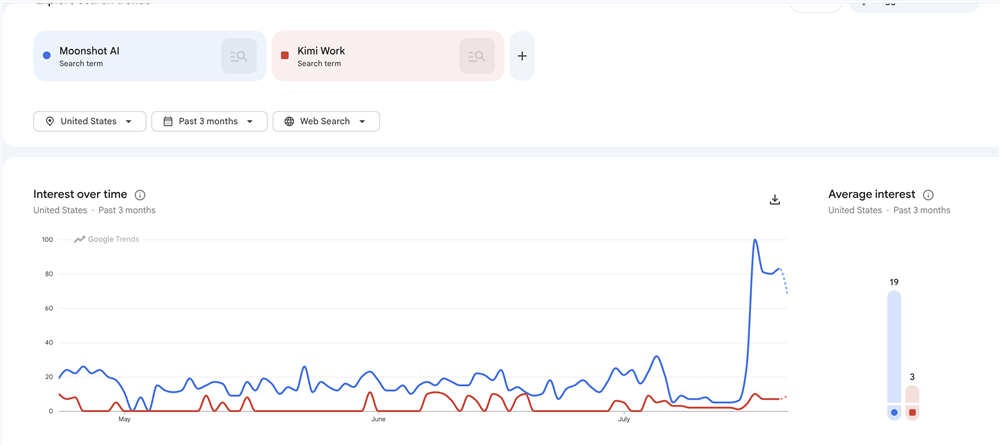
On July 19, three days after K3's release, Moonshot said it was temporarily pausing new subscriptions because usage over the previous 48 hours had pushed against its GPU capacity.
Kimi K3 is a 2.8 trillion-parameter open-weight model that debuted at No. 1 on LMArena's frontend coding leaderboard and ranked fourth globally on Artificial Analysis's intelligence index — within three points of Anthropic's Claude Fable 5 and OpenAI's GPT-5.6 Sol. It costs $3 per million input tokens and $15 per million output tokens through Moonshot's API, matching Anthropic's Sonnet 5 tier and running at roughly half the price of Anthropic's flagship Opus 4.8. When Moonshot publishes the full model publicly on July 27, any organization with the hardware to run it will be able to skip the API bill entirely. Self-hosted open models operate at $1 to $5 per million tokens at scale. The leading proprietary systems cost $15 to $60.
According to The Information, Microsoft is adding K3 to Azure and evaluating whether it can power Copilot features currently running on OpenAI and Anthropic systems, a shift the outlet reports could cut Microsoft's inference costs by as much as $600 million. Microsoft has not confirmed the figure or said which features are under review. Microsoft's Azure Foundry catalog has been listing earlier Kimi models for months, so the K3 evaluation isn't a new relationship.
Hosting a model on Azure is different from buying software directly from the company that built it. Customer data flows to Microsoft's infrastructure, not to Moonshot's. It's the same arrangement Foundry already offers for the earlier Kimi models and for open-weight releases from Meta, Mistral and others. That model-hosting layer is where a Chinese-developed model becomes usable by a U.S. enterprise that wouldn't touch a Chinese vendor directly — and it's what Microsoft is presumably testing at scale.
What K3 creates in terms of pricing pressure on the other models will be an area to watch. Anthropic and OpenAI are still ahead on benchmarks, but the gap is narrowing, while the price gap runs an order of magnitude in the other direction. If a hyperscaler the size of Microsoft can plausibly cut $600 million from its inference bill by swapping one model for another, it will push every enterprise buying AI at scale to reconsider their spend.
Kimi Work is how Moonshot is trying to put K3 directly in front of business users. It's a desktop application in the same category as Copilot Cowork, Claude Cowork and OpenAI's ChatGPT Work — a local app that reads files, browses the web on the user's behalf and runs recurring tasks for knowledge workers. It installs on Mac or Windows and connects to the user's own files and browser. It navigates websites through a feature called WebBridge and schedules tasks to run overnight. A separate mode called Goal, added in mid-June, keeps the agent running around the clock until a multi-step task is finished. A privacy control called "Ask before acting" requires users to authorize any file modification or code execution before it happens.
All of this sounds comparable to the other desktop applications, but a significant — and potentially insurmountable — barrier stands in the way of Kimi Work breaking into the U.S. market: the compliance question.
Moonshot offers an enterprise tier through Moonshot AI PTE. LTD priced at $599 per seat with a five-seat minimum. Its Kimi Business service agreement, effective June 1, commits to not training on customer content by default and includes standard enterprise language on ownership, security and confidentiality. The Kimi Business product page and Kimi API data security FAQ make the same commitment and describe standard technical controls: encryption in transit, tenant isolation, API-key authentication and file-deletion endpoints.
None of the three documents states where customer data is processed. The Business service agreement defers those questions to a data processing addendum that Moonshot has not published.
For most Western compliance teams evaluating a new AI vendor, that gap is where a procurement conversation stalls until it's answered. It's one reason Kimi Work as a direct product is a hard sell for U.S. enterprises. Microsoft's Azure route matters for a different reason: a model hosted by a U.S. hyperscaler is a different procurement question than software purchased directly from Moonshot with unpublished data terms.
Self-hosting the open weights once they're publicly released on July 27 is another option. Nothing goes to Moonshot. Nothing goes to Microsoft. Enterprises already do this with Llama and other open-weight models. Building an agent layer around a raw model is a real engineering project — Kimi Work took Moonshot months of product work — but the underlying capability is now available as an ingredient rather than a finished product.
Kimi K3 — like DeepSeek before it — exposes a pricing gap that the leading AI labs will have to face. A model roughly comparable to the U.S. frontier is now available at a fraction of the price, hostable by a U.S. hyperscaler and, in 10 days, self-hostable by anyone with the hardware. Anthropic and OpenAI have been able to charge what they charge because they were the only place to get frontier-grade AI. That is measurably less true this week than it was last week. Whether they can hold their pricing against that is the question worth watching.

Siobhan Fagan is the editor in chief of Reworked and host of the Apex Award-winning Get Reworked podcast and Reworked's TV show, Three Dots. Her reporting focuses on AI agents in the enterprise, digital employee experience, the evolution of learning and coaching platforms, and how organizations structure knowledge for AI retrieval.