Editorial
White Paper
Why Enterprise AI Fails at Scale

Here's a scenario that plays out in enterprises every month:
IT teams invest significant effort into building a technically impressive GenAI system. The architecture is robust, the retrieval mechanisms are finely tuned and the demonstration leaves stakeholders impressed with its capabilities.
Yet, despite the system's strengths, users choose to ignore it.
It's not the technology that fails. Rather, the system does not integrate into the users' existing workflows. Users were not involved in the development process, and their actual needs were overlooked. The solution addresses challenges that are not their own, while the real pain points remain unaddressed.
This leads to a cycle of blame: IT attributes the failure to users' reluctance to adopt new tools, while users fault IT for not engaging them or understanding their requirements. Ultimately, the project is quietly abandoned.
This isn't a technological failure. It's an alignment failure.
McKinsey's 2024 research on AI implementation confirms this pattern: 73% of AI project failures are attributed to organizational factors — misalignment, unclear ownership, change resistance — rather than technical issues.
The brutal truth about GenAI at scale: Most projects fail not because of technology, but because teams aren’t on the same page. Departments work in silos, ownership is unclear and priorities often compete. When organizational misalignment exists, what gets built rarely matches what is needed, which leads to stalled adoption and wasted investment.
The stakeholder ecosystem that surrounds any enterprise AI initiative is complex, contentious and often working at cross-purposes. Understanding that ecosystem — and navigating it successfully — is the difference between a pilot that scales and a pilot that dies.
Related Article: Why AI Pilots Miss the Mark — and What the Top 5% Get Right
Every GenAI initiative has eight key stakeholder groups. Each has different priorities, different success metrics and different objections. Miss any one of them and your project is at risk.
The executive sponsor controls the budget and political capital. They need to justify the investment to their peers and the board. They're measuring in quarters, not years. If they can't show progress, they lose patience, and you lose funding.
What they need from you: Clear milestones, regular wins to communicate, a narrative about strategic value and honest assessments of timeline.
Business units value AI only when it improves efficiency and productivity. If your AI tool complicates tasks or causes delays, people will avoid it.
What they need from you: Solutions designed for their actual workflows, involvement in requirements gathering, quick responsiveness to feedback.
IT owns the technical foundation. They're responsible when things break. They're cautious because they've seen too many projects that looked good in demos but collapsed under real load.
What they need from you: Realistic technical requirements, respect for security constraints, partnership rather than mandates.
Legal's job is to protect the organization from liability. AI introduces new risk vectors they're still learning to assess. Their default position is caution, and they have veto power.
What they need from you: Clear risk frameworks, human-in-the-loop for high-stakes scenarios, documented governance and early involvement — don’t wait until you're ready to launch.
Content owners, typically subject matter experts, already have day jobs. Asking them to "just tag 10,000 documents" is asking them to do significant unpaid work on top of their actual responsibilities.
What they need from you: AI-assisted tools that reduce their burden rather than add to it, clear value proposition for their time, phased approaches that don't overwhelm.
End users don't care about your architecture. They care about getting answers. If your AI is clunky, slow or inaccurate, they'll abandon it for whatever worked before — even if "before" was asking a colleague.
What they need from you: Intuitive interface, fast responses, correct answers, easy feedback mechanisms.
The KM team is often small and already stretched thin. They see the need for AI-ready content, but they don't have the capacity to create it. And they're often skeptical of AI promises after years of failed initiatives.
What they need from you: Resources (people and tools), realistic scope, AI assistance for their work, recognition of their expertise.
Finance approves the budget, and they can cancel it. They want to see returns, and they're comparing your initiative to every other investment competing for the same dollars.
What they need from you: Clear business case with measurable outcomes, realistic cost projections, ongoing ROI tracking.
Here's what makes this hard: these eight groups often have conflicting priorities.
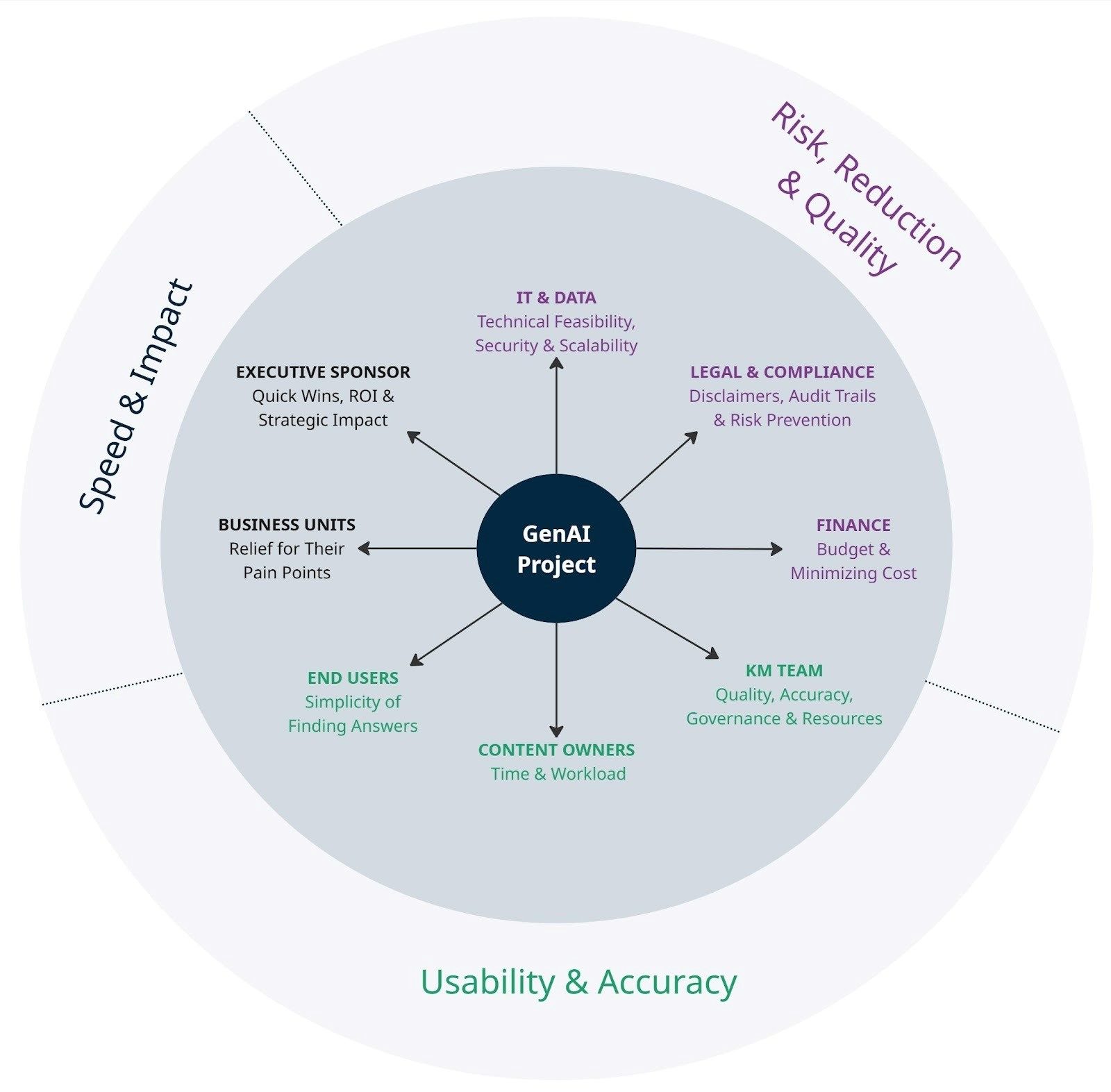
Your job is to find the overlap — the solution that satisfies enough stakeholders to move forward without fatally compromising any of their core requirements.
This isn't a technical problem. It's a political problem. And ignoring it is why most GenAI projects fail.
Through hundreds of enterprise AI initiatives, we've found six misalignment patterns that consistently derail projects. Recognizing them early is the first step to preventing them.
The Pattern:
IT builds a technically impressive GenAI system. They optimize the architecture, tune the retrieval, polish the demo. Then they announce it's ready.
Users don't come.
The system doesn't fit their workflow. It solves the wrong problem. It requires too many steps. It lives in a different app than where users work.
IT blames users for being resistant to change. Users blame IT for not understanding their needs. The project dies.
The Fix:
User research BEFORE building to understand actual workflows and pain points:
The Pattern:
The Sales department builds an AI chatbot for competitive intelligence. Support builds a separate one for customer queries. HR builds one to answer policy questions. Marketing builds yet another for content generation.
Four teams, four pilots, four different systems, four different content repositories. Sometimes they give conflicting answers to the same question.
None of them scale because none of them have enterprise backing. Resources are fragmented. Lessons aren't shared. Eventually, budget pressure kills all but one. Or even all of them.
The Fix:
The Pattern:
AI launches with mediocre content. It gives some bad answers. Users lose trust and stop using it.
Without usage, there's no feedback to improve. Without improvement, there's no reason to use it. Without users, the business case evaporates. Budget gets cut. Content doesn't get updated.
AI gets worse. Even fewer users. The spiral continues until the project is quietly shut down.
The Fix:
The Pattern:
The project is ready to be launched. Legal reviews and finds risk they can't accept. AI could give incorrect information to customers. Liability exposure is unclear. Regulatory requirements aren't satisfied.
Launch is blocked. Weeks become months. The project team moves on to other priorities. By the time Legal is satisfied, momentum is gone.
Or worse: The team launches without Legal approval, creating real liability the organization discovers later in a lawsuit or regulatory action.
The Fix:
The Pattern:
Finance approves the pilot based on vague promises: "AI will transform how we work." No specific metrics are defined. No baseline is measured.
Twelve months later, someone asks: "What did we get for that investment?"
The team has anecdotes. Qualitative feedback. A sense that things are better. But no hard numbers. No defensible ROI calculation.
Budget is cut. The initiative scales back or dies.
The Fix:
The Pattern:
The GenAI initiative needs content tagged with metadata. Someone decides the subject matter experts should "just tag their documents." After all, they know the content best.
SMEs have actual jobs. They're engineers, sales reps or HR specialists. Content tagging isn't in their job description. They don't have time. They don't have training. They don't see the value.
Documents don't get tagged. Or they get tagged poorly. Content quality suffers. AI performance degrades. SMEs are blamed. Relationships sour.
The Fix:
Understanding misalignments isn't enough. You need practical approaches to build alignment.
Before anything else, identify every stakeholder group affected by your initiative. For each:
Create a stakeholder map. Keep it updated. Reference it before every major decision.
Look for the solution that serves multiple stakeholders simultaneously:
The best initiatives aren't zero-sum. They find approaches that give multiple stakeholders what they need.
You can't satisfy everyone at once. Sequence your rollout to accumulate wins:
Different stakeholders need different messages, but all of them need regular communication:
Silence breeds suspicion. Over-communicate.
Don't try to convince everyone individually. Build coalitions of aligned stakeholders:
Find your champions and amplify their voices.
Related Article: The 5-Level Content Operations Maturity Model: Where Are You on the Path to AI-Ready?
Organizations that invest in stakeholder alignment see dramatically different outcomes.
With alignment:
Without alignment:
The technology is the same in both scenarios. Organizational dynamics dictate whether it succeeds.
A large insurance company's GenAI initiative for claims processing stalled for eight months due to stakeholder misalignment:
The project team conducted stakeholder mapping and discovered the core issue: each group had different success criteria, and no one had reconciled them.
Resolution approach:
Results:
The technology didn't change. The alignment did.
The GenAI stakeholder ecosystem is complex: eight groups with different priorities, different success metrics and different objections. Miss any one of them and your project is at risk.
Watch out for the six misalignments that kill projects:
Recognize them early.
Alignment isn't a soft skill — it's a survival skill.
The organizations that bridge the alignment gap successfully are the ones whose GenAI initiatives scale. The ones that ignore it are still wondering why their technically excellent pilots keep failing.
Your AI is only as good as your ability to get eight different stakeholder groups to row in the same direction.
 Learn how you can join our contributor community.
Seth Earley is the founder and CEO of Earley Information Science, a professional services firm working with leading brands. He has been working in the information management space for over 25 years. His firm solves problems for global organizations with a data/information/knowledge architecture-first approach. Earley is also the author "The AI-Powered Enterprise," which outlines the knowledge and information architecture groundwork needed for enterprise-grade generative AI. Connect with Seth Earley: 