Editorial
White Paper
Why Enterprise AI Fails at Scale

Every major technology shift begins with a story we want to believe. In the early days of enterprise search, the story was that a single box could organize the world’s information. In the cloud era, the promise was that infrastructure complexity could be abstracted away by scale. Today, the dominant story is that autonomous AI agents can reason, plan and execute across the enterprise with minimal human involvement.
Watch the demos and the story feels plausible. An agent queries multiple systems, retrieves documents, summarizes content, updates systems of record and completes workflows end-to-end. It looks intelligent, coordinated and inevitable. The implication is not subtle: the enterprise is finally on the brink of frictionless cognition.
Then those same agents are deployed inside real organizations.
They hallucinate. They surface contradictory answers. They misinterpret policy. They pull outdated or non-authoritative documents. They fail silently when context shifts across systems. The tone remains confident, the language fluent and the error difficult to detect until consequences emerge downstream. The failure is not subtle to the people responsible for results, and it is not primarily a model problem.
It is an information architecture problem.
Agents do not operate in clean, curated environments. They operate inside enterprises shaped by decades of accumulated systems, overlapping vocabularies, inconsistent metadata and undocumented assumptions. Humans survive in this environment because they carry context in their heads: they know which system is authoritative, which report is “directionally right” and which document has been superseded but never formally retired. They understand where the official process ends and the real process begins. Agents cannot infer these distinctions unless they are explicitly encoded.
Large language models do not possess enterprise intuition. They do not understand organizational history, political compromise or informal precedent. They operate by predicting likely continuations of text based on statistical patterns. When the enterprise context is fragmented or ambiguous, the model fills gaps with plausibility rather than truth.
This is why agent failures are particularly dangerous in business settings. The answer does not look wrong. It sounds reasonable, aligns with expectations and reads with confidence. The risk lies not in obvious error, but in quiet misalignment. In regulated industries, plausibility without traceability is not intelligence; it is liability.
Related Article: Why Composable Architecture Is Mandatory for Agentic AI
This is the point where many AI initiatives begin to unravel.
Early success in bounded environments creates confidence, which leads to broader deployment. Broader deployment exposes semantic cracks that were previously hidden. Once trust erodes, adoption slows. Once adoption slows, leadership questions ROI. Once ROI is questioned, the initiative is reframed, paused or quietly absorbed into another program with a different name.
This cycle has played out before with enterprise search, master data management and knowledge management initiatives that promised transformation but delivered uneven results. What is different now is the speed and visibility of failure. Agents operate at conversational speed. They feel personal. When they are wrong, users experience the failure immediately and viscerally. A bad dashboard can be ignored. A confident but incorrect answer cannot.
Information architecture does not eliminate error. It contains it. It provides the scaffolding that constrains intelligence to operate within known bounds rather than improvising across uncertainty. This is why the phrase “No Agents Without IA” is not a slogan; it is a diagnostic.
If an organization struggles to define core entities, align terminology across systems, establish content ownership or enforce metadata discipline, agents will not fix those problems. They will expose them. Conversely, organizations that have invested in information architecture often discover that agentic capabilities emerge naturally: retrieval improves, generation stabilizes, orchestration becomes predictable. The model did not change. The environment did.
Enterprises that treat agents as magic will experience short-lived excitement followed by long-term disappointment. Enterprises that treat agents as multipliers of structure will find that intelligence scales in ways that are both measurable and trustworthy. The difference is not ambition. It is architecture, and that is where the real work of the agentic enterprise begins.
One of the most revealing patterns to emerge from real enterprise GenAI deployments is this: the systems that actually deliver sustained value are not agent-led. They are search-led.
This observation runs counter to much of the current hype, which emphasizes chat interfaces, autonomous workflows and reasoning agents that appear to “think” across systems. Yet inside organizations where AI is producing measurable outcomes, search remains central, not as a legacy interface, but as a foundational capability that intelligence depends on.
In traditional enterprise environments, search was treated as a convenience layer. It helped users find documents, tickets or records more quickly, but it was rarely viewed as strategic. Its success was measured in clicks and satisfaction scores rather than business outcomes.
Generative AI changes the role of search fundamentally. When AI systems generate answers, recommendations or actions, the quality of those outputs is constrained by what the system retrieves. Retrieval becomes perception. If the system “sees” the wrong information, it reasons incorrectly, regardless of model sophistication. This is why retrieval-augmented generation works when it works and fails when it fails. The model itself is not the differentiator. The retrieval pipeline is.
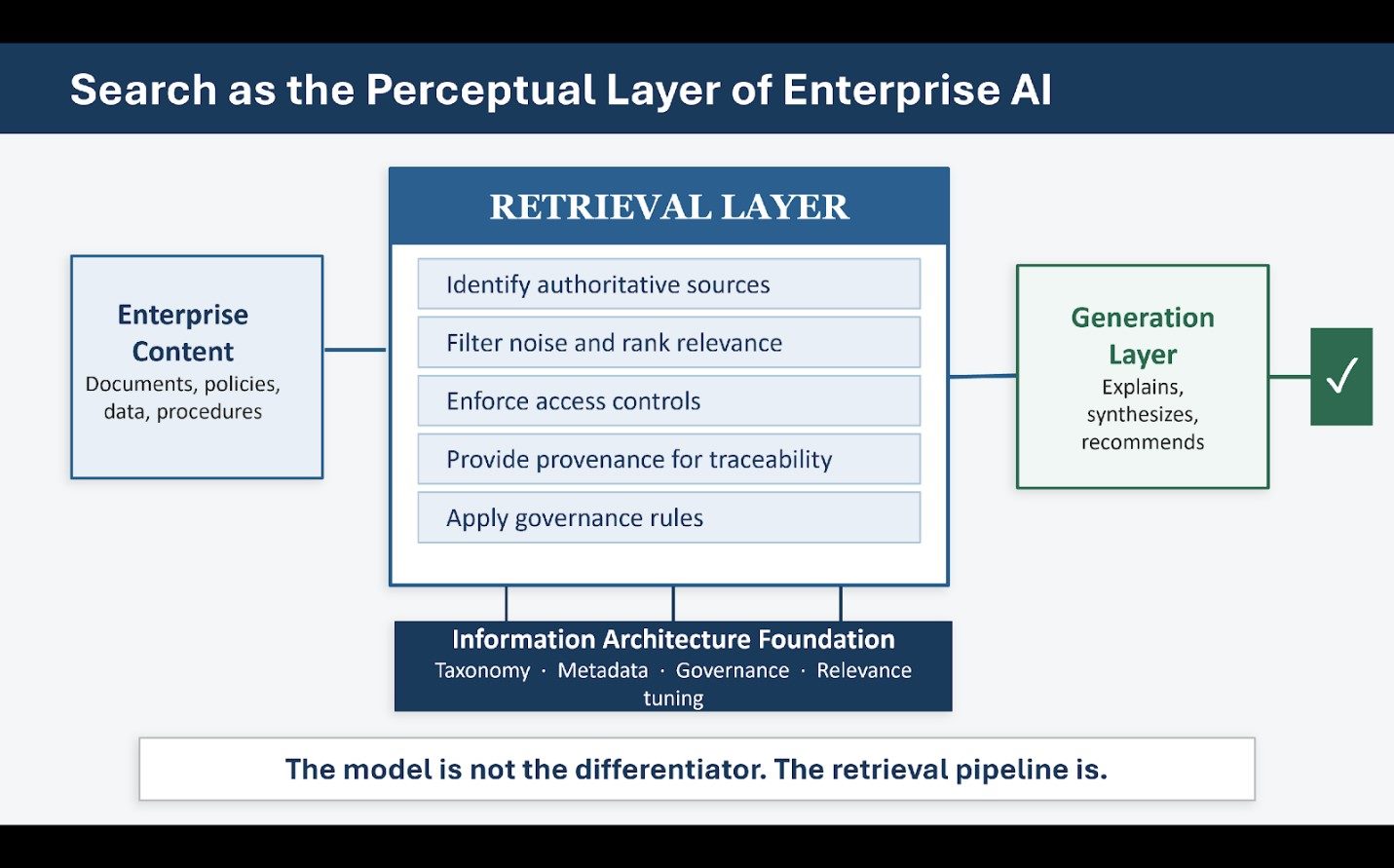
In successful enterprise implementations, search performs several critical functions simultaneously. It:
When these functions are weak, generative systems compensate by guessing. When they are strong, generative systems become remarkably reliable.
This pattern is visible across domains. In customer support environments, search retrieves validated procedures, policies and known-issue documentation; the language model does not invent answers but explains and contextualizes retrieved content. Accuracy improves not because the model is “smarter,” but because it is constrained by trusted inputs. In field service and manufacturing contexts, search grounded in structured product metadata drives diagnostic guidance, while in compliance and regulatory environments, search enforces provenance before synthesis, allowing generation to become an interpretive layer rather than a creative one.
Across these examples, the same principle holds: search is the perceptual system of enterprise AI.
Related Article: RAG vs. Fine-Tuning: A Practical Guide to LLM Customization
Organizations that invested early in taxonomy, metadata and search tuning now find themselves ahead of the curve because they already solved problems that agent-centric narratives tend to ignore.
Together, these elements form the substrate upon which intelligence operates.
This also explains why organizations that bypass search discipline struggle when they jump directly to agents. Without strong retrieval, agent orchestration becomes an exercise in compensating for missing structure: prompts grow longer, guardrails multiply, human review increases and the system becomes brittle and expensive to maintain. In contrast, when retrieval is treated as infrastructure rather than an afterthought, downstream complexity collapses. Prompts simplify, agents become composable and governance becomes tractable.
Rather than asking, “Where can we deploy agents?” leaders should ask, “Where do we have retrieval discipline strong enough to support reasoning?” The answer often surprises them. Many organizations discover that their most AI-ready assets are not the newest systems, but the ones where information architecture work has already been done.
A common misconception holds that search is inherently static and agents are inherently dynamic. In practice, modern search systems are highly adaptive: they learn from interaction patterns, incorporate feedback and adjust relevance based on context. When integrated properly, search and generation form a feedback loop. Retrieval informs generation, user interaction informs relevance and relevance improves retrieval. Over time, the system becomes more aligned with how the enterprise actually operates.
The agent narrative often obscures this reality by presenting intelligence as something that happens after retrieval. In truth, intelligence is distributed across the entire pipeline. Retrieval is not a precursor to reasoning; it is part of reasoning. Instead of building agents that “go find information,” mature enterprises build agents that assume retrieval has already done its job. The agent’s role is not to search indiscriminately, but to act within a curated semantic frame.
Search, in this model, is no longer about finding things. It is about shaping reality for machines. In the agentic enterprise, search becomes invisible when it works and catastrophic when it does not. It is not legacy infrastructure. It is cognitive infrastructure.
As organizations move from experimentation to operational deployment, the conversation around agents inevitably turns to economics.
Early pilots are often funded as innovation initiatives, with success measured in novelty and possibility. But once agents are expected to operate at scale, the questions change quickly: How much does this cost? Where does the value come from? And why do outcomes vary so dramatically between organizations using similar tools?
The answer lies less in models and more in structure.
Information architecture has long been treated as a background discipline: necessary, but rarely strategic. Taxonomy, metadata and governance work is often framed as cleanup, hygiene or foundational overhead. It is difficult to tie directly to revenue and easy to defer in favor of more visible initiatives. Agentic AI reverses this dynamic. In AI-driven systems, structure directly determines marginal cost, reliability and scalability.
When content is inconsistent or poorly described, retrieval precision drops. To compensate, prompts become longer and more complex, increasing token usage and latency while introducing more surface area for error. As confidence in outputs declines, human review increases, exceptions proliferate and manual intervention becomes the norm rather than the edge case. Each of these steps adds operational drag. Individually, the costs seem manageable. Collectively, they undermine the business case for automation.
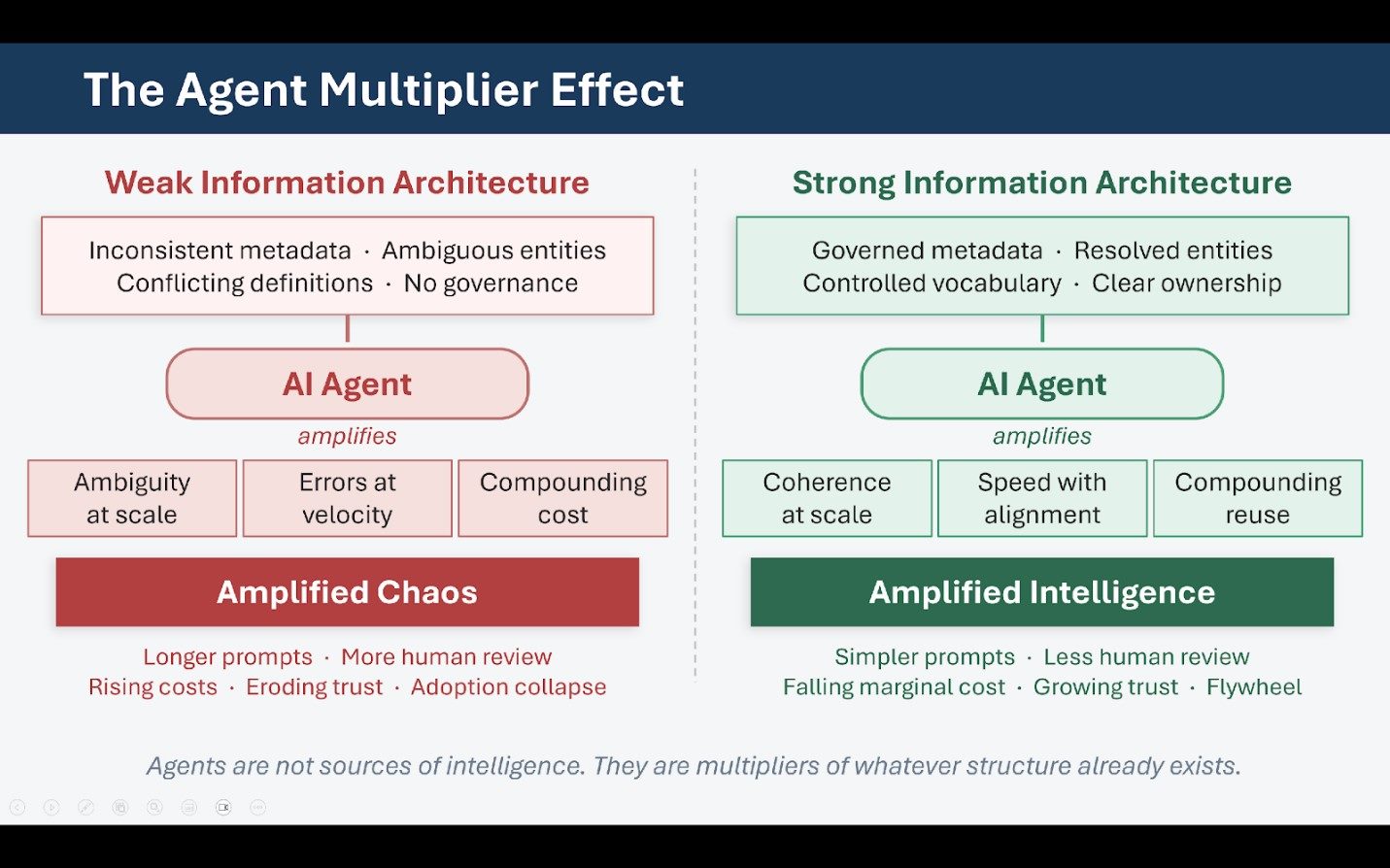
Strong information architecture inverts this equation. When entities are clearly defined, metadata is consistent and content ownership is explicit, retrieval becomes precise. Precise retrieval reduces prompt complexity. Simpler prompts reduce cost and improve explainability. Improved explainability increases trust, and increased trust reduces the need for human intervention. The result is not just better AI; it is cheaper, more predictable AI.
This is why organizations with mature information architecture often report outsized returns from generative AI investments. They are not doing anything magical with models. They have reduced the friction intelligence encounters as it moves through the enterprise.
This leads to a critical insight that is often missed in agent discussions: agents are not sources of intelligence. They are multipliers. They amplify whatever structure already exists. If definitions are ambiguous, agents amplify ambiguity. If governance is weak, agents amplify risk. If content is outdated, agents accelerate the spread of outdated information. Conversely, when structure is strong, agents amplify coherence, speed and alignment.
This multiplier effect explains why agent deployments produce wildly different outcomes across organizations that appear similar on the surface.
Two enterprises may use the same foundation model and orchestration framework yet experience opposite results. The difference is not tooling; it is architecture. It also explains why copying another organization’s agent strategy rarely works. The visible layer (the interface, the workflow, the agent logic) can be replicated. The invisible layer (the semantic foundations that make those agents reliable) cannot.
A well-scoped pilot performs well in a controlled environment. Encouraged, the organization expands the scope. As scope expands, semantic inconsistencies surface, the system becomes brittle, costs rise and confidence erodes.
This is often framed as a scaling problem. In reality, it is an architectural debt problem. Agents make that debt visible because, in traditional systems, semantic inconsistency could persist for years without immediate consequence. Humans compensated through experience and informal knowledge sharing. Agents do not compensate. They execute.
This execution pressure forces organizations to confront questions they have deferred for decades: What is the authoritative definition of a customer? Which policy version applies? Who owns this content? When should it be retired? These questions are uncomfortable precisely because they are organizational, not technical. They cut across silos, expose misalignment and require governance. But they are unavoidable if agents are to operate safely.
From an economic perspective, this reframes information architecture as capital investment rather than operational expense. Architecture work done once reduces cost and risk across every downstream AI use case. Architecture work deferred becomes a tax that compounds as automation increases. Another implication of the multiplier effect is that agents magnify not only efficiency, but also error velocity. A human making a mistake affects a small number of cases. An agent making the same mistake can affect thousands in minutes.
This does not argue against automation. It argues for bounded autonomy. Well-architected systems do not aim for maximum automation; they aim for appropriate automation. Agents operate within clearly defined domains, escalate uncertainty and defer when confidence thresholds are not met. Information architecture enables this calibration by providing the signals agents need to know when they are operating within safe bounds and when they are not.
Related Article: As AI Agents Go Into Production, Enterprises Confront an Access Dilemma
Organizations that understand this invest differently. They fund taxonomy and metadata work alongside model experimentation. They staff semantic stewardship roles. They measure retrieval quality, not just model accuracy. They treat governance as an enabler rather than an obstacle. Over time, these investments compound: each new agent is easier to deploy than the last, each new use case builds on shared foundations, and intelligence becomes reusable rather than bespoke.
Agents do not eliminate the need for information architecture. They make its absence untenable. In the economics of the agentic enterprise, structure is not overhead. It is leverage.
In Part 2 of this series, we examine how semantics and knowledge graphs address the limits of text-centric AI, and how governance and operating models must evolve to enable safe autonomy at enterprise scale.
 Learn how you can join our contributor community.
Seth Earley is the founder and CEO of Earley Information Science, a professional services firm working with leading brands. He has been working in the information management space for over 25 years. His firm solves problems for global organizations with a data/information/knowledge architecture-first approach. Earley is also the author "The AI-Powered Enterprise," which outlines the knowledge and information architecture groundwork needed for enterprise-grade generative AI. Connect with Seth Earley: 