Feature
White Paper
Why Enterprise AI Fails at Scale

The biggest barrier to scaling AI inside enterprises is no longer technical maturity, but workplace culture, according to a global report from Infosys and MIT Technology Review Insights.
According to the study, which drew on responses from business leaders across industries and regions, 83% of business leaders say psychological safety has a measurable impact on the success of AI initiatives.
Fear — particularly fear of failure — continues to slow AI adoption, even as investments in AI tools and platforms accelerate.
According to the findings, employees who worry about criticism or negative consequences often hesitate to:
That hesitation, in turn, limits innovation and keeps many initiatives stuck in pilot phases.
Despite rapid advances in AI capabilities, human factors are holding organizations back; adoption falters when employees lack confidence in how the technology should be used or fear making mistakes.
Related Article: The Full Journey of AI-Powered Transformation: From Idea to Impact
The report frames AI adoption as a change management challenge as much as a technology deployment, arguing that scaling AI requires building resilience and trust across the workforce.
Ashish Nadkarni, group vice president and general manager with IDC's worldwide infrastructure research organization, sees the issue as a practical response to risk in a high-hype environment. Because AI sits inside an unusually intense cycle of expectations, board pressure and peer comparison, it amplifies leaders’ fear of being blamed if initiatives fail to deliver.
In that context, psychological safety shows up as protection from downside risk. Leaders want room to experiment with AI without being penalized for pilots that don’t pan out or for choosing not to move as fast as competitors.
Many executives feel pulled in opposite directions, said Nadkarni. They want credit for being seen as innovators, but they also want insulation if results fall short or the technology underperforms. When leaders fear criticism or reputational damage, they may overpromise, rush adoption or quietly avoid hard decisions.
By contrast, environments that acknowledge uncertainty and normalize experimentation allow AI initiatives to proceed more deliberately, with clearer accountability and more realistic expectations.
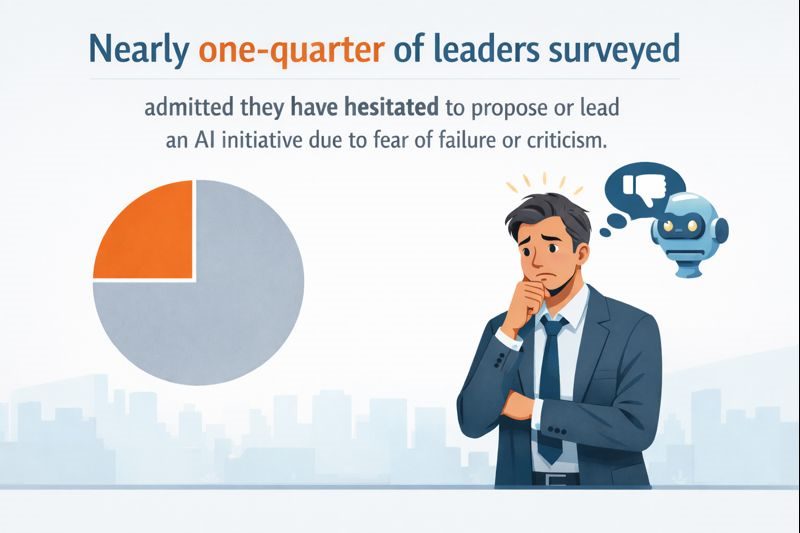
Nearly one-quarter of leaders surveyed admitted they have hesitated to propose or lead an AI initiative due to fear of failure or criticism, highlighting how caution at the top can cascade through organizations.
“People want to be able to have a level of insurance that they are not going to be chastised for the initiatives they take or do not undertake,” Nadkarni noted. “They want to benefit from the upside, but they also want protection from the downside.”
Survey results also highlighted a strong link between psychological safety and business outcomes, with 84% of respondents reporting a direct connection between psychologically safe environments and tangible business results.
At the same time, the data reveals persistent gaps: Fewer than half of respondents — 39% — describe their organization’s current level of psychological safety as “high,” while 48% rate it as “moderate,” suggesting many companies are pursuing AI transformation on unstable cultural foundations.
Leadership behavior and communication emerge as decisive factors. In fact, 60% of respondents say clearer communication about how AI will — and will not — affect jobs would most improve psychological safety.
Nadkarni frames psychological safety around AI as a leadership discipline grounded in clarity, pacing and accountability, rather than hype or reassurance alone. His guidance centers on three practical moves:
Related Article: Why AI Training Is Failing — and What Hands-On Learning Gets Right
Psychological safety around AI depends on organizations embracing a fast-fail mindset rather than defaulting to risk avoidance, Nadkarni argues.
Leaders must remove punitive consequences for initiatives that are experimental or carry uncertainty, especially in fast-moving areas like AI. While excessive caution may feel safer from a job-security standpoint, Nadkarni warns it ultimately limits differentiation and innovation at the company level.
Creating space to test ideas, learn quickly and move on when something does not work allows teams to experiment without fear and prevents organizations from stagnating.
“A fast-fail mentality is a good way to inculcate psychological safety, because then you can say you have a culture of trying out different things, and if it doesn’t work out, you move on — you’re not going to be stuck in the mud,” he said.
Nathan is a journalist and documentary filmmaker with over 20 years of experience covering business technology topics such as digital marketing, IT employment trends, and data management innovations. His articles have been featured in CIO magazine, InformationWeek, HealthTech, and numerous other renowned publications. Outside of journalism, Nathan is known for his architectural documentaries and advocacy for urban policy issues. Currently residing in Berlin, he continues to work on upcoming films while contemplating a move to Rome to escape the harsh northern winters and immerse himself in the world's finest art. Connect with Nathan Eddy: 