Editorial
Research Report
The AI Transformation 100: Concrete Ideas for Fixing How We Work

When AI gives a wrong answer, what happens next?
If the answer is "nothing" or "eventually someone notices," your governance is broken. If the answer is "we lock everything down until we are sure it is perfect," your governance is also broken, in the opposite direction.
Part 1 and Part 2 of this series established that enterprise AI complexity grows exponentially with scale and that information architecture provides the retrieval foundation. This is the third pillar: governance designed for iteration rather than prevention. Without it, even well-architected content degrades over time, and the AI system your organization invested in quietly becomes operationally useless.
Traditional content governance was designed for a world where humans created content, humans reviewed content and humans published content. Every step was manual. Control meant preventing mistakes before they happened. Quality meant perfection at launch.
That model does not work for AI. AI will make mistakes. It will hallucinate. It will retrieve outdated content. It will miss context that humans would catch. No amount of pre-launch review will prevent every error. The question is not whether AI will be wrong. It is how quickly you can detect and correct those errors.
The organizations that succeed with GenAI do not prevent all mistakes. They catch and fix mistakes faster than anyone else.
The mindset shift is profound, analogous to moving from gatekeeping to gardening. Traditional governance builds gates: content is reviewed, approved and posted. AI-era governance cultivates a garden: you plant, you monitor, you prune, you refine. The system is never "done." It is always improving.
Related Article: The 5-Level Content Operations Maturity Model: Where Are You on the Path to AI-Ready?
Effective AI governance operates at three distinct layers. Miss any one of them and the system fails.
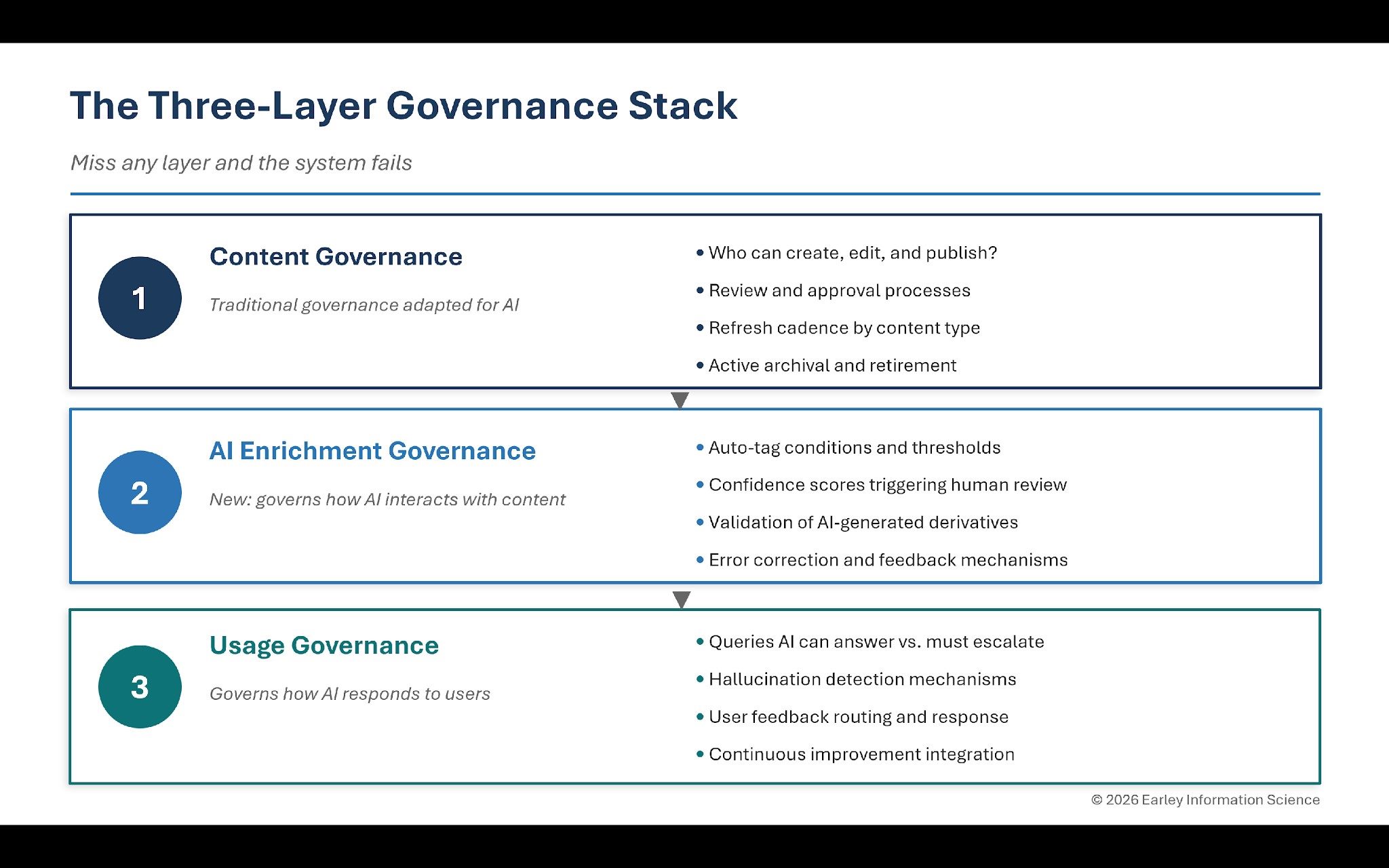
This is traditional governance adapted for AI context. It addresses four questions:
This layer is new. It governs how AI interacts with content and requires decisions that most governance frameworks have never addressed.
This layer governs how AI responds to users and closes the loop between system output and system improvement.
If there is one mechanism that distinguishes effective AI governance from governance theater, it is the feedback loop.
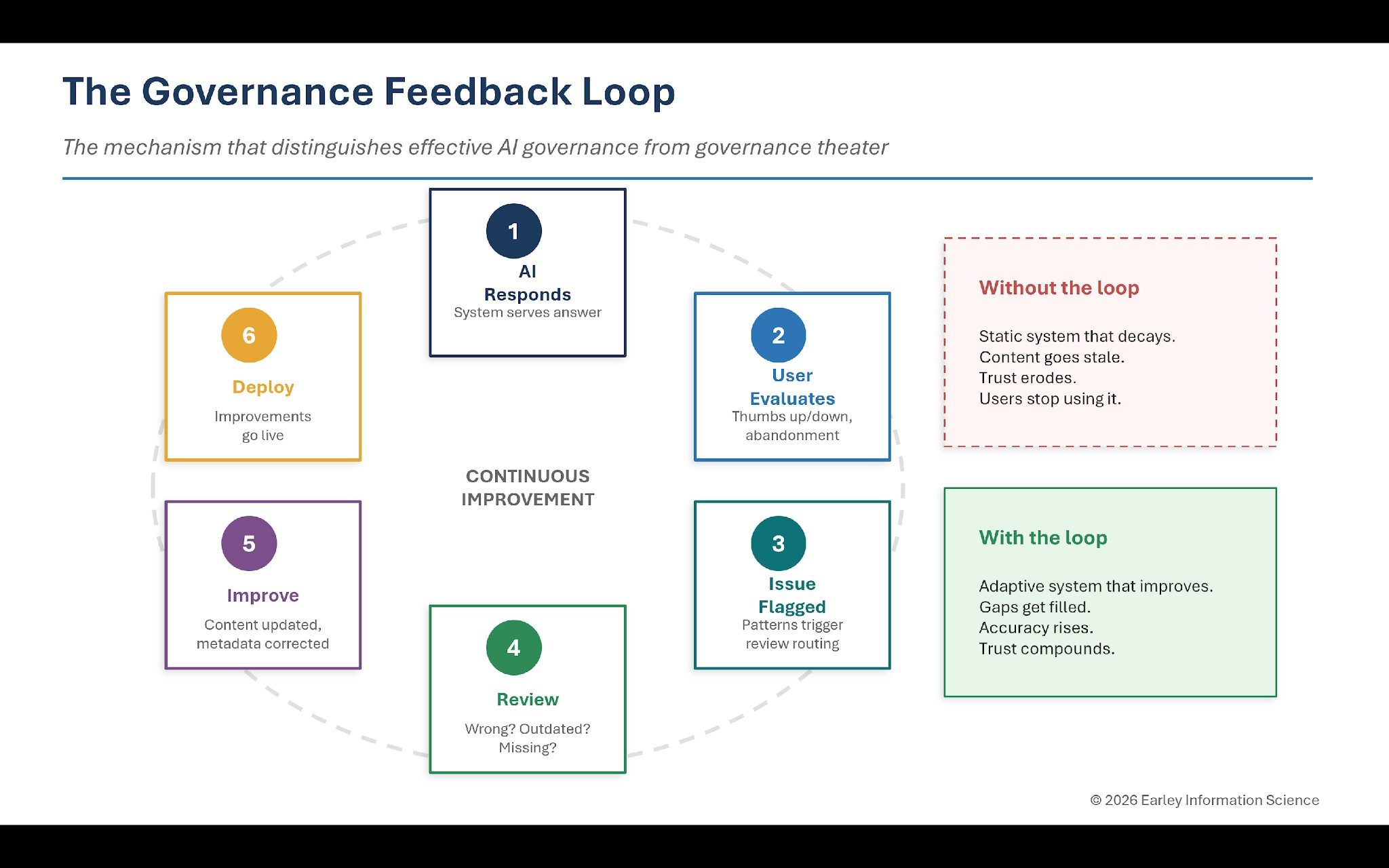
The cycle operates in six stages:
Without this loop, you have a static system that decays. Content goes stale. AI makes the same mistakes repeatedly. User trust erodes. Eventually people stop using the system and the investment yields nothing.
With this loop, the system becomes adaptive. Coverage gaps get filled. AI accuracy improves. User trust grows. Usage increases, which generates more feedback, which drives more improvement.
The ultimate governance goal: enable AI to improve content quality faster than content decays.
Not all content warrants the same governance intensity. The organizations that sustain quality at scale stratify their governance by risk level.
This stratification is what makes governance scalable. Applying high-risk controls to every piece of content creates the bottleneck that causes content to go stale. Applying low-risk controls to compliance content creates liability. The governance framework must distinguish between the two and apply intensity proportionally.
Organizations with broken governance exhibit predictable patterns, and recognizing them early is the best way to intervene before user trust erodes.
Every one of these failures is a governance failure, not a technology failure. And every one is preventable with the three-layer stack and feedback loop described above.
Related Article: Garbage In, Confidence Out: How Information Architecture Powers Enterprise Retrieval
Done right, governance is not overhead. It is an accelerator.
This is the flywheel that Parts 1 and 2 of this series have been building toward. The integration infrastructure (Part 1) and the information architecture (Part 2) provide the foundation. Governance provides the operating model that keeps the foundation current, reliable and improving.
Traditional governance asks: "How do we prevent mistakes?"
AI-era governance asks: "How do we detect and correct mistakes faster than our competitors?"
The shift is fundamental. AI will make errors. Content will go stale. Users will encounter problems. The question is whether your governance enables rapid response or creates organizational paralysis.
When AI gives a wrong answer, what happens next? If you can answer that question with a clear, fast and reliable process, you have governance that works. If you cannot, start building it now, before your GenAI initiative teaches users that AI cannot be trusted.
This is Part 3 of a three-part VKTR series on scaling enterprise AI. Part 1, "The Pilot Paradox," examined why integration complexity grows exponentially. Part 2, "Garbage In, Confidence Out," addressed the information architecture foundation that enterprise retrieval requires.
 Learn how you can join our contributor community.
Seth Earley is the founder and CEO of Earley Information Science, a professional services firm working with leading brands. He has been working in the information management space for over 25 years. His firm solves problems for global organizations with a data/information/knowledge architecture-first approach. Earley is also the author "The AI-Powered Enterprise," which outlines the knowledge and information architecture groundwork needed for enterprise-grade generative AI. Connect with Seth Earley: 