News Analysis
Guide
Is AI Making Your Organization More Productive or More Dependent?


The AI industry has moved a long way from chatbot demos. As Google I/O 2026 made clear, the focus is now on systems that can take action across search, commerce, productivity tools and cloud environments.
During the event's keynote, Google rolled out a collection of Gemini-powered tools built to do more than answer questions. The company showed AI systems that can keep working after the prompt, move between applications and help manage tasks across commerce and cloud environments. Taken together, the announcements cast Gemini less as a chatbot and more as the connective tissue embedded throughout everyday computing.
CEO Sundar Pichai tied Google I/O 2026 back to the company’s original mission: to “organize the world’s information and make it universally accessible and useful.” But the keynote pushed that mission into a new phase: AI systems that can act on information, not just retrieve it.
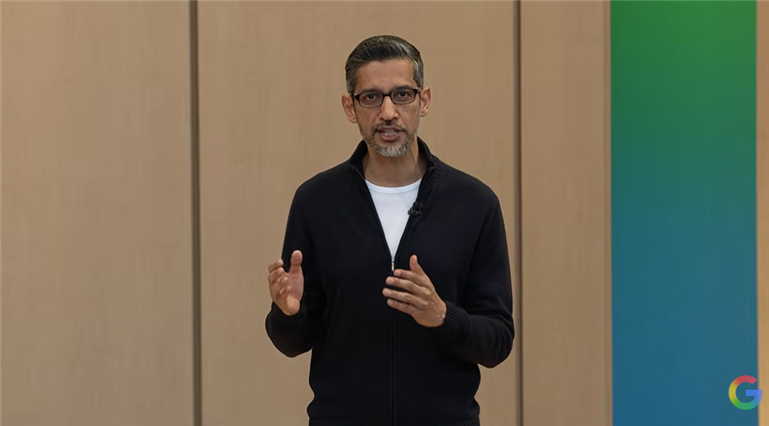
The announcements also showed that the AI race is no longer just about model performance. Google is now competing to build the ecosystem around the model: the protocols, interfaces and tools that let AI agents operate across the web. As Pichai put it, “AI has moved from chat to act.”
Google also spent a noticeable amount of time on permissions and approvals, a matter of growing importance as more autonomous AI systems will require users to trust what they can do, when they can do it and how much control people retain. Rather than present Gemini as a standalone assistant, Google increasingly framed it as an embedded orchestration layer coordinating interactions across search, commerce, development and productivity systems.
Related Article: Unify Agentic AI in Martech: End‑to‑End Workflow Integration
Search is becoming a place where tasks get done, not just where information gets found.
The scale of adoption shows how quickly conversational AI is becoming embedded into Google’s core Search experience. According to Google, AI Mode has already surpassed one billion monthly active users, while AI Overviews now reach more than 2.5 billion monthly active users globally.
Rather than simply returning links, Search can now generate interfaces, mini-applications and operations designed around the user’s intent. AI-generated interfaces may also increasingly persist and evolve over time, allowing Search experiences to become more adaptive, contextual and task-oriented across longer-running routines.
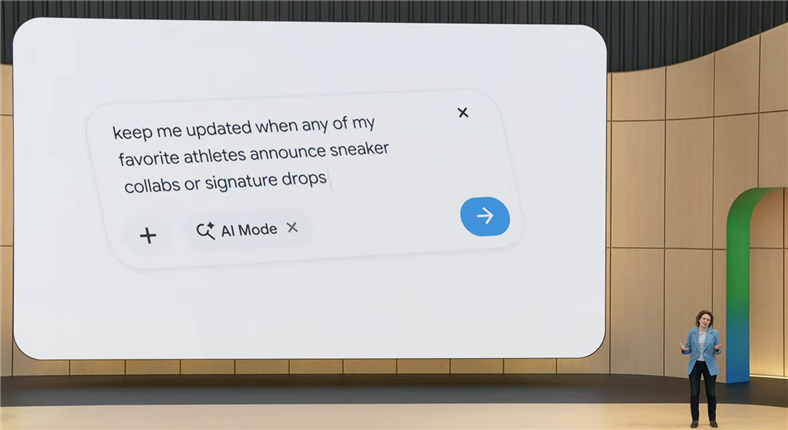
That could change the role of search altogether.
Search engines used to send users elsewhere to finish the job. AI search is starting to keep more of that work inside the search experience. Product research, scheduling, shopping, trip planning and workflow coordination can now potentially occur inside AI-mediated search environments rather than requiring users to manually navigate across multiple applications and websites.
Google also introduced persistent information agents that are capable of continuously monitoring topics, reporting updates and performing actions asynchronously in the background.
Google returned several times to the idea that “the best version of search is the one that works for you.” In practice, that means Search is becoming more personalized, more context-aware and more willing to act on a user’s behalf. For ecommerce and marketing teams, the shift could be serious. If AI-generated interfaces handle more of the journey, traditional navigation and click-driven experiences may matter less.
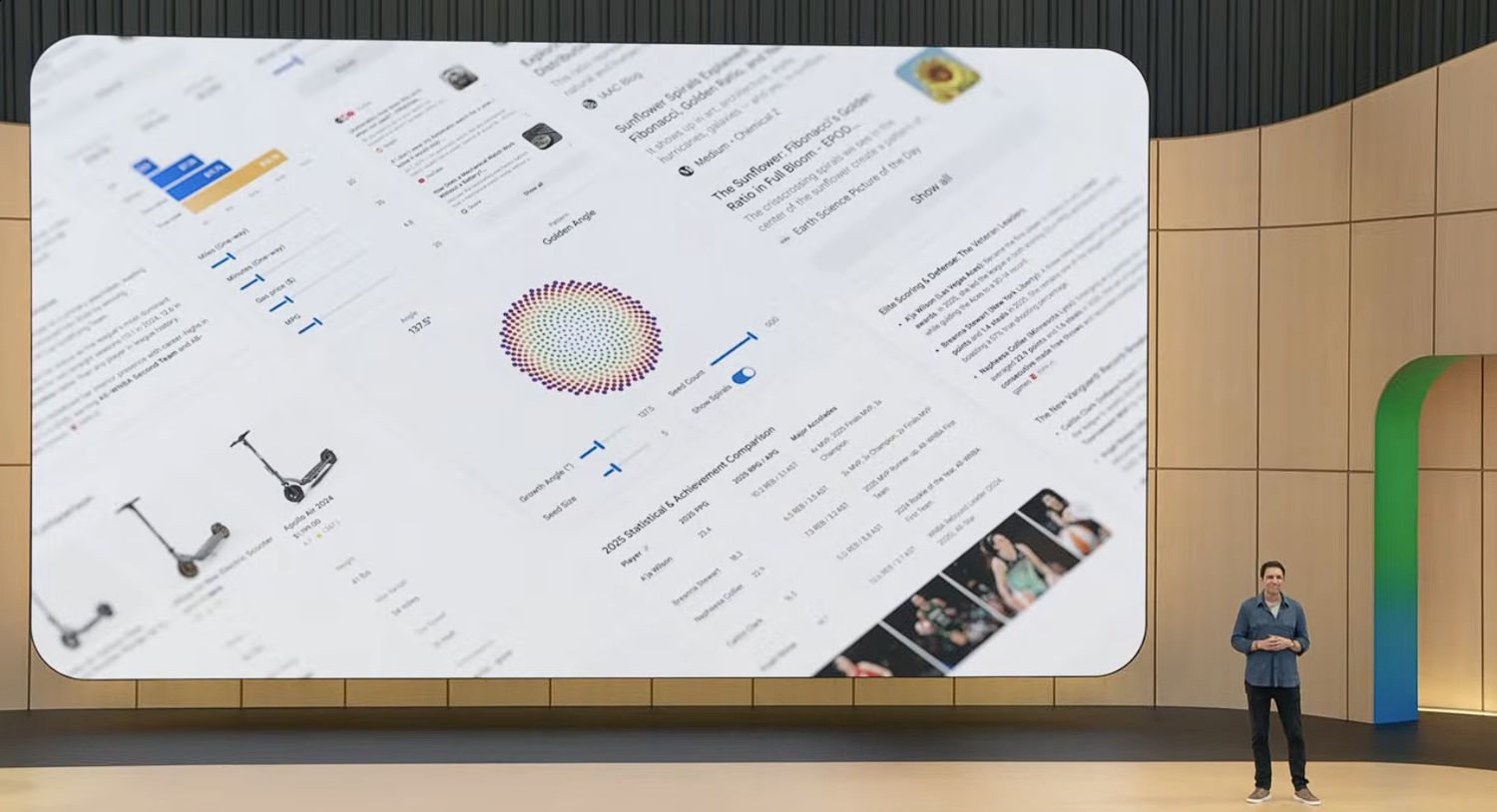
Businesses may soon need to optimize for two audiences: people, and the AI agents capable of researching products, comparing options and potentially completing transactions without human intervention.
Some of Google I/O 2026’s most important announcements focused not on chatbots or assistants, but on the infrastructure required to support AI-mediated commerce.
“We’re firmly in our agentic Gemini era,” said Pichai, a theme reflected in announcements surrounding the Universal Commerce Protocol (UCP), Universal Cart and Agent Payments Protocol (AP2), which collectively point toward more interoperable commerce systems that are capable of supporting autonomous purchasing functions across platforms and services.
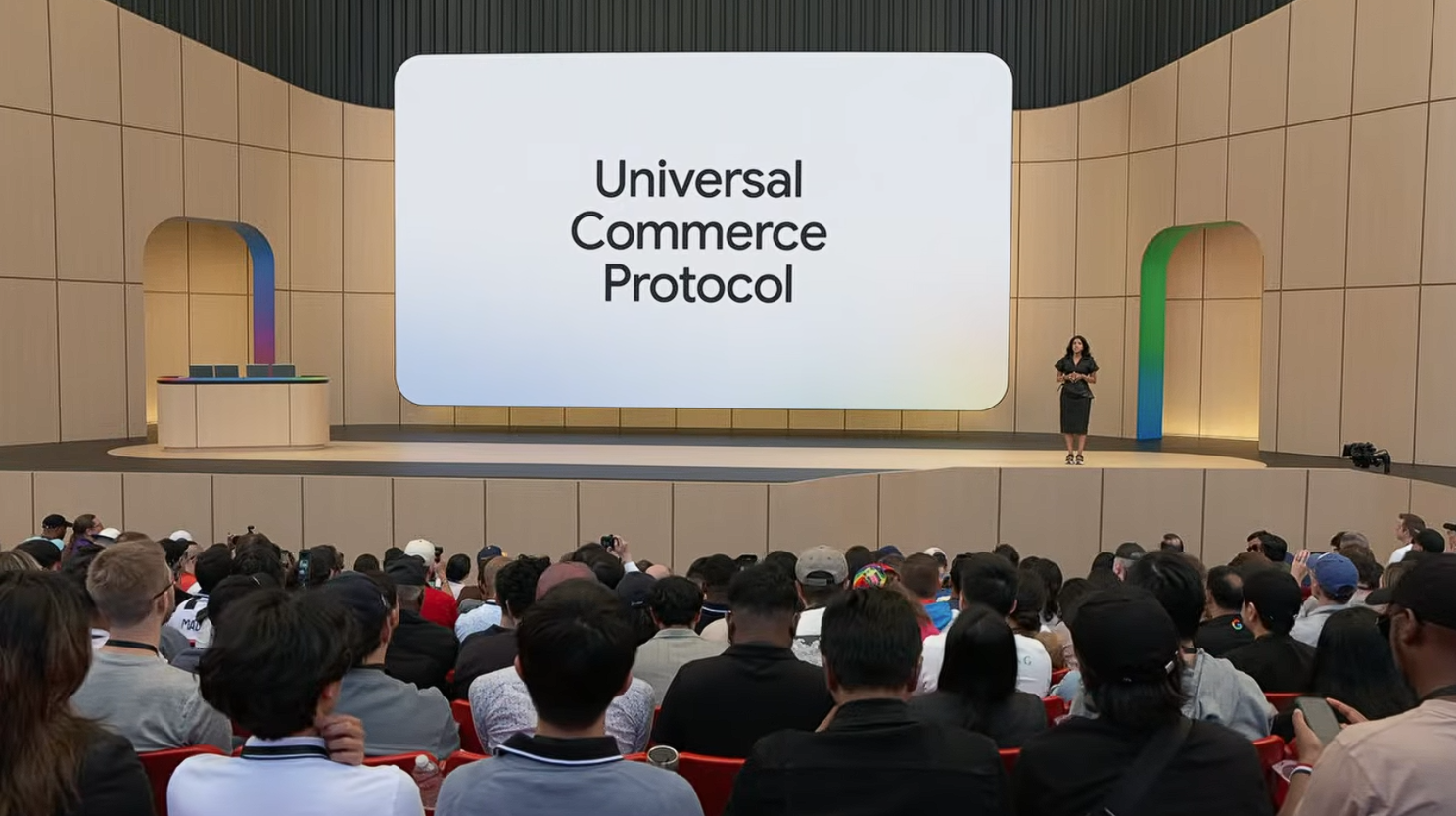
Google appears to be preparing for a version of ecommerce where AI agents sit between the buyer and the storefront — instead of clicking through product pages and checkout screens, users may ask AI agents to handle more of the shopping process for them.
That same message carried through the rest of the keynote: Gemini is being built to operate across services, not sit inside a single chat window.
Google also leaned hard into interoperability and open standards. Unlike many earlier Web3 and metaverse efforts that struggled with fragmented ecosystems and incompatible platforms, Google is trying to avoid that problem by backing shared protocols and bringing in major UCP partners, including Walmart, Target, Shopify and Etsy. That approach could become increasingly important as AI agents begin operating across ecommerce, payments and digital services more autonomously.
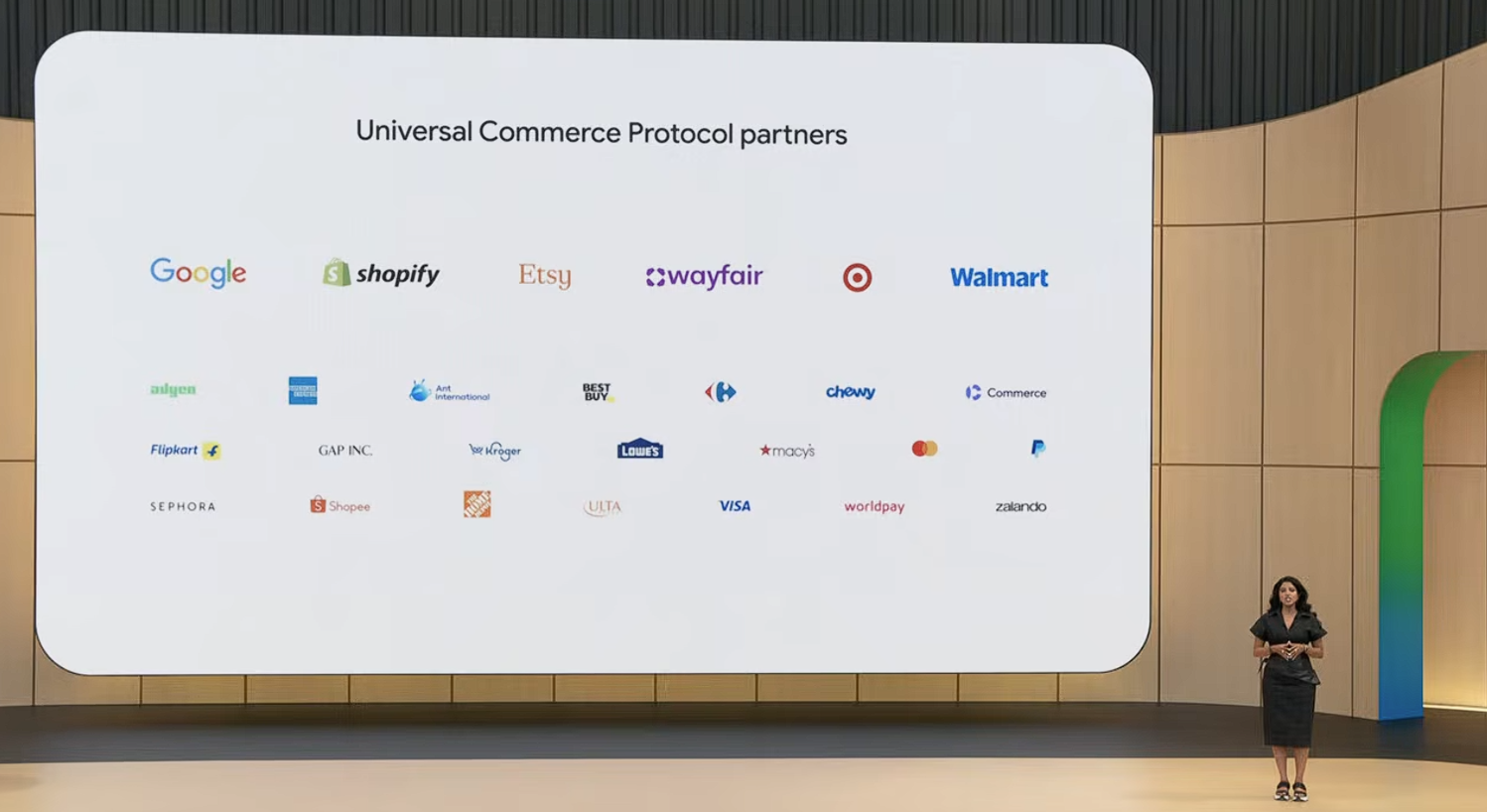
For ecommerce teams, the pressure point is clear. Online shopping has long been built around attracting human attention and driving clicks. Agent-led commerce may shift the focus toward product data that machines can read, transaction systems agents can use and checkout flows that do not depend on a person moving through every step.
Google also used I/O 2026 to showcase how it wants to change the way software gets built.
Antigravity 2.0 introduced new CLI and SDK tooling, native voice support and deeper integration with Android, Firebase and Google AI Studio. The product fits into Google’s larger plan for developers to increasingly build software through conversation, prompts and AI-assisted iteration.
The demos showed developers using AI to build and change software through conversation instead of writing every step by hand. In one example, an AI-generated operating system was iteratively modified through conversational prompts until it was capable of running Doom, illustrating how software creation is increasingly shifting toward intent-driven orchestration rather than traditional step-by-step coding alone.
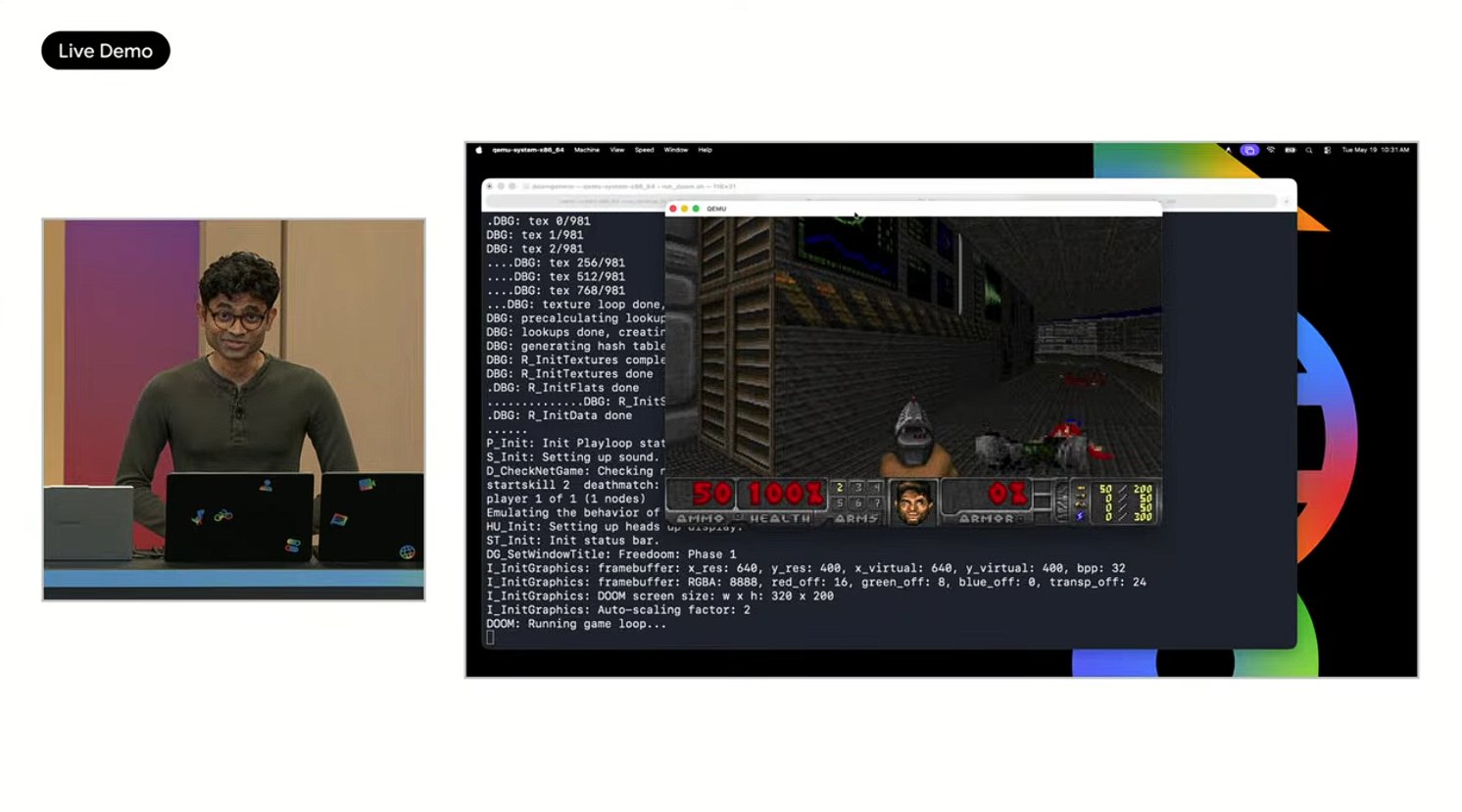
The demos also put into focus a broader trend emerging across the AI industry: software development is increasingly becoming collaborative, iterative and AI-assisted. Rather than focusing solely on code generation, AI systems act as active development partners that are fully capable of coordinating processes, revising implementations and accelerating prototyping across increasingly complex projects.
Related Article: Best AI Coding Platforms in 2026: Cursor, GitHub Copilot, Claude Code and More Compared
Beyond the product announcements themselves, Google I/O 2026 repeatedly came back to a problem that may shape the future of agentic AI: trust.
As AI systems gain more autonomy, Google kept returning to permissions, approvals and user control as central parts of the experience. Google also noted the expanding adoption of its SynthID watermarking technology by businesses like OpenAI and ElevenLabs. As AI-generated media spreads, provenance and authenticity systems are becoming harder to treat as optional.
The message is that better models will not be enough. Users also need to believe AI systems will act safely, explainably and within limits. Persistent agents raise hard questions. Who approves an action? Can it be reversed? How much authority should a user hand over to software?
Interoperability ran through many of the announcements, leaning on open protocols, cross-platform compatibility and broader ecosystem participation rather than isolated proprietary systems. That's the lesson from earlier tech cycles: fragmented ecosystems can slow adoption before the market ever gets moving.
The larger message from Google I/O 2026 is not that models are getting smarter — that's undeniable. It's that the next phase of AI will depend on whether companies can make autonomous systems useful, interoperable and trustworthy enough for people to let them act.