Editorial
Research Report
The AI Transformation 100: Concrete Ideas for Fixing How We Work


Returns are a longstanding and fundamental aspect of a retailer’s business: Provide a frictionless experience and keep a loyal consumer happy. But, inflated labor costs and an increase in returns abuse are turning a customary process into a crisis.
IHL reports that since 2020, labor and processing costs have increased 40% for each return, and that’s not just inflation but the growing complexity of the returns process.
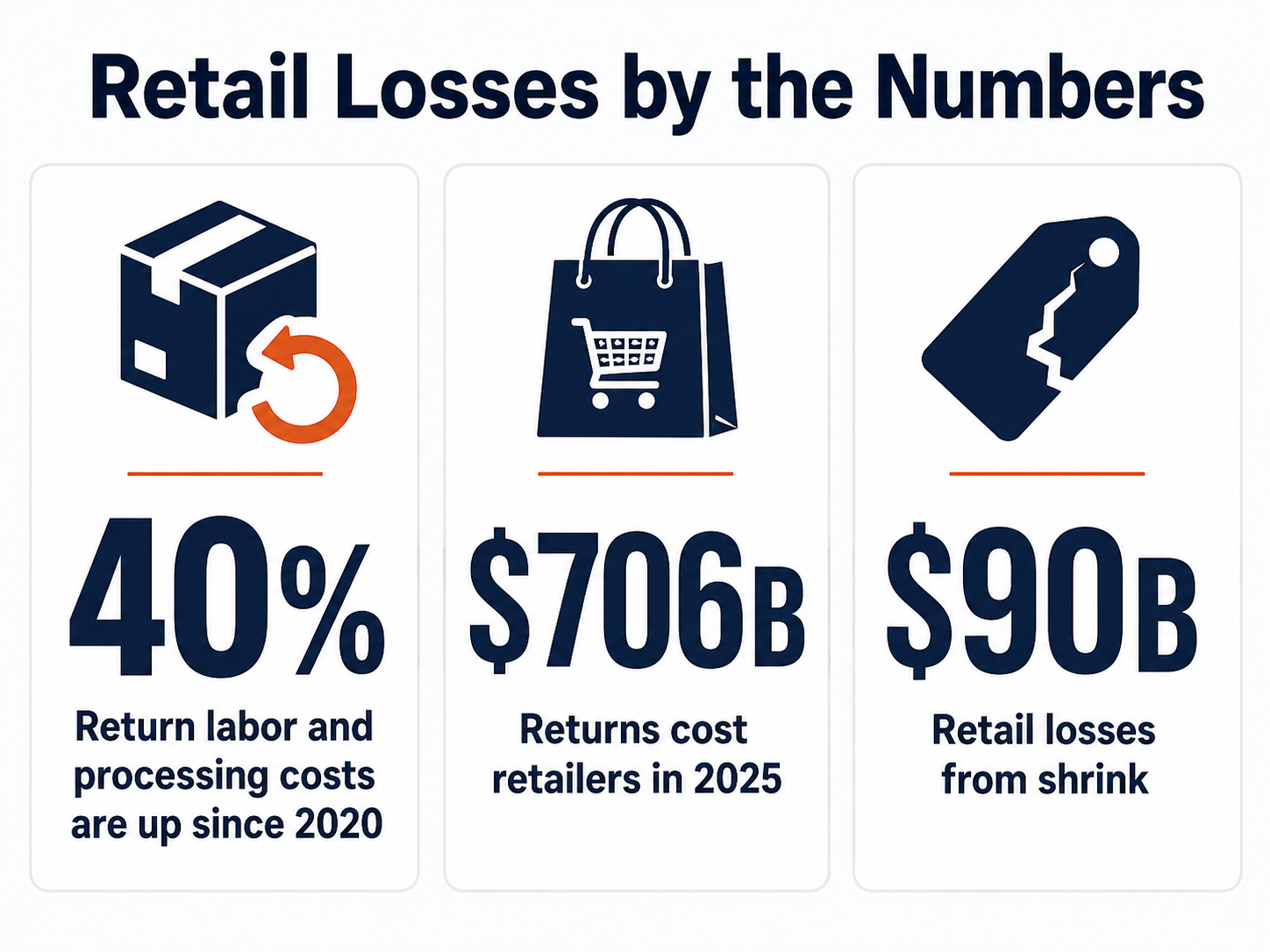
By comparison, shrink — including employee theft, inventory errors, operational miscues and organized retail crime — totaled $90 billion in retail losses, according to the data.
Now, beneath the significant weight of retail loss that retailers are enduring, much can be prevented through more efficient processes. This is where AI enters the picture. Automation and immediate AI analysis has been happening within returns for a long time, but the advent of autonomous AI agents reasoning and executing returns is a new prospect.
Retailers with a modern returns workflow already use AI, even if consumers don’t realize it.
Companies use AI-driven analytics to identify unusual patterns during a return, monitor abusive behavior and evaluate a shopper’s return history in real time. The AI analysis generates a recommendation for a staff member to accept or deny a return or issue a friendly warning about a return behavior that can guide a consumer toward being a more profitable returner in the future.
It's important to note that consumers are not pushing back against this level of AI involvement. In Appriss Retail’s survey of 1,000 shoppers, 61% said they’re comfortable with AI working in real time to check on the eligibility of a return. Younger consumers especially are on board, with nearly 70% of Gen Z consumers responding in favor of the technology at the point of returns.
However, transparency is the key to these consumers feeling comfortable. Consumers aren’t offering blind trust, so retailers do need to provide clarity around how AI is being used during a return.
As enterprise businesses explore agentic AI, enabling AI agents to make automated, autonomous decisions, retailers need to be careful and keep transparency in mind.
Related Article: AI Uncovers the Root Causes of Total Retail Loss
Agentic AI brings retailers meaningful efficiency gains in how they operate a business and make business decisions. The technology is being used in forecasting, inventory management, assortment planning and can also be used in returns.
The difference with a returns process, however, is that it can be an emotional, customer-facing experience. While consumers express comfort in the use of AI during returns, 80% want transparency in how AI makes a return decision. Similarly, 71% said they trust human associates more than AI when it comes to approvals, and only 10% trust AI outright on a return decision.
To fully leverage the speed and accuracy of empowered AI agents, retailers must keep humans in the loop when approving, denying or offering a warning and advice on how to properly return products. They also need to provide a path of de-escalation for when a consumer questions the returns decision, such as a phone number to call for more information and clear next steps.
Ultimately, agentic AI can accelerate the returns process, but it works best when supported by an associate and backed by total transparency from the retailer.
Retailers understand that AI-enhanced analytics inside the returns process can reshape how they recover lost profits. AI can stop fraud and abuse, warn consumers against high-risk behaviors, decline abusive transactions and approve legitimate returns for loyal consumers. The process ultimately prevents retail losses and protects profits.
Getting a connected, empowered AI or agentic AI system in place requires more than a single system or point solution. Retailers need to build in connected intelligence across operations, human resources and their data infrastructure.
On the operational side, teams need visibility into what’s happening at the register, in the warehouse and across channels as returns occur. Then, more than catching criminals, AI in returns is often about training gaps and reinforcing consistent processes. Human resources and loss prevention teams need to translate insights into coaching that helps store managers correct issues before they become systemic. Lastly, transactional data alone is not enough. Retailers need to integrate transaction, inventory, cash and other data sources to deepen insights and fight back against margin erosion.
Related Article: Master Data Management: The Quiet Foundation Your AI Strategy Can't Afford to Ignore
Returns aren’t going away; they’re only becoming more complex. Omnichannel retailers need to account for all the ways consumers can return items and deliver a frictionless experience. AI and agentic AI helps keep the process consistent and connected.
The technology will undoubtedly play a critical role in how retailers manage returns, strike a balance between customer trust and loss prevention and reduce loss inside the returns process.
What’s more, when AI is used to empower and support associates, retailers can become more profitable but also gain more loyal consumers. In this sense, returns can move from being a source of crisis to a competitive advantage.
 Learn how you can join our contributor community.

Dr. Vishal Patel is chief product officer at Appriss Retail.