Feature
Guide
Is AI Making Your Organization More Productive or More Dependent?


Something is happening to the internet, and it has serious implications for every AI built on top of it. AI systems are increasingly learning from content generated by other AI systems. That feedback loop may sound harmless, but researchers warn it could gradually reduce the quality, diversity and reliability of future models.
This phenomenon is known as model collapse. When AI-generated content dominates the pool that future AI models train on, what gets fed back into those systems is a thinner version of the already filtered human knowledge that made those models useful in the first place.
Model collapse has been thrown around in academic literature since at least 2022, but conditions in which it becomes an actual operational concern are only now materializing. Here’s what model collapse really entails and why it's now a threat to AI's long-term reliability.
Model collapse occurs when a generative AI system is trained (either fully or in part) on the outputs of previous AI systems rather than on original human-created content. This leads to a self-reinforcing feedback loop that, over time, erodes the model's capacity to generate accurate, diverse or non-derivative responses.
Imagine a model that incorrectly states a historical event occurred in 1872 instead of 1882. That error appears in thousands of AI-generated articles. A future model then learns from those articles and begins treating 1872 as the correct answer.
Over successive generations, the original mistake becomes increasingly difficult to identify, because it now appears consistently across the training data.
Every AI model creates an output based on statistical patterns. It also samples from its own version of the whole (biases and omissions). The problem arises when a subsequent model trains on those outputs, where a statistically inferred representation is treated as ground truth.
"As AI-generated content increasingly dominates the web and is recursively incorporated into future training datasets, the resulting degradation compounds across generations," noted Farinaz Koushanfar, professor at UC San Diego and founding co-director at the Center for Machine Intelligence, Computing and Security (MICS).
Rare information gets systematically pruned away because the model learns to favor what appears most frequently in its training data. Minority perspectives, niche expertise, unusual phrasings and edge-case facts all erode. What survives after several generations is a narrowed, homogenized version of the original.
A 2024 study by Oxford researchers confirmed this empirically across multiple model architectures. Their experiments showed that iterative retraining on synthetic data leads to measurable performance degradation, with variance in the learned distribution collapsing across successive generations.
"These emergent dynamics create challenges that traditional machine learning security frameworks were not designed to address," said Koushanfar.
Related Article: Are AI Models Running Out of Training Data?
There are three common ways model collapse is most likely to manifest:
The most obvious effect is that a model will lose expressivity. AI systems are built to predict probable outputs. When a model's training data consists of more probable (and, in fact, typically already predicted by another machine) outputs, it further constrains the distribution.
This means rarer subjects, minority languages, niche knowledge and creative stylistic choices all shrink. The model moves toward a norm: decent-sounding on predictable inputs, and increasingly unreliable on anything even a tiny bit outside that narrow range.
One reason model collapse is easy to miss is that standard evaluation benchmarks may themselves be contaminated. A model’s performance can appear stable on polluted benchmarks while degrading against real-world tasks. That means the model performs well in testing and then underperforms in production.
For organizations that rely on published benchmark scores to select AI vendors or validate internal systems, this gap poses a material risk.
Every model makes mistakes, and those mistakes get amplified when one model is used as training data for the next one. For example, a misattributed quote, an incorrect date, a subtly wrong technical explanation: each gets passed forward and treated as legitimate.
These inaccuracies worsen with each passing generation of machine learning, leading to outcomes that are confidently wrong but whose errors are difficult to trace back to their source.
"Model collapse is indeed transitioning from a theoretical concern to a practical challenge, manifesting much like the degradation we observe when training with noisy labels," said Chen Feng, lecturer at Queen's University Belfast. "As real-world systems increasingly ingest synthetic or AI-generated data, the iterative amplification of these latent errors gradually shifts the distribution and degrades performance."
Not all uses of synthetic data carry equal risk.
Recent research has made major strides towards identifying the critical variable: whether synthetic data substitutes or augments original data in training.
In most cases, substitution leads to collapse; augmentation may help stave off such collapse. With each iteration, degradation will worsen if developers discard human outputs altogether and train an updated model exclusively on synthetic outputs.
The implication is that if you’re building or tweaking AI systems, you should think of the original human-generated training data as an asset and keep it around. Every iteration that discards source data in favor of synthetic substitutes pushes the model further down the collapse curve.
The consequences of model collapse are not abstract. They show up in ways that directly affect the reliability, fairness and usefulness of AI systems in production.
As a model drifts from the distribution of real-world knowledge, its outputs become increasingly detached from verifiable fact. AI hallucinations kick in, and the result is not occasional errors but a pattern of confident fabrication. The model has learned to produce fluent-sounding text regardless of whether the underlying information is accurate, because its training data has normalized that behavior across generations.
Model collapse disproportionately erases the edges of human experience. Minority languages, underrepresented communities, niche professional domains and regional knowledge all sit in the statistical long tail that gets pruned first. As the training distribution narrows, the model becomes less reliable for use cases that depend most on accurate representation. This is a fairness failure that does not show up in standard aggregate benchmarks.
Organizations that rely on AI for content generation, customer experiences or knowledge synthesis will find their output quality gradually flattens. Responses become less specific, approximation-laden and more repetitive.
Creative range reduces while technical depth flattens. What was once a capable system starts producing outputs that feel templated rather than reasoned, because in a meaningful sense they are: the model has learned to produce the statistical average of its collapsed training distribution.
Related Article: Voice Is Where Enterprise AI Has to Prove Itself
Without safeguards for data quality and training pipelines, organizations may become increasingly vulnerable to model degradation, including model collapse.
Here are key mitigation strategies the industry is using to modify the synthetic retraining process to avoid model collapse and even possibly help reverse the trend from collapse to improvement.
Some organizations are building infrastructure to detect AI-generated content before it enters training pipelines. Adobe, Microsoft, the BBC, Intel, Sony and OpenAI are among the founding members of the Coalition for Content Provenance and Authenticity (C2PA), which has developed a standard for tagging content with verified origin metadata at the point of creation.
Adobe's Firefly image generation tool already embeds these credentials automatically, and the BBC and the New York Times have both piloted provenance-enabled editorial workflows.
Google DeepMind's SynthID system has also watermarked over 10 billion pieces of content and open-sourced the text watermarking component in 2025. These tools give training pipeline operators a mechanism to identify and filter synthetic content before it compounds.
The surge in licensing agreements between AI companies and content publishers is the clearest industry-wide signal that original human data has become a strategic resource. Google signed a deal with Reddit in 2024 providing access to real-time user-generated forum discussions for model training.
OpenAI soon followed with a similar agreement. News Corp, AP, Axel Springer, Stack Overflow and FT have all since signed similar deals with major AI labs.
The trend is clear: organizations that maintain and curate their own data assets are less exposed to the contamination risks associated with open web data. More generally, control over training data is control over the long-term integrity of AI outputs.
Not all synthetic data is equally dangerous, and Microsoft Research demonstrated this with its AgentInstruct framework. This agentic pipeline generates synthetic training data from raw source material and then applies multi-stage quality filtering before the data is used.
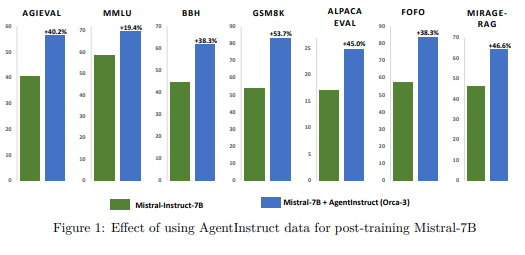
The framework powered Orca and Orca 2, smaller models that reached performance levels previously seen only in much larger systems. Microsoft's research noted that successful use of synthetic data requires significant human effort in curation and filtering.
Related Article: The Subtle Signals That AI Is Going Off TrackFor enterprise teams building, procuring or validating AI systems, there are a few takeaways regarding model collapse.
First, vendor vetting should probe the origins of training data, as model performance specs alone don’t cut it. Organizations need to ask how training datasets were assembled, how synthetic data was incorporated and what guardrails exist to detect contamination and cap it.
Second, the feedback loop for human review is more important than you might think. AI systems that generate content used in downstream decisions or knowledge bases can contaminate any future model trained on that content. Errors introduced by today's AI become training data for tomorrow's models.
And as always, organizations that maintain proprietary datasets, such as customer communications, internal documentation and domain expert annotations, have a long-term advantage. That data represents the kind of high-entropy, human-generated content that future model training will increasingly depend on as the open web becomes less reliable as a source.
Partially, but it depends on the severity of the degradation. In early stages, when the model begins losing information at the edges of its training distribution but still performs well on common tasks, the model can recover some of that lost ground through retraining or fine-tuning or verified human data.
Advanced model collapse is not reversible through fine-tuning alone, and some models may need to be retrained from scratch.
Yes, model collapse affects visual models, though it occurs differently. In image generation, it presents as amplified visual artifacts. For example, if a model generates slightly incorrect hands, subsequent generations trained on those images can cause the concept of a "hand" to degrade into a distorted blob.