News
Research Report
The AI Transformation 100: Concrete Ideas for Fixing How We Work

Anthropic launched Claude Sonnet 5 on Tuesday, an AI model built for agentic tasks such as planning, tool use and autonomous operation.
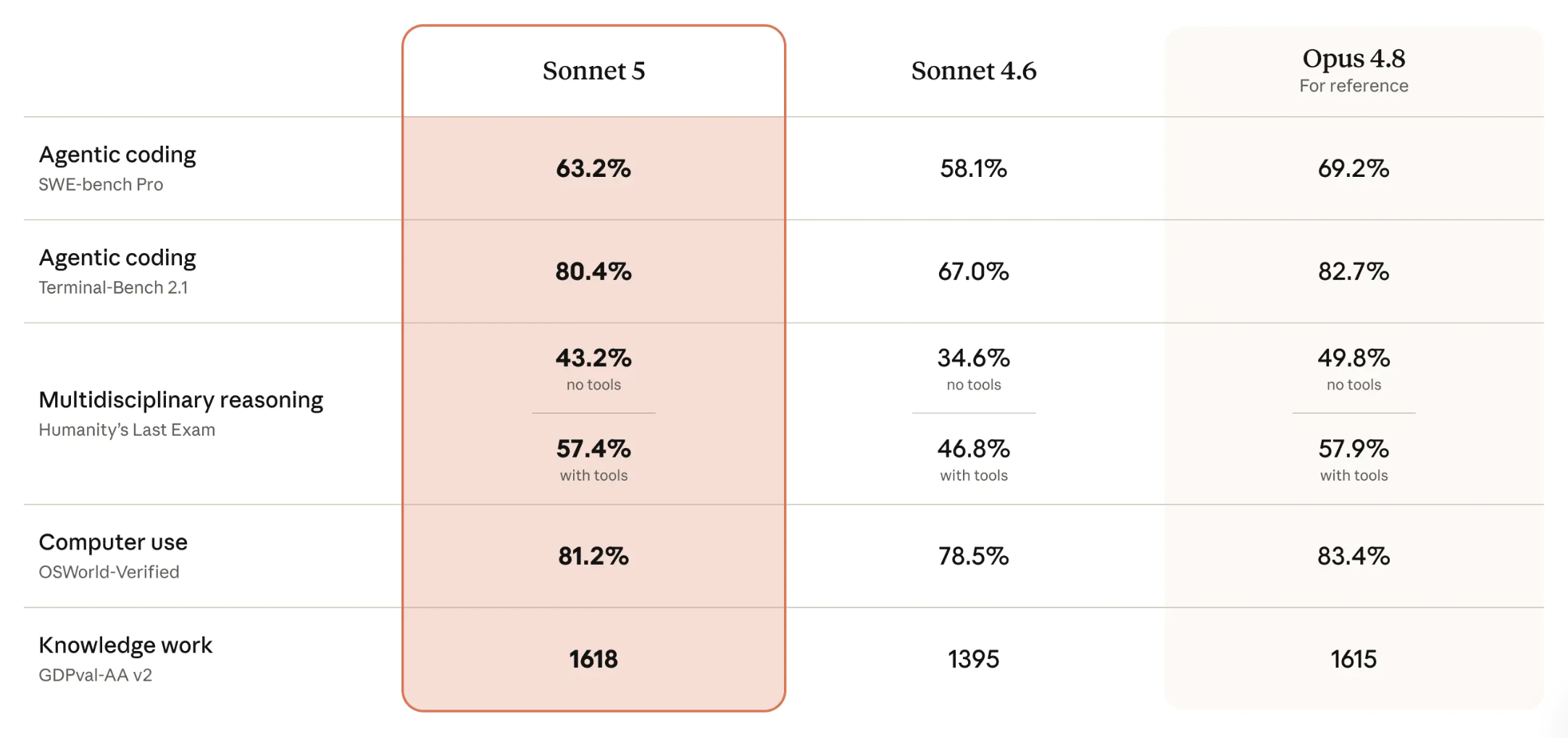
According to the company, Sonnet 5 approaches the performance of its higher-priced Opus 4.8 model while improving on Sonnet 4.6 in reasoning, coding and knowledge work.
According to Anthropic, Claude Sonnet 5 offers:
| Capability | How It Works |
|---|---|
| Agentic planning | Autonomous multi-step task planning and execution |
| Tool use | Operates browsers, terminals and external tools |
| Enhanced coding performance | Aims to narrow the gap with Opus 4.8 in code tasks |
| Safety improvements | Lower hallucination and sycophancy rates than Sonnet 4.6 |
| Introductory pricing | $2/M input, $10/M output tokens through Aug. 31, 2026 |
According to Anthropic, Sonnet 5 can plan, use tools such as browsers and terminals and run autonomously at a level that previously required larger, more expensive Opus-class models.
Compared to Claude Sonnet 4.6, Anthropic said Sonnet 5 delivers stronger performance across reasoning, tool use, coding, agentic search, computer use and knowledge work. Early testers found the model better able to continue work that earlier Sonnet models might leave unfinished and check its own output without being explicitly prompted.
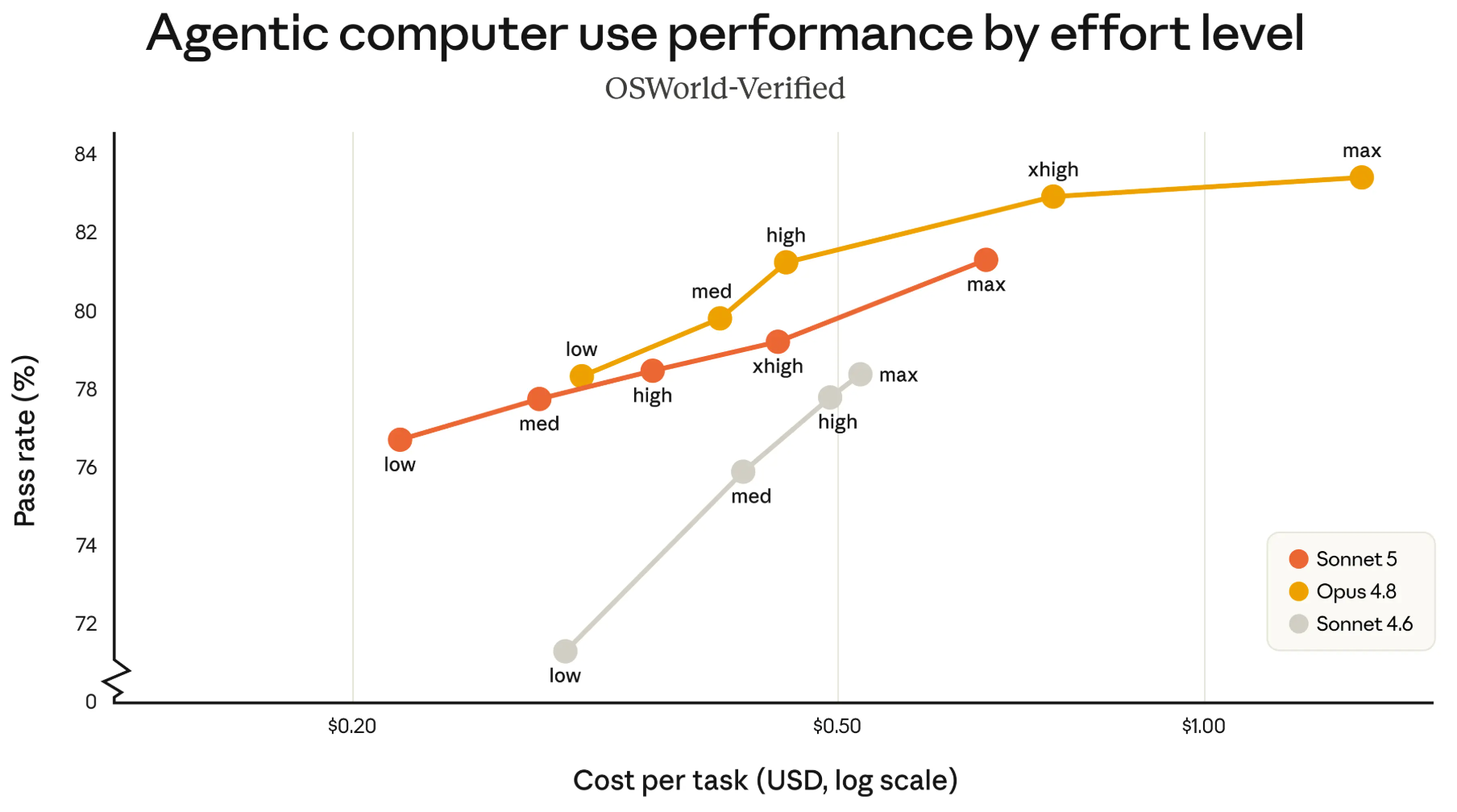
Opus 4.8 remains the higher-accuracy choice for demanding agentic tasks, but Sonnet 5 gives users a cheaper model with much stronger capabilities than the previous Sonnet generation.
Sonnet 5 reportedly improves on Sonnet 4.6 in several safety areas, including:
The model showed somewhat stronger cybersecurity ability than Sonnet 4.6 but remained well below Opus 4.8 and Mythos 5 on dangerous cyber tasks.
Block Quote: Claude Sonnet 5 gives our agents a strong execution layer for multi-step software engineering work. It handles sustained coding, tool use, and debugging well across messy technical contexts, and has been especially useful for workflows where follow-through and technical grounding matter. — Zimu Li, member of technical staff, Factory
Sonnet 5 is available across all Claude plans, Claude Code and the Claude Platform, with introductory API pricing of $2 per million input tokens and $10 per million output tokens through Aug. 31, after which the price will be $3 per million input tokens and $15 per million output tokens.
Opus 4.8, by comparison, costs $5 per million input tokens and $25 per million output.
Anthropic has had a number of capital-raising campaigns across 2025 and 2026, including:
Revenue scaled from roughly $1 billion in annualized run rate in January 2025 to about $20 billion by early March 2026, per Bloomberg. Claude Code alone exceeded $2.5 billion in run-rate revenue by February 2026.
On the product front, Google opened Workspace to Claude in April 2025, Apple integrated the Claude Agent SDK into Xcode 26.3 in February 2026 and Anthropic launched Managed Agents and a Claude Design tool in April 2026. Infrastructure deals included a multi-billion dollar TPU agreement with Google for up to one million Tensor Processing Units.
Not all momentum has gone uncontested, however. In early March 2026, the State, Treasury and HHS departments directed staff to stop using Claude after a dispute over military-use guardrails, and CEO Dario Amodei for pursuing the same Pentagon contract without equivalent safety conditions.