Editorial
Guide
Is AI Making Your Organization More Productive or More Dependent?


Agentic AI is not a feature rollout. It is an autonomous system that reads, reasons, decides and acts on behalf of your business. The bar for who gets to build it should reflect that reality.
Some organizations are ignoring this to cut costs. They are handing powerful AI tooling to whoever raises their hand first and calling it innovation. That is not a strategy. That is deferred liability.
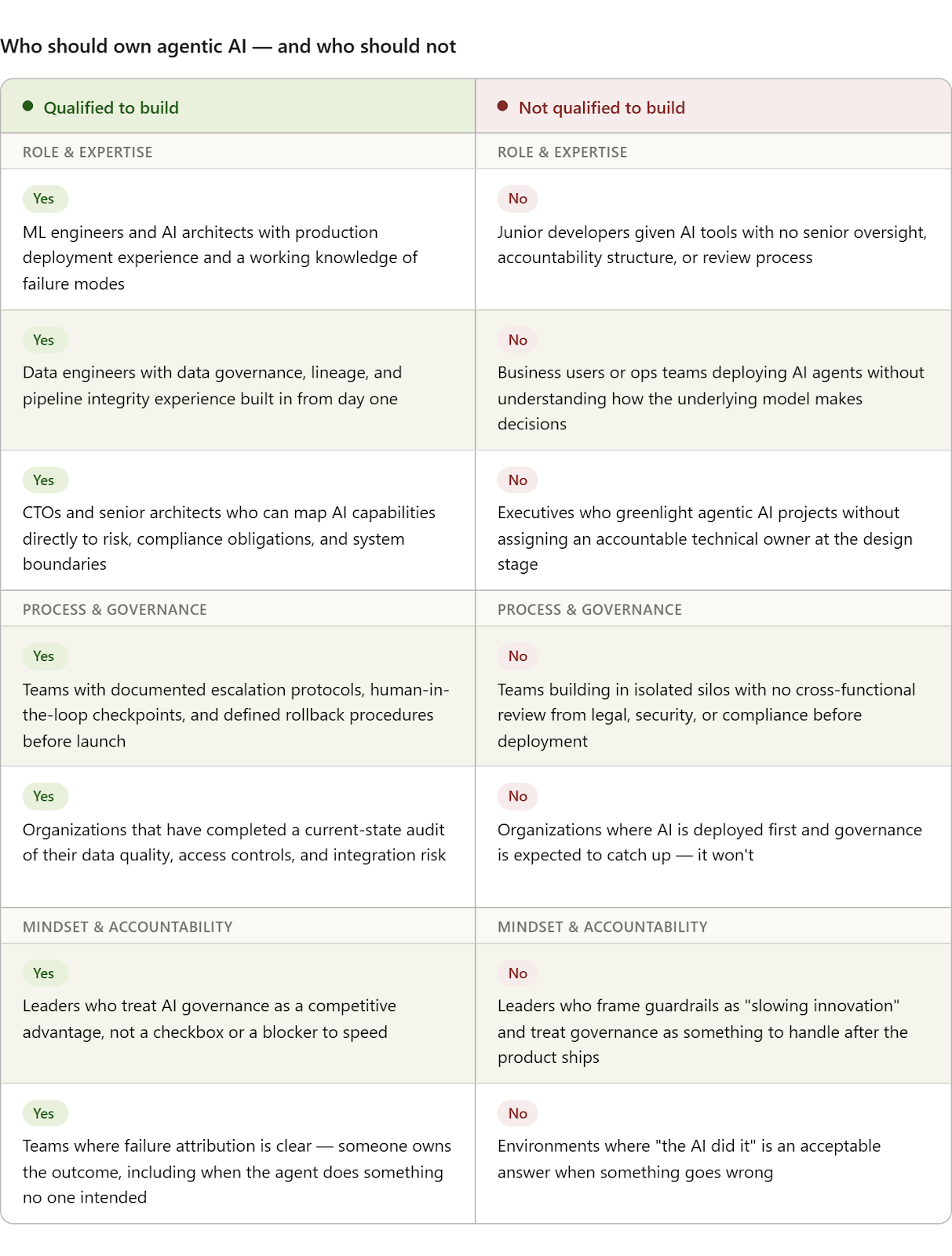
Qualified does not mean someone who watches AI tutorials on YouTube. It means someone who has operated at the intersection of systems design, data integrity and risk management and knows what can break.
ML engineers with production deployment experience. Data engineers who have built pipelines with governance baked in from the start. CTOs and senior architects who can read an agent's decision tree and immediately identify where it diverges from what the business actually intends. These are the people who belong in the design room on day one.
Equally important: organizations that have done the internal audit first. Before a single agent touches a live workflow, the team should be able to answer three questions.
If those answers do not exist on paper, the organization is not ready.
Related Article: AI Compliance Audit Checklist: What to Expect & How to Prepare
The danger is not incompetence. Most people being handed AI tools are smart and motivated. The danger is structural.
Junior developers without oversight. Business operators who understand the outcome they want but not the model producing it. Executive sponsors who greenlight projects and disappear before governance is defined. These are not failures of character. They are failures of organizational design.
The most common pattern is also the most dangerous: deploy fast, govern later. It sounds practical. In practice, it means launching a system that makes consequential decisions with no accountability structure, no rollback plan and no audit trail. When something goes wrong, and inevitably something will, no one knows who owns it.
Qualified builders treat guardrails as architecture, not afterthought. They define human-in-the-loop checkpoints before they write the first prompt. They document what the agent should never do as rigorously as what it should do. They have cross-functional sign-off from legal, security and compliance before anything touches production.
The organizations getting this right are not moving slower, they are moving with more precision — and this distinction matters more every quarter.
 Learn how you can join our contributor community.

Catherine Brinkman is an AI strategist, executive trainer and keynote speaker based in Columbus, Ohio.
She is the founder of Boundary Labs, an AI decision governance platform where she hosts The CatBot AI Podcast, advises on growth strategy and sources capital from Seed through Series C.