News Analysis
Guide
Is AI Making Your Organization More Productive or More Dependent?
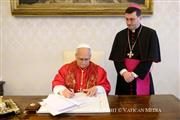

Artificial intelligence has rapidly evolved from a technical and business issue into a broader societal debate that involves labor, governance, truth, human identity and institutional power. Now, the Vatican is speaking up.
Pope Leo XIV recently released his first encyclical focused entirely on safeguarding human dignity in the age of AI, appearing publicly alongside Anthropic cofounder Christopher Olah during the document’s presentation. The event centers the Catholic Church as a growing moral voice in debates surrounding AI development, regulation and social impact.
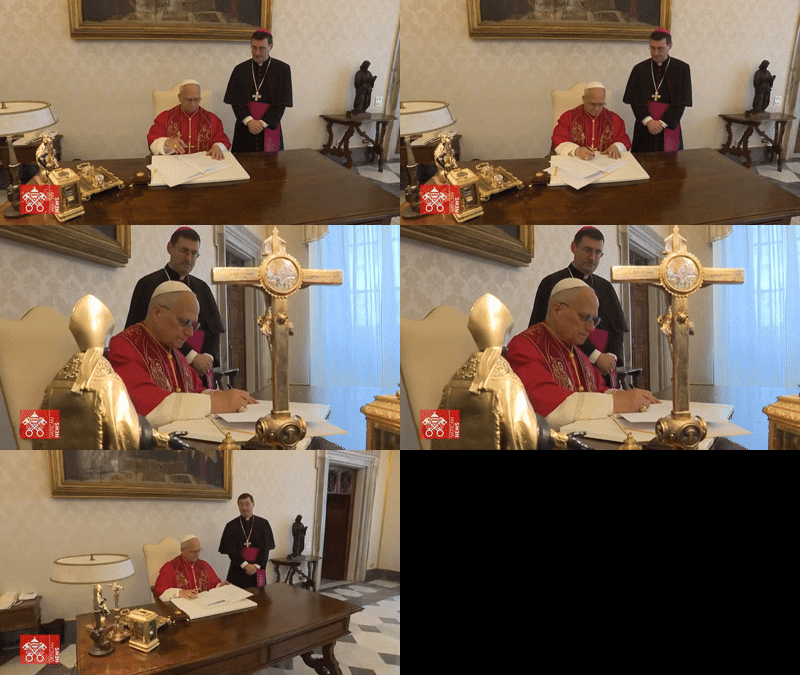
Pope Leo XIV made AI the defining subject of his first encyclical, Magnifica humanitas — a formal papal letter addressing major moral and societal issues. The move appears to indicate that the Vatican views AI not simply as a technological development, but as a civilizational issue with profound implications for labor, human dignity, truth and social stability. Released on Memorial Day, May 25, the encyclical letter focuses on safeguarding humanity during what the Pope repeatedly described as a transformative technological era comparable in significance to the Industrial Revolution.
In the encyclical, Leo XIV wrote that “It has become increasingly evident how rapidly and profoundly digitalization, artificial intelligence (AI) and robotics are transforming our world.”
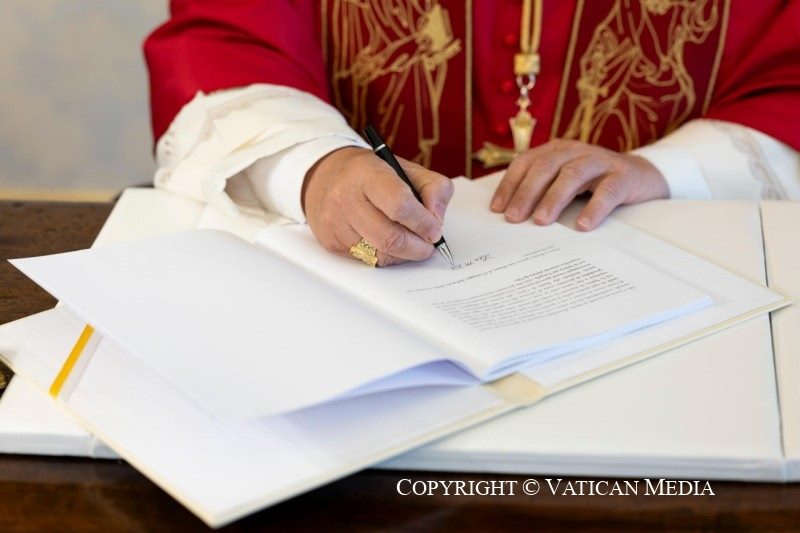
The decision to center his first major papal document on AI instead of more traditional Church priorities such as poverty, migration or internal reform immediately distinguished Leo XIV’s papacy. The move also reinforced comments he had made previously warning that AI systems could interfere with human relationships, distort information ecosystems and gradually reduce people into what he once described as “passive consumers of unthought thoughts.”
Related Article: 3 Principles to Prioritize Ethics in AI
The encyclical’s release alongside Anthropic’s Christopher Olah further stressed the Vatican’s intention to engage directly with the AI industry rather than comment from a distance. During the presentation, Leo XIV openly thanked Olah and stated that the Church wanted to “walk together” with researchers and civil society to help guide humanity through the rise of artificial intelligence.
The Pope’s approach also carries historical significance through its connection to Rerum novarum, the landmark 1891 encyclical issued by Pope Leo XIII during the Industrial Revolution. That document became foundational to modern Catholic social teaching by addressing worker exploitation, industrial capitalism and the social disruption caused by mechanization.
Vatican officials and Leo XIV himself have repeatedly drawn parallels between that era and the current AI transition, framing AI as a new industrial revolution capable of reshaping labor, communication and human identity on a global scale.
The Vatican’s growing involvement in AI discussions did not emerge suddenly. Over the past several years, Church leaders have increasingly framed AI as a technology capable of reshaping labor, communication, relationships and even human identity itself.
Concerns around automation, surveillance systems, synthetic media, misinformation and autonomous weapons gradually pushed AI beyond the boundaries of a purely technical or business issue and into what the Vatican describes as a broader moral and humanitarian challenge. The encyclical itself repeatedly frames AI as part of an unprecedented concentration of technological capability. As Pope Leo XIV wrote, “Never has humanity had such power over itself.”
Among the Vatican’s central concerns is the possibility that AI systems could weaken authentic human interaction while simultaneously concentrating power within governments and corporations. Pope Leo XIV warned that AI-generated information and synthetic relationships may gradually alter how people understand truth, creativity and human connection. In previous remarks, he cautioned against what he described as becoming "passive consumers of unthought thoughts."
The Vatican has also made itself a participant in broader digital ethics discussions, rather than remain solely focused on traditional theological matters. Under both Pope Francis and Pope Leo XIV, Church officials have engaged in conversations surrounding algorithmic accountability, AI governance and the social consequences of emerging technologies. Earlier Vatican initiatives, including the Rome Call for AI Ethics, attempted to establish ethical principles centered on transparency, accountability and human dignity in AI development.
When GenAI became capable of producing human-like conversation, synthetic media and increasingly autonomous decision-making, the technology began affecting areas that have been traditionally associated with philosophy, labor ethics and social stability rather than software alone. For the Vatican, AI increasingly became not just a question of what machines can do, but of how societies should preserve human dignity, agency and moral responsibility in a world where machines may influence so much.
One of the more significant aspects of the Vatican’s AI announcement was the public involvement of Anthropic’s Christopher Olah during the presentation. At a symbolic level, the collaboration reflects a growing recognition that AI development increasingly intersects with questions surrounding ethics, governance and human values.
Olah himself emphasized the importance of involving institutions outside the technology sector, stating during the presentation that “the Church’s voice is especially needed” in discussions surrounding labor displacement, human flourishing and the societal consequences of increasingly autonomous systems.
The questions posed by AI are bigger than the AI community. We urgently need the world – religions, civil society, academics, governments – to participate in creating a positive outcome.
— Chris Olah (@ch402) May 18, 2026
I'm glad the Catholic Church is engaging, and honored to speak at the presentation. https://t.co/l3BnKr3UZH
Anthropic’s presence was particularly notable because the business has consistently positioned itself around AI safety. Unlike some AI businesses that focus heavily on rapid commercial deployment or consumer-scale growth, Anthropic has publicly emphasized risk mitigation, constitutional AI models and the importance of building systems that remain understandable and controllable as capabilities advance. That positioning likely made the business a more natural fit for Vatican discussions centered on moral responsibility and long-term societal consequences.
The Vatican’s decision to involve Anthropic rather than another major AI business may also reflect the Church’s broader concerns about balancing technological innovation with ethical oversight. The business has already publicly faced difficult questions surrounding AI deployment, including debate over the use of frontier AI systems in defense, intelligence and surveillance contexts. Those tensions closely parallel several of the encyclical’s broader warnings surrounding autonomous systems and concentrated technological power. Throughout Magnifica humanitas, Pope Leo XIV repeatedly emphasized the importance of preserving human dignity and moral agency while avoiding situations where technological systems begin operating beyond meaningful human accountability.
During the Vatican presentation, Olah acknowledged that commercial competition, geopolitical pressure and ambition can sometimes conflict with responsible development. He argued that “if we want this technology to go well, it is enormously important that there be people outside those incentives.”
Related Article: ‘AI Psychosis’ Is Real, Experts Say — and It’s Getting Worse
At the center of Magnifica humanitas is the argument that artificial intelligence must remain subordinate to human dignity rather than becoming a system that gradually reshapes human behavior, labor and relationships around the priorities of machines or institutions.
Throughout the encyclical, Pope Leo XIV repeatedly warned against treating people as data points, behavioral patterns or passive recipients of algorithmically generated information. Instead, the document frames human beings as morally responsible individuals whose value cannot be reduced to efficiency metrics or automated decision-making processes.
A major theme running through the encyclical involves the growing concentration of technological power within a relatively small number of governments and AI businesses. Leo XIV warned that advanced AI systems could deepen global inequality, centralize influence over information and weaken individual autonomy if ethical oversight fails to keep pace with technological capability. The document repeatedly calls for stronger governance structures and regulatory frameworks designed to ensure AI development remains accountable to broader human interests rather than narrow commercial or political incentives.
According to Leo XIV, societies must avoid “Babel syndrome,” which he describes as “the idolatry of profit that sacrifices the weak” while reducing people to systems focused primarily on efficiency and control.
Labor displacement also occupies a significant portion of the encyclical, particularly through parallels drawn to the Industrial Revolution and Pope Leo XIII’s Rerum novarum. The Vatican argues that AI-driven automation could transform employment and economic stability at unprecedented speed if businesses and governments prioritize efficiency without considering long-term human consequences. Rather than condemning automation itself, the encyclical focuses more heavily on protecting workers and preserving human agency.
It also warns against autonomous warfare systems and unchecked technological ambition, which Leo XIV compares to a modern “Tower of Babel.” The Vatican argued that increasingly autonomous systems could weaken moral accountability while encouraging societies to pursue capability and control without adequately considering the human consequences.
Leo XIV repeatedly distinguishes between human intelligence and machine simulation, arguing that AI may imitate reasoning and creativity without possessing consciousness, wisdom or moral understanding.
Taken together, the encyclical presents AI not simply as a software or infrastructure issue, but as a broader philosophical challenge involving labor, governance, truth, morality and the future relationship between humanity and increasingly autonomous technological systems.
The Vatican’s direct intervention in the AI debate immediately generated mixed reactions. Many AI safety advocates welcomed the encyclical’s emphasis on accountability and human oversight, particularly as concerns surrounding autonomous systems, misinformation and labor disruption continue to rise.
Some researchers viewed the Vatican’s involvement as further evidence that AI development now carries societal consequences that are large enough to demand participation from institutions far outside the technology sector itself. Among the more supportive responses was AI researcher Yoshua Bengio, who praised the Vatican’s willingness to engage directly in AI ethics discussions.
“Like nuclear energy, AI must be at the service of all and of the common good. Decisions about technology must never be separated from conscience and responsibility.”
— Yoshua Bengio (@Yoshua_Bengio) May 25, 2026
I agree with this sentiment by @Pontifex. The Vatican and other global institutions can and must play a role in…
Bengio said he views the Church’s involvement as a sign that conversations surrounding AI governance are increasingly extending beyond regulators and technology businesses and into broader societal institutions.
At the same time, critics questioned whether religious institutions possess the technical expertise necessary to meaningfully contribute to AI governance discussions, arguing that effective AI regulation requires highly specialized technical understanding alongside broader ethical oversight.
The encyclical also intensified ongoing debate over whether ethical principles alone can realistically constrain AI markets that are driven by intense competition, geopolitical pressure and massive financial incentives. Critics continue arguing that competitive pressures still reward rapid capability expansion even when governance structures remain incomplete, a concern echoed by Christopher Olah during the Vatican presentation when he warned about the influence of commercial and geopolitical incentives on AI development.
Others responded more cautiously to the Vatican’s proposals surrounding oversight and regulation. Former White House AI adviser David Sacks reportedly agreed with many of the Pope’s concerns surrounding concentrated technological power and AI risk, while also warning that aggressive government-led AI regulation could itself create new forms of centralized control and surveillance.
Christopher Olah’s participation during the Vatican presentation also reinforced the growing overlap between frontier AI research and broader governance discussions. Olah warned against placing unquestioned trust in AI businesses themselves and described the societal consequences of AI-driven labor disruption as a “moral imperative of historic proportions.”
Although the Vatican holds no formal regulatory authority over AI, its influence stems from a different kind of power: moral authority operating across global political, cultural and religious boundaries.
The Vatican’s involvement may increase pressure on international AI policy discussions by adding another highly visible institutional voice to ongoing debates over regulation, accountability and human oversight. Governments and regulatory bodies already struggle to balance innovation with concerns surrounding misinformation, surveillance, labor displacement and autonomous systems. The Church’s intervention broadens that conversation further by framing AI governance not simply as a matter of compliance or technical safety, but as a question involving human dignity and moral responsibility.
The Vatican’s outreach may also resonate with people who are already uneasy about AI’s growing role in education, employment, media and everyday communication. By elevating those concerns within one of the world’s largest religious institutions, the Church may help normalize wider public scrutiny of AI systems beyond technical and enterprise circles alone.
At the same time, the Vatican’s position could create tension with some technology businesses and governments pursuing aggressive AI deployment strategies. While many AI businesses publicly endorse responsible AI principles, competitive pressure surrounding frontier model development continues encouraging rapid capability expansion and commercialization.
Related Article: Why AI Needs Cultural Governance
Underlying Magnifica humanitas is the argument that AI represents far more than a software or productivity issue. Throughout the encyclical, Pope Leo XIV repeatedly framed AI as a technology that is capable of reshaping how people understand work, creativity, truth, identity and human relationships themselves. Rather than focusing solely on technical risks or regulatory policy, the document treats AI as part of a larger cultural transformation.
Leo XIV summarized this concern directly, stating that “In the era of artificial intelligence, when human dignity is threatened by new forms of dehumanization, ours is the pressing duty to remain profoundly human.”
Labor remains one of the Vatican’s central concerns, particularly as generative AI systems begin affecting creative professions, knowledge work and communication-based industries once considered relatively insulated from automation. The encyclical warns that economic systems driven primarily by efficiency and optimization could gradually erode human agency if workers become increasingly subordinate to algorithmic systems or disposable within highly automated labor structures.
Questions surrounding truth and human perception also occupy a significant role within the document. As AI-generated media becomes increasingly difficult to distinguish from human communication, the Vatican warns that societies may enter a period where information itself becomes more unstable and easier to manipulate.
The document also reflects on synthetic relationships and emotional dependency on AI systems. Leo XIV cautioned that increasingly human-like conversational systems may blur the distinction between authentic human connection and machine simulation, potentially altering how people experience companionship and social interaction.
Olah added during the Vatican presentation that “computer scientists are not the people to handle these questions,” arguing that AI’s societal implications increasingly require participation from philosophy, religion and broader civil society.
What was once viewed primarily as a technology industry issue is increasingly becoming a societal conversation involving governments, educators, labor advocates, ethicists and religious institutions attempting to understand how increasingly autonomous systems may reshape human life itself.