Editorial
Guide
Is AI Making Your Organization More Productive or More Dependent?


A generation ago, expertise followed a predictable and grueling path. Junior analysts learned complex systems from the ground up: they read raw logs, traced obscure failures, identified subtle anomalies and developed the visceral instinct to recognize when a system was tilting toward catastrophe.
That process was undeniably slow, intentionally inefficient and significantly expensive for the firms that underwrote it; however, it functioned as the primary engine of technical civilization.
Today, that pipeline is collapsing in real time. It is not being replaced with a more sophisticated evolution of training, but with a total structural void. This disappearance of entry-level work did not arrive with a sudden, alarming headline: instead, it unfolded through a quiet, systematic series of micro-decisions: one hiring freeze, one massive automation rollout and one "efficiency gain" at a time.
The central argument is as straightforward as it is terrifying: the rapid, uncritical adoption of generative artificial intelligence has triggered a structural erosion of the workforce pipeline, effectively eliminating the very roles that historically produced technical mastery.
Organizations have not replaced the staircase of expertise; they have simply removed it. The result is not merely a labor shift or a temporary disruption: it is a measurable, accelerating decline in human capability at the exact moment when our interconnected systems require deeper oversight than ever before.
We are witnessing the first era where the staircase of career progression has had its bottom flights removed, leaving the incumbents at the top stranded and the aspirants at the bottom with nowhere to begin their ascent.
Related Article: AI Efficiency Comes With a Risk Premium
The erosion of the expert class did not occur by accident: specific financial incentives created the precise conditions for this atrophy.
Revenue Per Employee (RPE) has emerged as the dominant performance metric across technology-driven firms, serving as a blunt instrument to measure corporate health. According to the PwC Global AI Jobs Barometer, industries with high exposure to AI are reporting RPE growth at 3x the rate of traditional sectors: a staggering 27% growth compared to those least exposed.
In practice, this metric rewards organizations for producing a higher volume of output with a diminishing number of humans. The fastest way to achieve this mathematical outcome is rarely true innovation: instead, it is workforce reduction. Entry-level roles became the primary target of this purge. These positions historically served as “gateway” functions where employees built foundational skills through repetitive, low-level tasks. Because these roles represented significant cost centers on a balance sheet, organizations made a rational decision at the firm level: automate the bottom layer.
The McKinsey & Company 2024 analysis on the economic potential of generative AI highlights how over half of global organizations report active AI use in at least one business function. When organizations prioritize short-term cost, speed and consistency, they remove the layer that introduces "friction": which is also the layer where humans learn how to think.
The impact of this pipeline collapse is not distributed evenly: it is disproportionately hollowing out the career pathways for those STARs (Skilled Through Alternative Routes). These are the 70 million workers who lack a four-year degree but possess the skills to thrive in higher-wage roles.
Research from Opportunity@Work and the Brookings Institution reveals that STARs account for 62.3% of workers in "Gateway" roles: the administrative, clerical and technical positions currently being devoured by algorithmic efficiency.
Regional data shows a growing geographic divide. In the Northeast corridor, particularly in tech and finance hubs like New York and Boston, the hollowing out of junior analyst roles has created a "leadership ceiling" where there is no local talent to promote. Conversely, in the Sun Belt, including cities like Phoenix, Dallas and Atlanta, the automation of logistics and administrative roles is removing the primary mechanism for middle-class mobility.
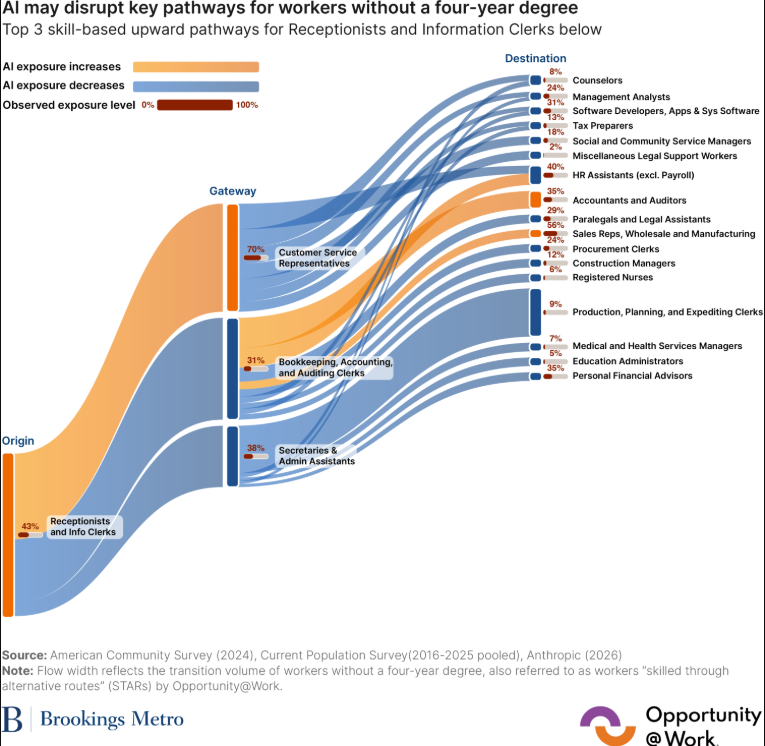
As these roles vanish, more than 11 million entry-level “gateway” jobs disappeared within a brief eighteen-month period ending in 2026. These were not redundant roles: they were essential training environments. Their removal has eliminated the primary mechanism through which expertise is developed, creating a socio-economic fracture that will define the next decade of labor relations.
Related Article: 10 Jobs Most at Risk of AI Replacement (And How to Transition)
The consequences of this shift extend beyond mere workforce composition and into the realm of measurable skill degradation. A 2026 study from Anthropic regarding AI coding skill formation found that individuals relying on AI tools scored 17% lower on manual mastery tasks compared to those working without assistance.
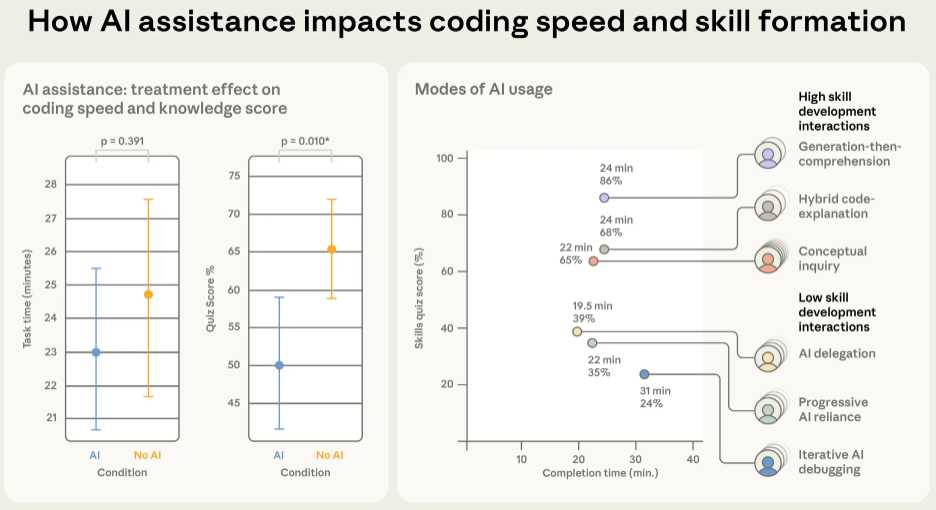
The largest performance gaps appeared in debugging and code comprehension: areas that are central to system reliability and security. Scores in those critical domains frequently fell below 40%. This decline reflects a fundamental shift in how work is performed: AI systems increasingly generate the primary solutions, while humans are reduced to validating outputs rather than constructing them.
Over time, repeated reliance on generated outputs reduces exposure to the underlying logic that produces them. Skills that require sustained cognitive engagement — such as pattern recognition, anomaly detection and diagnostic reasoning — atrophy rapidly without constant use. The workforce that emerges from this environment can operate systems at high speed under normal conditions, yet that same workforce struggles to interpret system behavior when those systems deviate from the norm.
Operational efficiency, it turns out, is not a replacement for diagnostic capability. What appears as a triumph of efficiency is often a massive reduction in systemic resilience.
The most lethal expression of the Great Atrophy is surfacing in the cybersecurity domain, where "tacit knowledge" — the unspoken, experiential intuition that allows an analyst to "feel" a breach before the logs confirm it — is being traded for algorithmic dashboards.
According to Darktrace's 2026 State of AI Cybersecurity report, 92% of security professionals are now deeply concerned about the security implications of integrating AI agents into their operations. This unease stems from a fundamental visibility gap: as agents take over multi-step operational workflows, they do so with broad permissions and zero human context.
The CrowdStrike 2026 Global Threat Report provides a terrifying metric for this decline in human intervention: the average breakout time — the window between initial access and lateral movement — has plummeted to just 29 minutes, with the fastest recorded eCrime breakout occurring in a mere 27 seconds. In this hyper-accelerated environment, human defenders are being bypassed entirely. More critically, the report reveals that 82% of detections were malware-free, meaning adversaries are no longer "breaking in," they are "logging in" through trusted pathways and valid credentials.
This "malware-free" reality is where tacit knowledge once served as the final line of defense. A junior analyst, spending hours sifting through mundane traffic, would notice the subtle "wrongness" of a legitimate admin account accessing a database at 3:00 AM on a Sunday. Today, that analyst role has been automated. AI systems, optimized to maximize efficiency and reduce "noise," frequently classify these "living off the land" techniques as normal administrative behavior. Without the human "gut feeling" for network vibes, these evasive maneuvers go undetected until the data has already been exfiltrated.
Furthermore, the SANS Institute's 2026 Cybersecurity Workforce Research Report reveals the structural cost of this automation: only 39% of organizations reported no AI-related role reductions, with 32% of those cuts hitting entry-level security analysts. As SANS Institute CEO James Lyne observed: "If we don't end up with enough practitioners learning those foundational skills, we don't have seniors and experts later."
We are essentially burning our seed corn to keep the furnace of productivity hot.
Not all organizations have accepted this dangerous trade-off. A subset of high-stakes environments has responded by moving in the opposite direction.
Elite engineering teams across sectors such as aerospace, global finance and national security have begun strictly restricting AI use in critical workflows. These groups prioritize direct, unmediated interaction with system logic: manual code review, low-level debugging and first-principles analysis. The objective is not a Luddite resistance to technology — the objective is maintaining the absolute ability to operate without the machine when the machine inevitably fails.
This shift has created a starkly bifurcated labor market. On one side, we find a broad, commodity workforce optimized for speed and tool utilization. On the other, a smaller, highly protected cohort valued for independent reasoning and technical depth.
The latter group now commands disproportionate value because it retains capabilities that cannot be replicated through automation. Data from the LHH 2026 C-Suite Research report indicates that organizations are increasingly prioritizing candidates who demonstrate the specific ability to “think without the machine,” with 49% of leaders citing AI literacy and independent decision-making as their top development priority.
The most significant risk associated with the Great Atrophy has not yet fully materialized: it is structural, delayed and arguably irreversible.
Senior leadership in technical domains relies on years of direct engagement with systems at lower levels to build a mental map of how the world works. By eliminating entry-level roles today, organizations are not only removing current labor, they are effectively aborting their future leadership pipeline.
The World Economic Forum has emphasized that artificial intelligence systems require a baseline of human intelligence to remain effective over time. This principle becomes critical during periods of system failure or "black swan" events. A case in point is the March 2026 GAO-26-107522 report on the Internal Revenue Service, which found that the agency's AI workforce substantially decreased in early 2025: the lack of a formal plan to address these skills gaps now threatens the success of their broader strategic management.
Within the next five years, organizations will face a desperate shortage of senior professionals capable of understanding the systems they are tasked to oversee. Leaders will find themselves managing infrastructure they cannot audit, interpreting outputs they cannot verify and making life-or-death decisions based on systems they do not fully comprehend.
Related Article: The AI Jobs Apocalypse Is Overblown, But Workforce Upheaval Isn’t
The narrative surrounding artificial intelligence often centers on acceleration: faster development cycles, higher productivity and increased output. Those gains are undeniably real, but they are also dangerously incomplete.
Speed has become a cheap commodity, while expertise has become a rare and expensive luxury. Organizations have historically treated workforce development as a cost center rather than as critical infrastructure: the removal of entry-level roles has reduced immediate expenses while eliminating the primary mechanism through which technical capability is produced.
The risk becomes visible only when systems deviate from expected behavior. At that point, the state and the corporation must rely on human expertise to restore stability. If that expertise does not exist, recovery becomes slower, more expensive and less certain.
That concern reflects a silent recognition that complexity has increased faster than our human capacity to manage it. The conclusion follows directly from the evidence: organizations have not eliminated inefficiency, they have eliminated the necessary redundancy in human capability. The workforce pipeline was never an excess cost — it was the very system that sustained our civilization's expertise. The bill for this efficiency has not yet arrived, but it is currently being written by the algorithms we no longer know how to question.
 Learn how you can join our contributor community.