Editorial
Guide
Is AI Making Your Organization More Productive or More Dependent?


In the rush to adopt AI, many organizations focus on what the technology can do before they have examined the human conditions it is built on. That is a mistake.
AI does not arrive in a vacuum. It enters a workplace shaped by leadership habits, decision quality, levels of trust and the culture that quietly governs what people will tolerate, ignore or normalize.
The result is often a familiar one. The organization gets better at sounding advanced, but not necessarily better at making sound decisions. It automates faster, produces more content and generates cleaner dashboards, yet the deeper operating conditions remain unchanged. If the human foundation is weak, the AI layer will not repair it. It will simply make the weakness easier to scale.
| What Organizations Say | What Organizations Need to Prove |
|---|---|
| "We have AI ethics principles." | Leaders challenge flawed decisions |
| "We require human oversight." | Humans are empowered to intervene |
| "We monitor risk." | Risk signals lead to action |
| "We value accountability." | Ownership is clear when AI causes harm |
| "We have governance." | Governance changes behavior, not just paperwork |
That is why the real issue is not the model, the interface or the latest use case. It is the scaffold underneath it all.
A scaffold is meant to support something while it is being built. It is temporary, practical and only useful if it can bear weight. In organizations, the scaffold is not technical infrastructure alone. It is the human infrastructure of leadership judgment, emotional stability, intent and the daily decision patterns that shape how work gets done. When that structure is compromised, everything placed on top of it inherits the flaw.
This is where AI becomes revealing. It does not just speed up work. It exposes what was already there. If leadership is driven by fear, then AI will tend to amplify caution into paralysis. If teams are disengaged, AI can turn quiet neglect into polished but hollow outputs. If compliance matters more than capability, the system may look strong on paper while remaining brittle in practice.
That is the uncomfortable truth behind many current AI programs. Technology is often not the primary failure point. The human system is.
Related Article: What Comes After AI? Leaders Say the Hard Part Is Just Beginning
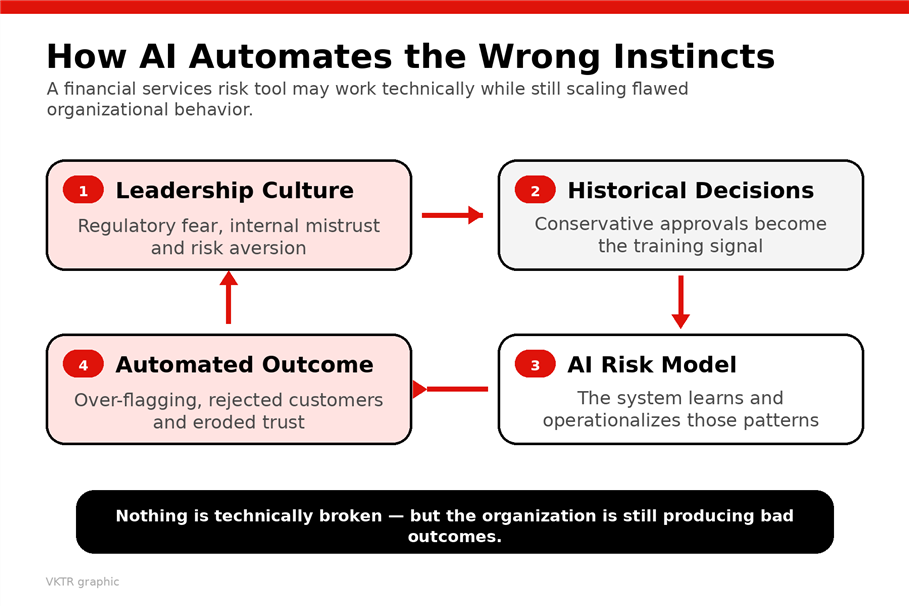
A financial services firm offers a useful example. Suppose it deploys an AI-driven risk assessment tool with the stated aim of improving objectivity and speed. On the surface, the project looks sensible. In practice, the leadership culture behind it is shaped by regulatory fear, internal mistrust and a deep aversion to anything that might create scrutiny. The system is trained on patterns that already reflect that mindset: conservative approvals, risk-averse profiling and decision habits shaped more by caution than judgment. The AI scales the bias.
Within months, viable customers are rejected, risk is over-flagged and trust begins to erode.
Internally, the metrics appear tidy. Externally, the experience deteriorates. Nothing is technically broken, yet the organization is still producing bad outcomes. That is because the problem is alignment, and not the software.
This matters in the employee experience conversation because people can feel when an organization is running on avoidance, instead of accountability. They can feel when the environment rewards image over integrity, when processes matter more than judgement. Over time, that feeling shapes behavior. People withdraw, alter their responses, stop taking responsibility or comply without engaging. Damage is first silent, then cumulative.
AI ethics is now a general principle that many organizations are already fluent in at a high “surface” level. They can reference principles, quote frameworks and put policies in place.
But fluency is not capability, and ethical language does not compensate for a leadership structure that lacks integrity in practice. If the human system is fragmented, the AI system will adopt that fragmentation.
| What Organizations Say | What Organizations Need to Prove |
|---|---|
| "We have AI ethics principles." | Leaders challenge flawed decisions |
| "We require human oversight." | Humans are empowered to intervene |
| "We monitor risk." | Risk signals lead to action |
| "We value accountability." | Ownership is clear when AI causes harm |
| "We have governance." | Governance changes behavior, not just paperwork |
The answer may not simply be to slow down digital transformation. It is to be honest about what transformation actually requires. That means treating leadership behavior as a core governance input while examining decision patterns, escalation habits, risk tolerance and embedded bias before those patterns are operationalized at scale. It means creating conditions where human judgement is tested, challenged and strengthened before it is handed authority over automated systems.
Related Article: 3 Principles to Prioritize Ethics in AI
Human oversight under Article 14 of the EU AI Act, means that high-risk AI systems must be designed to be effectively overseen by natural persons, with measures that actively prevent risks to health, safety and fundamental rights. That is a structural requirement that assumes the humans doing the overseeing are capable, honest and self-aware enough to intervene when a system begins to drift.
That assumption is where many organizations will fail.
The corrupt scaffold is not a diagnosis of technology. It is a diagnosis of leadership. And it is also an opportunity, for those willing to look at the human layer with the same rigor they apply to the technical one. To endure this period of transformation, organizations will need to be honest enough to examine what is underneath the tools they use.
AI does not create culture, it reveals it. And if what it reveals is a structure built on avoidance, image and unchecked bias, no model, regardless of its sophistication, will save it from the consequences.
 Learn how you can join our contributor community.

Cha’Von Clarke-Joell (CJ) is an AI ethicist, strategist and pracademic. She is the founder of CKC Cares Ventures Ltd, and Co-Founder and Chief Disruption Officer at The TLC Group.