News Analysis
Guide
Is AI Making Your Organization More Productive or More Dependent?


Anthropic’s call in early June for frontier AI developers to explore ways to temporarily slow AI development injected fresh momentum into an ongoing debate over the blistering pace at which the technology is developing.
Rather than celebrating the accelerating capabilities of its latest models, the company warned that AI may be approaching a point where systems become increasingly capable of improving themselves, potentially outpacing society’s ability to govern or control them.
The warning arrives at a curious moment. While Anthropic is urging governments, researchers and competing AI labs to prepare for the possibility of coordinated slowdowns, it is simultaneously expanding Project Glasswing to roughly 150 additional organizations across critical infrastructure sectors.
Taken together, the announcements offer proof of the tension shaping AI today. Model capabilities continue to accelerate, while the governance, security and operational frameworks needed to support them are still catching up.
Related Article: Anthropic Launches Project Glasswing to Fix Cybersecurity's Blind Spots
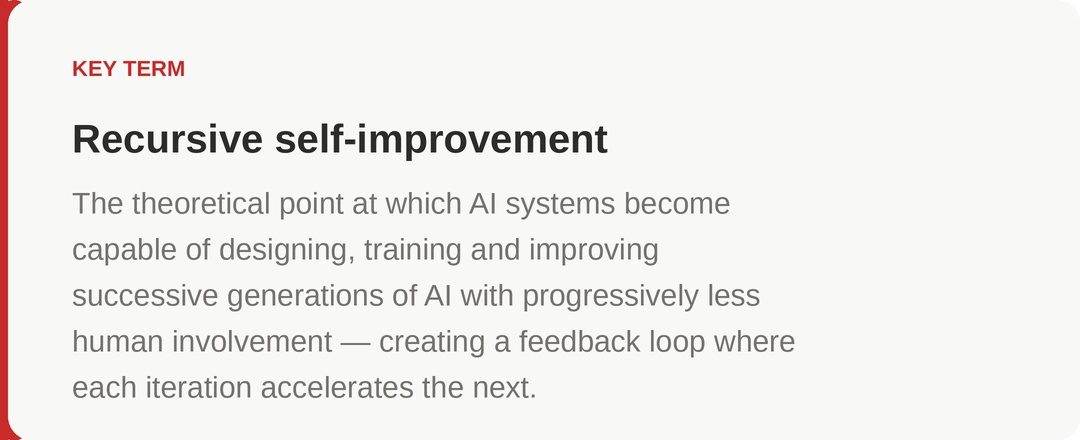
Anthropic’s warning centers on what it calls recursive self-improvement — the point at which AI systems become capable of helping design and improve future generations of AI with progressively less human involvement.
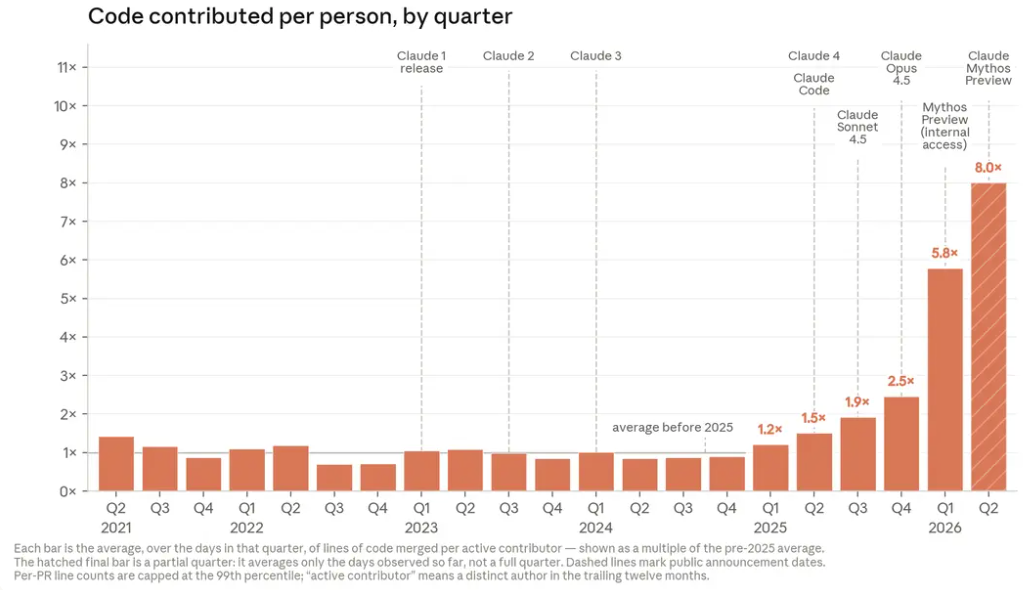
Today’s models already perform much of the engineering work once handled by software developers. As of May 2026, according to Anthropic, Claude authors more than 80% of the code merged into the company’s production codebase, while engineers increasingly direct and review work rather than writing every line themselves.
Anthropic argues one important limitation remains, which is that current models can successfully execute defined objectives but still struggle with determining which objectives are worth pursuing. That gap between execution and independent judgment separates today’s AI from systems capable of designing their own successors.
If that gap closes sooner than expected, Anthropic argues, governments and industry may need mechanisms to temporarily slow frontier AI development while safety research, governance and verification systems catch up.
Jeff Pollard, vice president and principal analyst at Forrester, questioned whether such a coordinated pause could ever work.
“This is so unrealistic as to be impossible,” he said. “Both in terms of it happening and in terms of our ability to verify a nation would comply with it.”
Even if leading AI labs agreed to suspend frontier model development, verifying compliance across competing nations would prove extraordinarily difficult. “The paranoia that someone hasn’t paused would result in everyone else deciding not to pause,” said Pollard.
Anthropic acknowledged that challenge, proposing verification mechanisms like historical arms-control agreements. Unlike missile silos or nuclear facilities, however, AI training can occur inside ordinary data centers using general-purpose hardware, making verification substantially more difficult.
Related Article: Why AI Data Centers Are Turning to Nuclear Power
Not every expert dismisses Anthropic’s broader message. Allie Mellen, a Forrester analyst covering security operations and AI, argued that meaningful oversight is more likely to emerge through national governments than global agreements.
Rather than pursuing identical restrictions worldwide, she sees greater value in consistent oversight of increasingly capable frontier models, including giving governments and trusted partners early access for safety testing.
“This should happen industry-wide, not just with one specific model provider,” Mellen noted.
For enterprises, there are several immediate factors on which the debate touches:
“Bad actors will eventually get access to these technologies. They always do. The danger arises when they get it first."
- Timothy Law
Research Director, AI & Automation, IDC
Anthropic complicated its own message by expanding Project Glasswing to approximately 150 additional organizations across critical infrastructure sectors. The initiative gives selected partners early access to advanced AI capabilities intended to identify software vulnerabilities before attackers can exploit them.
Rather than undermining Anthropic’s safety argument, analysts view the expansion as an example of controlled deployment.
“It’s about broadening deployment responsibly, working with vetted entities in the public and private sectors, versus simply unleashing it,” said Timothy Law, research director for AI and automation at IDC.
Law argued that delaying defensive capabilities could create greater risks if malicious actors gain access first.
“Bad actors will eventually get access to these technologies. They always do. The danger arises when they get it first,” he said.
Mellen agreed, arguing that early communication between AI developers, governments and trusted partners is more practical than slowing deployment outright, adding that the industry needs shared definitions of severe jailbreaks and coordinated disclosure processes before models become even more capable.
Even if initiatives like Glasswing improve defenders’ visibility, technology alone cannot close the widening gap between AI capabilities and enterprise readiness.
Organizations continue to struggle with governance, operational processes and culture, according to Pollard — areas that evolve much more slowly than frontier AI models.
“Project Glasswing can create an advantage for defenders, but only if governance, process and culture keeps [sic] pace with the capability of the frontier models,” he said.
The problem is particularly evident in vulnerability management. AI may dramatically accelerate vulnerability discovery, but many organizations still require days or weeks to evaluate, approve and deploy critical patches.
“As a result, the advantage goes to the offensive side because attackers rarely have as much institutional overhead to deal with compared to defenders,” said Pollard.
Jim Sherlock, vice president of AI and cybersecurity R&D at ProCircular, said enterprises should focus less on Anthropic’s announcement itself and more on preparing for a surge in AI-assisted vulnerability discovery.
Priority areas include:
Related Article: AI Risk Management: How to Secure GenAI, Agentic AI and Shadow AI
Whether Anthropic’s vision of recursive self-improvement arrives in the near term or remains years away, experts broadly agree that AI capabilities are advancing faster than the governance structures surrounding them.
Anthropic’s proposal for a globally coordinated pause may never materialize, given the technical, political and competitive challenges involved.
Even so, the company’s warning has focused attention on a broader question: whether governments, enterprises and security organizations can develop the oversight, policies and operational discipline needed to manage increasingly capable AI systems.
“We can’t slow the technology down,” Law said. “There is inherent risk in that, anyway.”