Editorial
Guide
Is AI Making Your Organization More Productive or More Dependent?


Scaling AI is one of the biggest challenges businesses face today — according to one McKinsey report, nearly two-thirds of organizations have yet to scale AI across their enterprise.
It's a topic high on the list of priorities for leaders, with scaling AI and overcoming deep-rooted organizational challenges that come along with it making the agenda for CEO sessions at the 2026 World Economic Forum.
The AI prototype trap is a phenomenon currently haunting enterprise IT. It begins with a successful internal demo — a chatbot that can parse a company’s HR documents or a script that summarizes meeting notes. It’s a "bottom-up" success, where individual departments find tangible uses for AI, which can originally be highly successful.
But these teams are building agents in isolation. A marketing team might build an agent using one open-source framework, while the IT operations team is building another using a different stack. These become bespoke projects — fragile, siloed applications that either don’t interact at all, or rely on point-to-point integrations, usually REST APIs, to function.
While this works for a demo, when leadership attempts to scale these successes into "top-down" enterprise-wide initiatives, they crash into a digital brick wall.
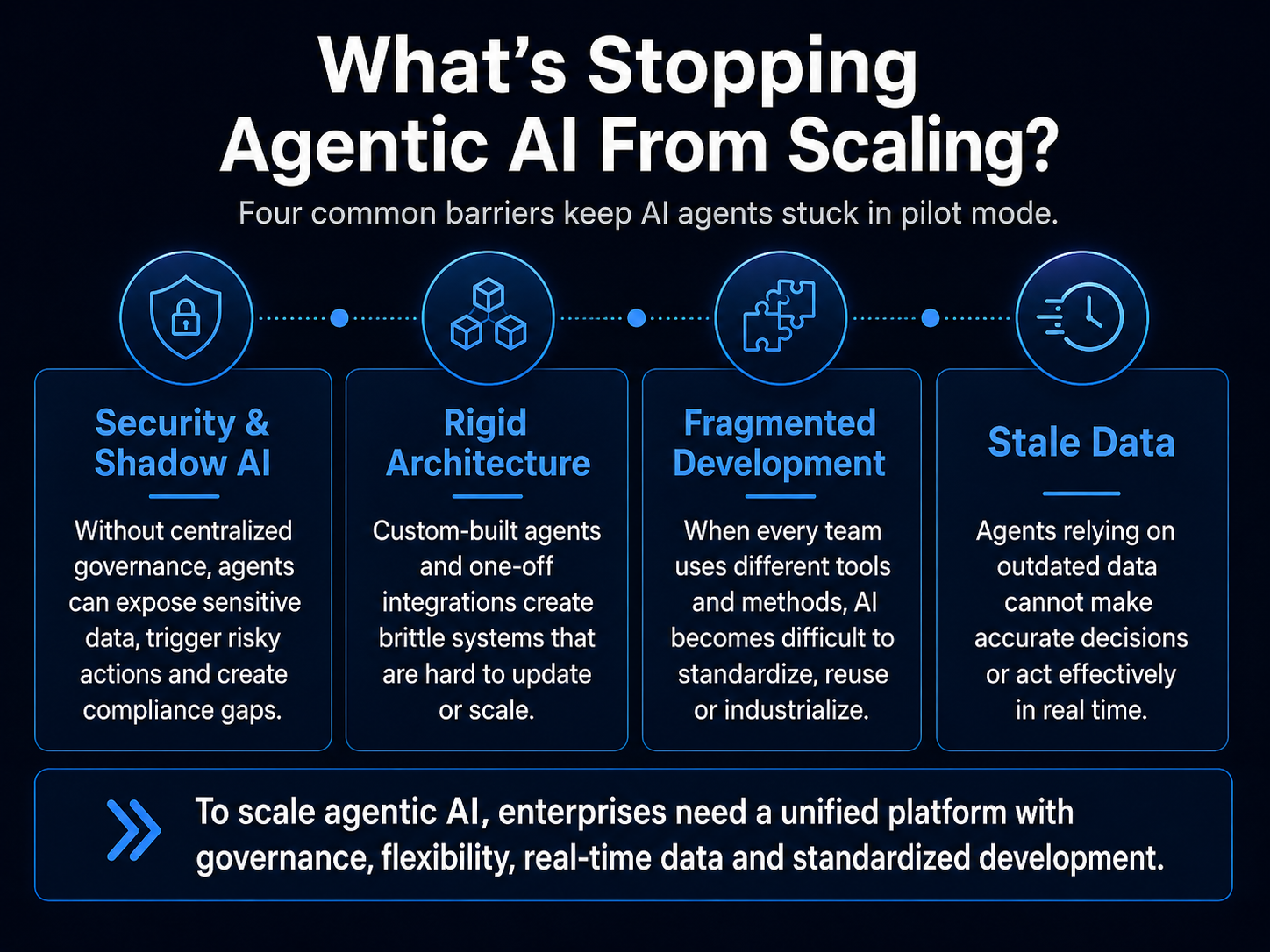
There are a number of major barriers that can prevent enterprises from successfully moving their agentic AI projects from experimentation to enterprise production. Some of the most common hurdles relate to access issues, rigid infrastructure, fragmented developments and out-of-date data:
When agents move from merely reading data to acting on it — executing trades, moving capital or modifying sensitive customer records — the enterprise attack surface expands exponentially. Without a centralized governance layer, organizations fall into the threat of shadow AI, where security protocols and access rights are hardcoded into individual agents or ignored altogether.
This can even happen in simple agentic use cases where attacks like prompt injection, if left unchecked, can override guardrails you thought you had in place.
This creates a serious compliance vacuum. If an autonomous agent improperly accesses PII (personally identifiable information) or triggers an unauthorized transaction, the enterprise cannot answer the fundamental question of who — or what — authorized the breach.
Creating AI components such as agents, prompt templates and vector databases as isolated assets creates a modern version of legacy silos. When AI architecture is built rigidly, it lacks the modularity to adapt to an evolving market.
Upgrading an underperforming large language model (LLM) to a more efficient model becomes a major engineering overhaul rather than a simple configuration change. This results in a new incarnation of spaghetti code, a brittle web of bespoke dependencies that kills agility and increases long-term technical debt.
The rapid evolution of AI has outpaced organizational standards, leading to a fragmented development landscape. Currently, separate teams tend to adopt quite wildly different technologies and methodologies for every pilot, forcing many new AI projects to become a ground-up "science experiment."
This lack of a standardized framework makes it impossible to industrialize AI. For ideas to move from the whiteboard to the production floor at enterprise speed, development must shift from bespoke craftsmanship to a repeatable, platform-driven engineering discipline.
To support the dynamic nature of agentic business activities, AI needs the now, not the yesterday.
Most current AI pilots are hindsight-driven, relying on static knowledge bases or data loaded once from a snapshot. To demonstrate the value of the use case, this is fine, but in a production environment, you need up-to-date information to make effective decisions or take appropriate actions. If a logistics agent plans a shipment based on inventory data that is even five minutes old, it isn't just inaccurate; it’s hallucinating a reality that no longer exists.
To solve these pain points, enterprises cannot rely on a patchwork of libraries and point solutions. They require a cohesive platform designed specifically for the complexity of the enterprise.
Cue the Agent Mesh, which offers an open agentic AI platform organizations need to effectively build, deploy and operate intelligent and well-governed AI-powered applications — from simple single-agent to powerful multi-agent orchestrated solutions — that interact in real-time with enterprise applications and data.
An Agent Mesh platform can help enterprises move to mission-critical deployment by delivering on several critical pillars:
To bridge the gap between initial ideation and functional enterprise systems, organizations must democratize development by lowering the technical barrier to entry. An Agent Mesh facilitates this through a no-code, AI-assisted interface so that business analysts, alongside pro-code options for developers, can ensure that subject matter expertise is directly translated into agent logic.
The whole process needs to be supported by rich, out-of-the-box connectivity to SQL, APIs and the Model Context Protocol (MCP), allowing agents to link seamlessly with real-time streams and enterprise applications.
By providing flexible orchestration that supports both dynamic task-breakdown and prescriptive, compliance-aligned workflows, an Agent Mesh platform enables teams to evolve simple pilots into sophisticated, production-ready systems.
Unlike traditional REST-based chains that can block and fail, an event-driven Agent Mesh allows for asynchronous, parallelized orchestration where multiple agents work simultaneously and recover automatically from individual stalls.
To manage the high costs and context limitations of LLMs, an Agent Mesh can employ an intelligent data management capability to pass only the most relevant information to LLMs, thereby reducing "token burn" and preventing hallucinations.
Finally, to navigate the rapidly shifting AI landscape, enterprises must adopt a cloud-agnostic and vendor-neutral strategy to avoid costly lock-in.
Utilizing an Agent Mesh with an open-deployment across on-premises, cloud or hybrid environments ensures that agents, the data they need and context they maintain can satisfy a variety of sovereignty and data security regulations. This flexibility extends to preserving prior investments by allowing the orchestration of third-party, A2A-compliant agents alongside native ones in a single, unified workflow.
What does this look like in practice? When we combine robust engineering with an event-driven Agent Mesh, we see the emergence of use cases across industries that move the needle on agentic AI ROI and survive the stresses of production deployment.
| Use Case | What the Agent Does | Business Value |
|---|---|---|
| Conversational analytics | Answers real-time business questions from governed data | Faster decisions |
| Customer onboarding | Coordinates identity checks, approvals and next steps | Fewer manual handoffs |
| Credit approvals | Runs checks in parallel and escalates exceptions | Faster processing |
| Logistics planning | Use live inventory and shipment data | Fewer operational errors |
The first hurdle for most enterprises is moving out of their comfort zone of static dashboards. Business users need to query complex systems, such as ERP, CRM and Inventory, without waiting days for a data analyst's report for new types of queries. Connecting a one-off agent directly to a database is a security nightmare, and static data is often outdated the moment it's viewed.
But through a secure, governed interface that meets users where they work (Teams, Slack, web), a user can run ad hoc queries like, "What are our unit sales and revenue for this morning compared to yesterday?" The Agent Mesh validates the user’s identity, pulls specific real-time data the user is permitted to see and allows the agent to summarize the answer. The result is dramatic, reducing time-to-knowledge from days to seconds while maintaining strict governance.
The "holy grail" of AI is the elimination of manual handoffs. This requires automating long-running, multi-step processes such as customer onboarding or credit approvals. Complex workflows are fragile; if step 3 of a 5-step chain fails, the whole process breaks, requiring manual intervention to fix.
The Agent Mesh manages the "state" of these complex workflows through parallelized orchestration. It can verify identities and check credit scores simultaneously. If one API is slow, it handles the wait asynchronously and moves to the next task in the meantime. If a step fails, it re-tries automatically.
The result is Straight-Through Processing (STP), slashing operational costs and errors while keeping a human in-the-loop for final approvals.
There is light at the end of the agentic AI tunnel. Through integrating an Agent Mesh, AI projects move from prototype to enterprise-wide platforms and seamlessly operate with real-time data, legacy platforms and people.
Scaling AI projects will no longer be a challenge with projects being built on the existing IT landscape, which is secure and reliable, enabling organizations to finally witness the true potential of AI projects. Value will also be gained quicker with AI projects developed, deployed and monitored from a common platform, allowing knowledge to be shared and enhancing re-usability.
 Learn how you can join our contributor community.

Edward Funnekotter serves as the Chief Architect and AI Officer at Solace. He leads the architecture teams for both Cloud and Event Broker products, as well as the company’s strategic direction for AI integration within products and internal tools.