Feature
Guide
Is AI Making Your Organization More Productive or More Dependent?


Atlassian recently cut roughly 1,600 jobs — about 10% of its global workforce — and pointed to AI as the culprit. Jack Dorsey announced Block was letting go of nearly 4,000 employees — about half its staff — for the same reason. These aren’t isolated incidents, but rather the public crest of a trend that began taking shape in boardrooms more than a year ago.
Paul Roetzer, founder and CEO of SmarterX, has been watching this unfold. In the opening letter to his company's 2026 State of AI for Business Report, he described a pattern surfacing in executive conversations across industries: "In nearly every executive conversation I'm part of these days, across tech and non-tech alike, I'm hearing a version of the same message: flat headcount is the goal, while companies are gearing up for the possibility of 10 to 20% workforce reductions."
That is the backdrop for this year's research. Between February and April 2026, SmarterX surveyed more than 2,100 professionals across roles, functions and industries. What came back was a portrait of a workforce running toward AI, an organizational structure barely moving and a set of uncomfortable disconnects that every business leader should sit with.
Here are the findings you need to know about.
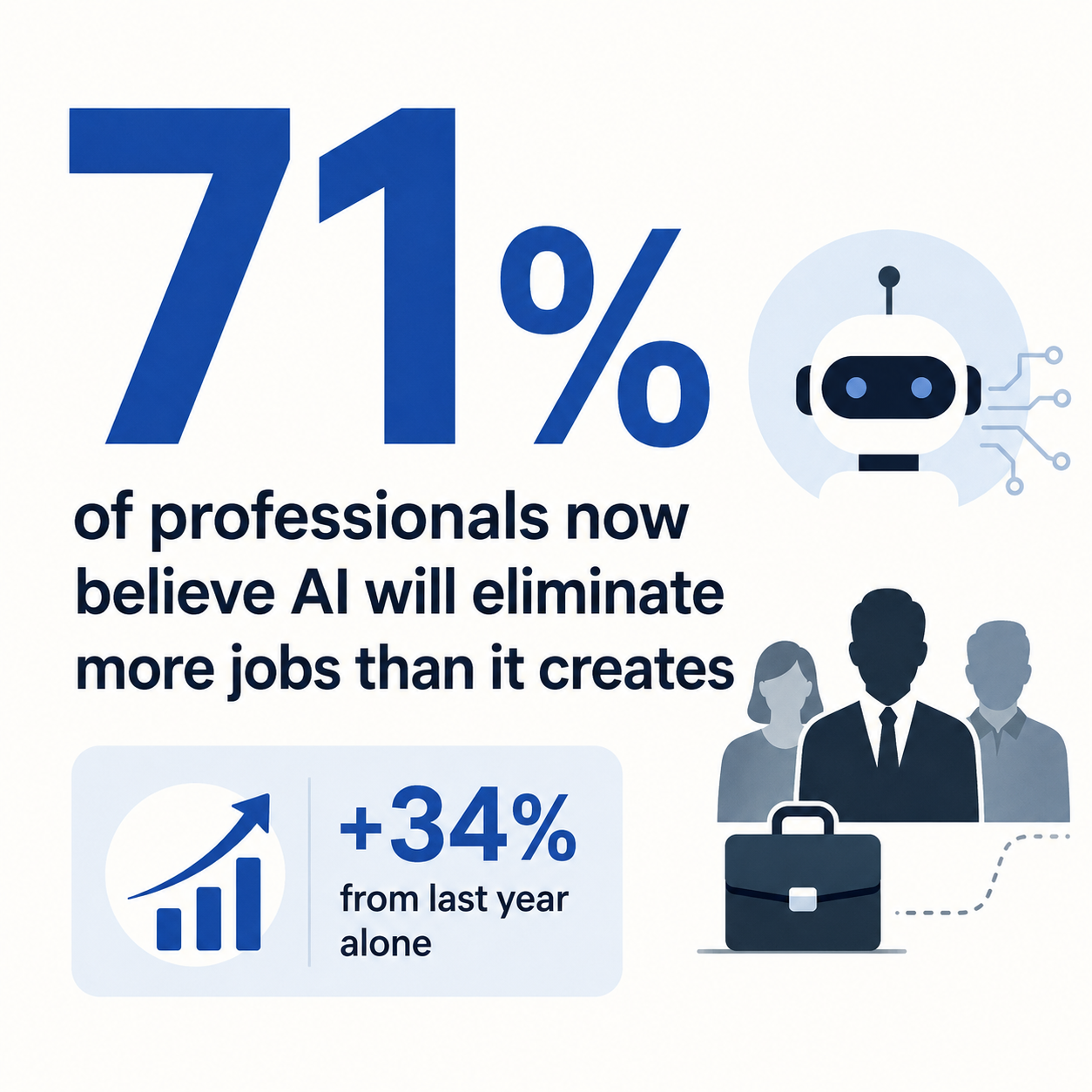
The report noted that many jobs are at risk of AI replacement, with 71% of respondents believing AI will eliminate more jobs than it creates over the next years. Only 13% expect net job creation. That belief holds steady regardless of role, function or seniority. CEOs and VPs come in at 73%. Directors and managers at 71%. Even entry-level specialists clock in at 64%.
And yet: only 20% of respondents say they are somewhat or very concerned about AI's impact on their own job. The largest group, 43%, describes their view as mixed — they see both risks and opportunities. Another 19% say they are not concerned at all.
The jobs most exposed to AI disruption are not necessarily the lowest-skilled roles, but those with repeatable, language-heavy or rules-based work. That includes parts of:
The risk AI absorbing specific tasks inside that job (not replacing the entire job itself), which can reduce the number of people needed to do the same amount of work.
This is often a perception gap. People can see AI changing the labor market in broad terms, but they tend to view their own work as too nuanced, relationship-driven or context-heavy to automate. In reality, AI rarely needs to replace 100% of a role to create workforce disruption. If it can automate 20% to 40% of the work across many roles, companies may redesign teams, slow hiring or reduce headcount.
Roetzer named this the defining tension in this year's data. "The workforce broadly expects disruption," he noted. "They just don't think it will happen to them."
Mike Kaput, chief content officer at SmarterX and co-host of The Artificial Intelligence Show, framed what makes this finding particularly urgent during podcast commentary on the report findings. Prominent voices had been publicly pushing back on the idea of an AI job crisis in the same week the report launched, but Kaput said straight up, look at the numbers. "71% of professionals now believe AI will eliminate more jobs than it creates, up 34% from last year alone. That's not a fringe view. That's the mainstream view inside organizations right now."
The open-ended survey responses are very revealing as to what's behind these numbers. People wrote about their kids, the fact that the wealth gap will continue to grow and how they're scared because society doesn't seem to realize how quickly this is going to happen.
One respondent mentioned how they thought they would be fine since they were an AI-forward leader, but didn't know about their six- and eight-year-old kids. This is not a detached, abstract concern — it is a psychological split that every leader needs to reckon with.
Related Article: The Entry Level Job Is Dead, and Young Talent Is Arriving With Ideas Instead of Resumes
Fifty-three percent of individual respondents say they are in the Integration or Transformation phases of AI adoption. They have moved past testing and experimenting; they are embedding AI into their daily workflows or fundamentally reimagining how they work. Only 12% remain in the earliest Curiosity or Understanding phases.
For comparison, in the 2025 State of Marketing AI Report, only 43% had reached the Integration or Transformation stage. Individual adoption has increased significantly.
The organizational story is a completely different one. Only 25% of organizations have gotten to Scaling. Almost half, 47%, are still in Piloting. Another 28% are still in the Understanding phase. Even among those respondents who are personally at Integration or Transformation, 62% report their organization has not yet scaled.
The gap between what employees can do and what their organizations have built is increasing.
The most common description of organizational AI momentum was "inconsistent or siloed," chosen by 41% of respondents. In fact, if you add up those who said their progress was “stalled” or hadn’t “started,” we’re looking at just shy of half, at 49%, people already working inside organizations but in shards and without an overarching approach. Only 28% say their organization is accelerating.
Roetzer was direct about who owns this problem. "Too many CEOs are still treating AI as a technical issue to delegate to IT and Legal. But IT and Legal are structured to reduce risk, not drive transformation. When you ask them to lead AI, the predictable result is exactly what the data shows: cautious experimentation that never quite scales."
Ask most executives what's blocking AI adoption, and they will say budget or technology. The data, however, tells a different story. The top barriers cited by respondents are:
The resource constraint is not financial, but one’s temporal and cognitive availability. Professionals aren’t struggling for approval to use tools; they’re struggling to find the hours to learn, experiment, build new muscle memory – while still doing their day jobs.
This is even more pronounced in the open-ended responses. One respondent wrote:
I feel like I'm falling behind every day, even though most would consider me an advanced user.
Another described trying to be an AI adopter inside an organization where using AI carries a stigma of cutting corners, while leadership simultaneously says everyone needs to use it.
A third captured the irony precisely:
Organizational success depends on us figuring it out before our clients do... and we're not there.
"The struggle isn't adoption resistance. It's capacity," said Taylor Radey, director of research at SmarterX. "Vanishingly few people said their struggle was deciding whether to use AI. The struggles are about: how to keep up, how to integrate it into real work, how to get their teams on board, how to find the time."
When employees work in organizations without approved tools, clear guardrails or real training, they do not stop using AI. They use whatever works for them on their own devices. Shadow AI is accumulating inside organizations whose leaders believe they have it all figured out.
Related Article: 7 Ways Leaders Can Address AI Anxiety at Work
Forty-six percent of respondents now say their organization offers AI-focused education and training, up 14 percentage points from 32% in 2025. That is real progress, even though 53% of respondents still don't have access to formal AI training from their employer.
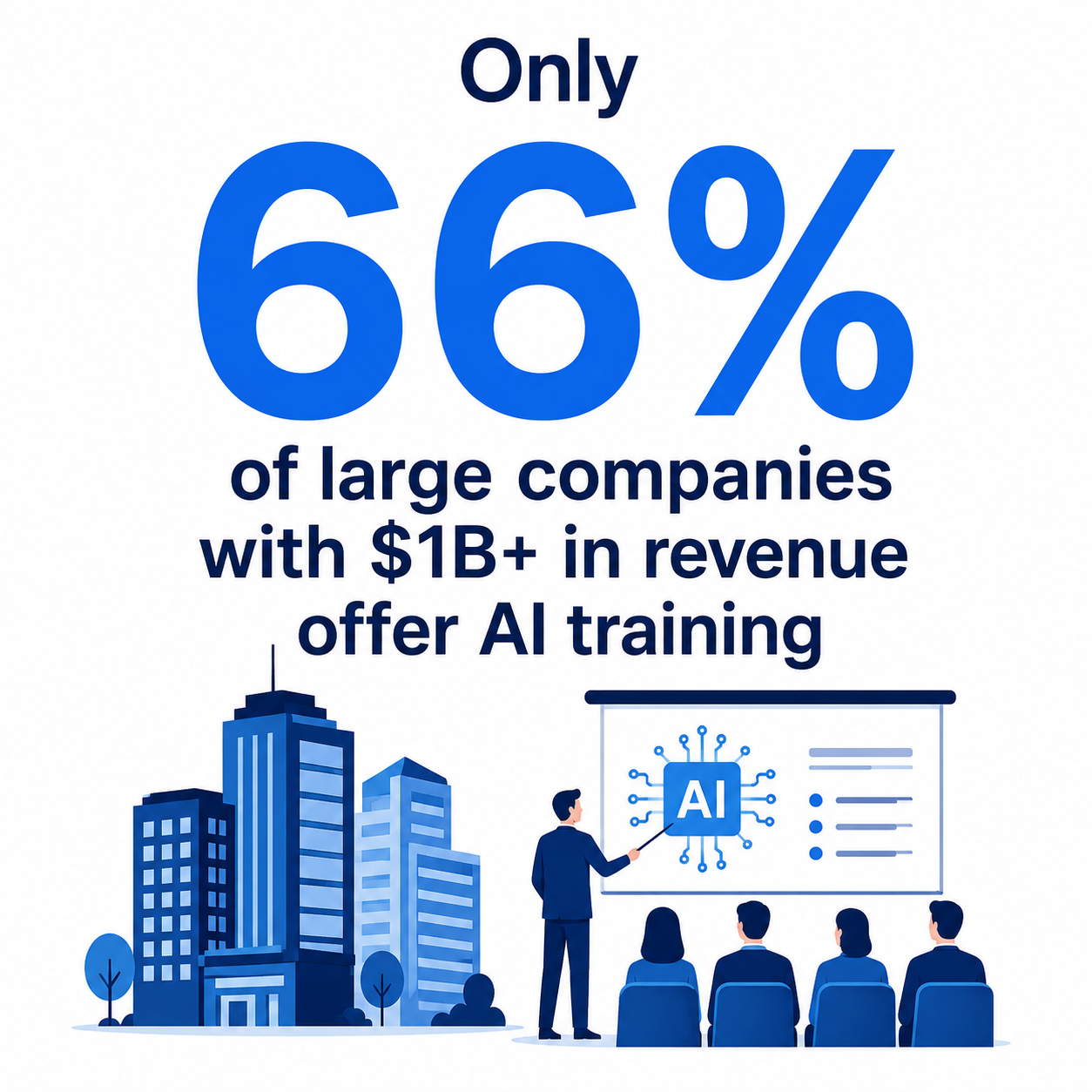
Among the largest companies (those with more than one billion in revenue), 66% offer training. Even there, one in three workers has none.
More pressing than availability is content. Respondents are not asking for introductory material. The top training requests were:
Only 15% cited prompting, once treated as the foundational AI skill. The workforce has moved past that, and training programs still teaching basic prompts are not serving the people sitting in the seats.
AI training should focus on how people actually work. That means teaching employees how to integrate AI into daily workflows, evaluate outputs, protect sensitive data, use AI agents responsibly, build simple automations and understand when human review is required. Prompting still matters, but it's no longer enough as a standalone skill.
AI training should start with leaders, managers and employees in functions where AI is already changing the work. Managers need enough AI literacy to redesign workflows, evaluate productivity claims and support their teams. Frontline employees need practical training tied to their specific roles, not generic demos that leave them to figure out the use cases alone.
The trend data on which technologies professionals are watching most closely reinforces this. Forty percent said that AI agents and agentic AI were the area they were following most closely. No other category came close to being mentioned by so many. Vibe coding made it into 10% of responses, despite barely existing in professional parlance as recently as twelve months ago.
Kaput flagged the governance risk that sits beneath the agent enthusiasm in his commentary on the report findings, saying, "The technology that professionals are most interested in is also the technology that requires the most governance. Most organizations haven't built adequate governance for the tools they're already using — and agentic AI is coming at them fast."
Overall, 59% of respondents indicate their organization provides ChatGPT. However, the headline number masks a stark divide when broken down by company size. Nearly three-quarters of workers at small businesses with less than one million dollars in revenue use ChatGPT.
For companies with more than one billion in revenue, 73% utilize Microsoft Copilot, and ChatGPT drops to 36%. Google Gemini sits at 42% overall and Anthropic Claude at 37%, both significant but trailing the top two.
The pattern reflects Microsoft's structural advantage, given its existing Office 365 and Azure relationships at enterprise scale with organizations, while smaller enterprises choose AI tools based on individual initiative rather than centralized procurement.
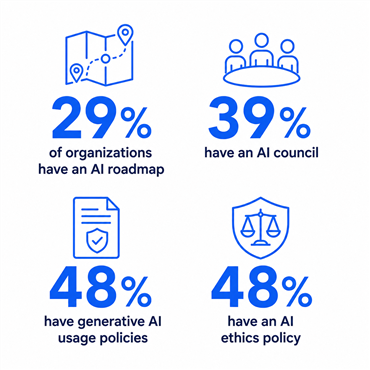
The 2026 report measures four governance foundations:
The findings are uncomfortable.
A mere 29% of organizations report having an AI roadmap; only 39% have an AI council; 48% have generative AI usage policies in place; 48% have an AI ethics policy.
Only 13% say their organization has all four of these foundations in place — while 32% of respondents say their organization has none.
An AI roadmap should define where AI will be used, who owns it, which tools are approved, what risks need to be managed and how success will be measured. It should also include timelines, training plans, governance checkpoints and priority use cases. A strong roadmap connects AI activity to business outcomes instead of leaving teams to experiment in isolation.
An AI council helps coordinate AI strategy across the organization. It typically includes leaders from:
An AI council's job is not just to say yes or no to tools, but to set priorities, manage risk, approve policies, review use cases and keep AI efforts from becoming siloed.
An AI usage policy tells employees what they can and cannot do with AI tools. It may cover approved platforms, data handling, human review and disclosure requirements.
An AI ethics policy is broader. It defines the organization’s principles for responsible AI, including fairness, transparency, accountability, privacy and the impact of AI on employees, customers and society.
The relationship between governance and momentum is the single most vivid pattern in the data. Half of organizations with an AI roadmap say their efforts are accelerating; only a fifth are inconsistent or siloed. This figure nearly doubles for those with AI training programs.
And half of the organizations that have all four governance factors in place can be considered as truly accelerating, while less than 1% report being stalled.
It’s not really a resource problem for the most part, either. Only 40% of employees at companies with more than $1 billion in annual revenue have access to an AI roadmap. The absence of a roadmap is a leadership and prioritization problem, not a budget one.
Fifty-two percent of respondents describe their overall sentiment toward AI as positive. Forty-eight percent are neutral, unsure or negative. In other words, this is not a workforce that’s all-in.
And let that 48% number sink in for a moment: Those are professionals working inside enterprises that are actively exploring AI — i.e., those who’ve not only been exposed to it but whose employers believe enough in the technology to have made it part of their strategy.
The open-ended responses on excitement tell a different story. Respondents wrote about unlocking new possibilities, building things they could not build before and the feeling of working in a territory as uncharted as the early internet.
One respondent described a future where society is no longer constrained by mundane tasks that suffocate creative and strategic thinking. Another called it a level playing field. Productivity ranked highest at 28%, but what came through in the language was that people do not just want to save time. They want to do things that were previously out of reach.
The report describes this as the defining tension of the current AI moment: the same people who fear job loss are excited about what AI unlocks for them personally. Both things are true simultaneously. How leaders acknowledge and navigate that duality will shape whether their organizations earn trust or erode it during the period of change ahead.
Related Article: Inside Stanford's 2026 AI Index Report: What the Data Actually Tells Us
The 2026 State of AI for Business Report comes at a time when people have already moved, organizations haven’t caught up and the technologies advancing fastest — particularly agents — require the most governance infrastructure to manage well.
The evidence is clear that organizations gaining an early advantage are doing so through similar approaches: they have roadmaps, governance infrastructures and view AI literacy as something requiring attention among their workforce, rather than as an afterthought.
The companies that get this right will not be the ones with the best tools. They will be those whose leaders view AI as a business opportunity, and invest in literacy, governance, as well as human-centered change management before reality forces them to.

Nelly Njeri is an enterprise AI journalist and researcher with more than nine years of experience covering the technologies, economics, markets and risks shaping the enterprise artificial intelligence ecosystem.
Her reporting spans the AI infrastructure powering enterprise deployment, from chip makers and inference hardware to head-to-head platform testing of tools like Cursor, GitHub Copilot and Claude Code.