Feature
Guide
Is AI Making Your Organization More Productive or More Dependent?


Artificial intelligence systems are becoming more capable, autonomous and embedded in enterprise operations. They're also becoming harder to explain.
Despite years of progress in explainable AI, many modern systems still operate as black boxes, producing outputs even their developers cannot fully trace. As models grow larger and more complex, the gap between what AI systems can do and what humans can understand appears to be widening.
That creates a growing problem for businesses deploying AI in high-stakes environments. If an AI system makes a bad recommendation, denies a loan, misclassifies a security incident or takes the wrong action inside an automated workflow, companies need to know why.
Yet that answer is increasingly difficult to find.
The AI black box problem is the challenge of understanding how advanced AI systems arrive at specific decisions, predictions or outputs.
| Traditional Software | Modern AI Systems |
|---|---|
| Human-written rules | Learned statistical patterns |
| Easier to trace through code | Harder to explain internally |
| Predictable outputs | Probabilistic outputs |
| Localized debugging | Distributed, opaque reasoning |
| Clear logic path | Hidden internal representations |
With traditional software, engineers can usually trace a system’s behavior through human-written rules and code. Given the same input and conditions, deterministic software generally produces the same result.
Modern AI works differently. Deep learning systems learn statistical relationships from massive datasets. Instead of following explicit rules, they generate outputs based on patterns, probabilities and internal representations that are often difficult to interpret.
That means an AI model may produce an accurate answer without being able to explain its reasoning in human terms. Large language models and other neural networks can contain billions or trillions of parameters, each interacting in ways that are difficult to map directly.
This trade-off sits at the center of the AI black box debate: In many cases, the most powerful AI systems are also the least explainable.
Related Article: The New Gatekeepers: When AI Agents Decide Who Gets In
The interpretability challenge has grown alongside AI model scale and capability.
Early machine learning systems were often narrow, trained for specific tasks using limited datasets and relatively simple architectures. Modern foundation models operate at a far greater level of complexity. Large language models and multimodal AI systems are trained across enormous volumes of text, images, audio, video and behavioral data.
That scale creates several problems.
First, modern AI models contain huge numbers of parameters distributed across deep neural architectures. Engineers can observe activation patterns and statistical behavior, but it is difficult to determine exactly how specific internal representations contribute to a final output.
Second, advanced AI systems can exhibit emergent behavior. A model trained primarily to predict language may appear to develop reasoning-like skills, planning abilities or cross-domain problem-solving capabilities. Researchers can observe those behaviors without fully understanding why they emerged or how reliably they will generalize.
Third, multimodal and agentic AI systems add more layers of opacity. Multimodal models combine different data types within shared architectures. AI agents add planning, tool use, memory and multi-step decision-making. Instead of producing a single output, these systems may evaluate options, revise objectives and interact with external tools before reaching a result.
As AI-generated systems become more embedded in enterprise infrastructure, the black box problem is also expanding beyond the model itself.
“The AI black box has evolved beyond model interpretability; it's now creating codebases that even seasoned engineers find difficult to navigate, significantly accelerating technical debt in enterprise settings,” Garima Agarwal, software developer at Bank of America, told VKTR.
In other words, opacity is no longer limited to neural network behavior. It's also showing up in AI-generated code, enterprise workflows and system architectures that teams must maintain over time.
Explainable AI, or XAI, has made meaningful progress over the past decade.
Tools such as SHAP (SHapley Additive exPlanations) and LIME (Local Interpretable Model-agnostic Explanations) help estimate which input variables influenced a model’s output. Other methods, including model tracing, activation analysis and attention visualization, can show how information appears to move through parts of a neural network.
These techniques can help with compliance, bias detection and risk analysis, especially in regulated industries such as healthcare, finance and cybersecurity. But they do not fully solve the black box problem.
| XAI Can Help Show | XAI Usually Cannot Fully Show |
|---|---|
| Which inputs influenced an output | The model’s complete reasoning path |
| Patterns in model behavior | Why internal representations formed |
| Possible bias signals | Whether a generated explanation is faithful |
| Localized decision factors | Full cognition-like reasoning |
| Audit support | Complete transparency |
Most explainability tools provide partial visibility. They can often show what influenced an output, but not fully explain why the system reached a specific conclusion.
The limitation becomes more pronounced with LLMs, multimodal models and autonomous AI systems. As models become larger, their internal representations become more distributed and abstract. Explainability tools may provide useful approximations, but they do not offer a complete window into the system’s reasoning.
Chain-of-thought reasoning adds another complication. Some AI systems generate intermediate reasoning steps that appear understandable to humans. But researchers have warned that those explanations may not faithfully represent the model’s internal process. In some cases, they may function more like plausible narratives than true reasoning traces.
That makes explainable AI useful, but incomplete.
Related Article: Data Lineage Explained: How to Build Trustworthy, Compliant, Reliable Data
The AI black box problem is now a business risk.
AI systems are increasingly used in:
In those environments, companies need to understand how decisions are made, especially when the stakes are high.
In regulated industries, explainability may be a legal or operational requirement. Financial institutions using AI for loan approvals may need to show why a system reached a specific decision. Healthcare organizations using AI-assisted diagnostics face similar pressure. A prediction may be accurate, but still create risk if clinicians cannot understand how it was produced.
Regulatory pressure is also increasing. Frameworks such as the EU AI Act place greater emphasis on transparency, auditability and human oversight for high-risk AI systems.
Customer experience adds another challenge. AI systems now influence product recommendations, dynamic pricing, customer support routing and automated service interactions. When those systems behave unpredictably, customers do not usually see an “AI issue.” They see a company failure.
For enterprises, this creates a difficult tension: More advanced AI systems can increase efficiency, personalization and automation, but they can also reduce visibility and control.
Opaque AI systems are risky not only because they can fail, but because they can fail quietly.
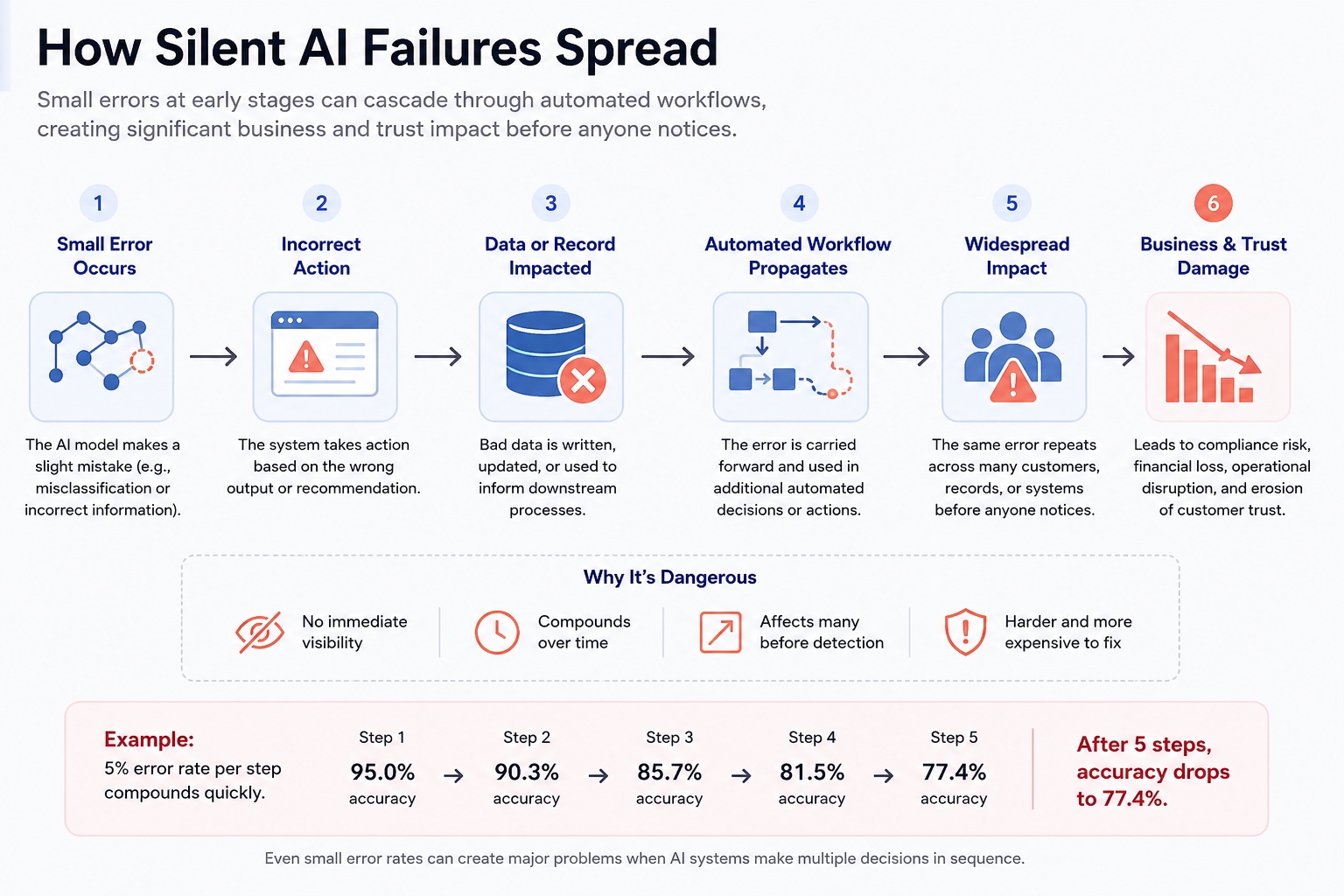
AI hallucinations are one familiar example. LLMs can produce confident but false answers, fabricated citations or misleading recommendations. These outputs are especially dangerous because they often sound credible.
Unpredictability creates another problem. Probabilistic systems may respond differently to small changes in prompts, data or context. That makes it difficult to guarantee consistent behavior across enterprise workflows.
The risk grows when AI is automated. A flawed human recommendation may affect one customer or one decision. A flawed AI system embedded in an autonomous workflow may replicate the same problem across thousands of interactions before anyone notices.
“The most dangerous risk is silent failure at scale,” said Noe Ramos, VP of AI operations at Agiloft. “Opaque systems don't always fail loudly. They can be slightly wrong for weeks: misclassifying tickets, updating records with small inaccuracies, escalating with misplaced confidence. In high-stakes environments, that compounds into compliance exposure and serious trust erosion before anyone notices.”
That is one of the core enterprise risks of opaque AI. The failure may not look dramatic at first. It may look like small inaccuracies, subtle workflow drift or misplaced confidence that compounds over time.
AI bias remains another concern. Systems trained on incomplete or skewed datasets can reinforce unfair outcomes in hiring, lending, healthcare and customer engagement.
Agentic AI introduces even more risk. Unlike static models that generate one output at a time, AI agents can plan tasks, call tools, maintain memory and make sequential decisions. One flawed assumption can trigger downstream actions before a human catches the error.
“Cascading errors, where each system is even 95% accurate, means you encounter a 5% error rate for each decision made. Clearly, this error rate then compounds at each step,” explained Jim Olsen, chief technology officer at ModelOp.
Even strong performance at the individual step level can become risky when systems depend on multiple autonomous decisions in sequence.
The black box problem becomes more complex as AI systems move from recommendation to execution.
Traditional machine learning systems often generated predictions that humans could review before acting. AI agents increasingly take action inside real workflows. They may search databases, update records, call APIs, trigger automations or interact with enterprise software. That creates more places for errors to occur.
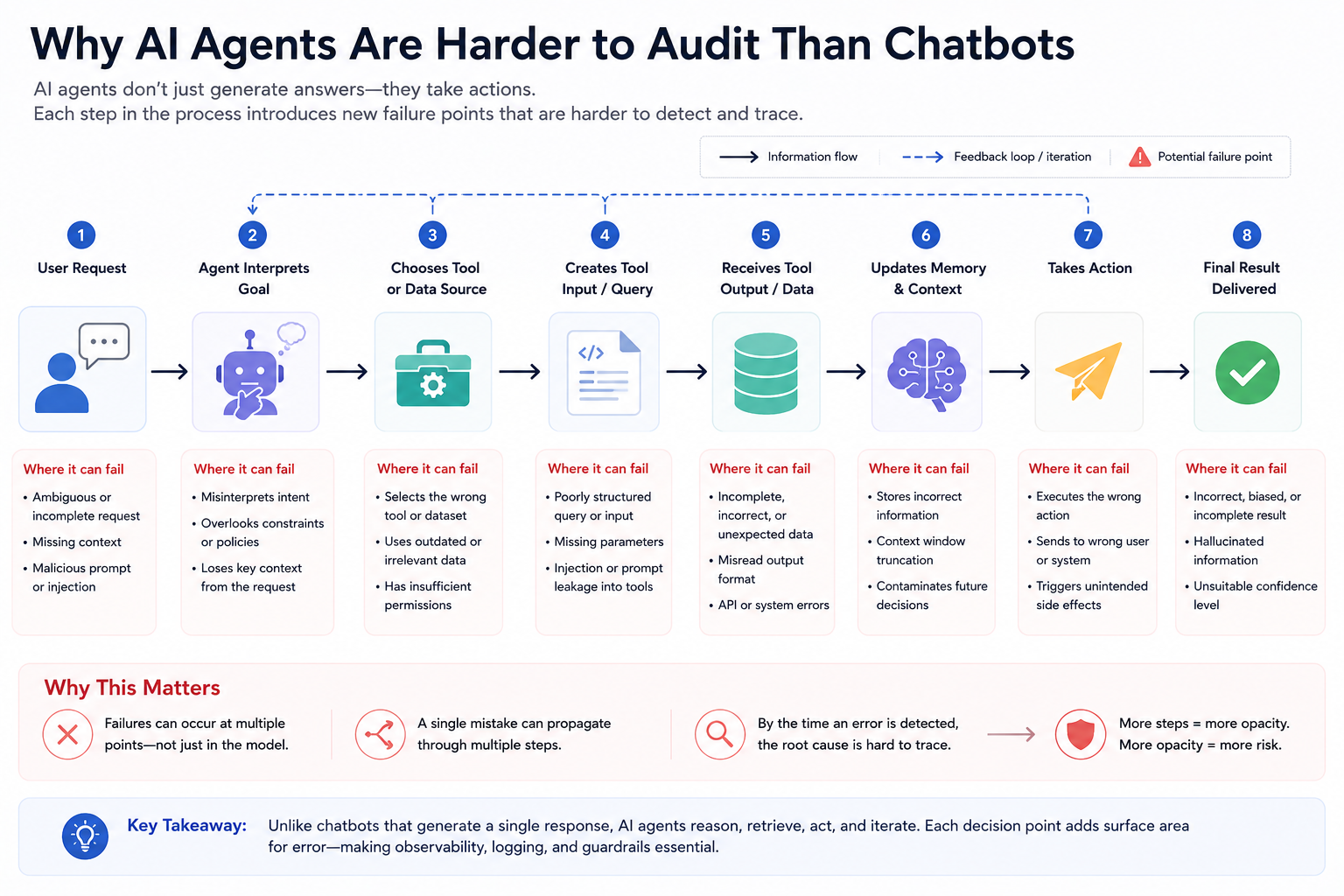
“A two-step agent has roughly three times the surface area of opacity of a single-step call, because the failure can live in tool selection, tool input or model response,” said Patrick Gibbs, founder at Epiphany Dynamics.
In an agentic workflow, the problem may not be the model alone. It may be the prompt, the retrieved context, the selected tool, the tool input, the external system response or the agent’s interpretation of that response.
The more systems involved, the harder it becomes to reconstruct what happened.
This is especially challenging when agents operate continuously or at scale. A hallucinated output or misinterpreted instruction early in a workflow can propagate through multiple downstream actions. By the time the problem becomes visible, the original cause may be buried inside a chain of probabilistic decisions.
For enterprises, monitoring and auditability are becoming just as important as AI capability.
The AI black box problem no longer exists only inside individual models.
Modern enterprise AI systems often combine foundation models, retrieval systems, memory layers, orchestration tools, hidden system prompts, model routers and API-driven workflows. A final AI-generated output may depend on several systems interacting at once.
| AI Stack Layer | Role in the System | Interpretability Challenge |
|---|---|---|
| Foundation Model | Generates predictions or outputs | Opaque internal representations and probabilistic reasoning |
| System Prompts | Guide model behavior and constraints | Hidden instructions may influence outputs invisibly |
| Retrieval Systems (RAG) | Inject external documents and context | Difficult to determine which retrieved data shaped responses |
| Memory Layers | Store prior interactions or state information | Persistent context may alter future behavior unpredictably |
| Model Routing | Select specialized models or workflows | Decision pathways become harder to reconstruct |
| API / Tool Chains | Connect external tools and services | Outputs from one system become inputs for another |
| Agentic Execution | Perform multi-step autonomous actions | Cascading decisions create complex causal chains |
“The fundamental challenge is architectural," said Diptamay Sanyal, principal engineer at CrowdStrike. "LLMs are probabilistic. In a multi-agent system, one model's output becomes another model's input. Errors compound, context gets lost and by the time something surfaces as a visible failure, the causal chain is nearly impossible to reconstruct."
That shifts the interpretability question. It is no longer enough to ask, “Why did the model generate this output?” Enterprises increasingly need to ask, “Which combination of prompts, models, retrieved documents, memory states, tools and workflows produced this outcome?”
Retrieval-augmented generation (RAG) systems add another layer. A model’s response may depend on which documents were retrieved, how they were ranked, what context was injected and how the system prompt shaped the final answer.
“Failures are rarely caused by a single hallucination anymore. They often emerge from context corruption, retrieval drift, hidden prompt interactions or cascading tool decisions that were never explicitly programmed,” Siddardha Vangala, senior AI developer at MasTec Advanced Technologies, told VKTR.
As enterprise AI stacks become more modular, autonomous and interconnected, transparency has to extend beyond the model. Companies need visibility into the infrastructure around the model as well.
Related Article: How to Build Multi-Agent Workflows That Don't Fall Apart
The AI black box problem may never be fully solved, at least not in the way traditional software can be understood.
Modern neural networks operate through distributed probabilistic representations, not explicit human-readable rules. That creates inherent limits on full transparency.
That does not mean enterprises are powerless. Explainability tools, model tracing, evaluation frameworks, audit logs, monitoring systems and human review can all improve visibility. Stronger governance can also help companies identify, contain and reverse failures when they occur.
But the goal may need to shift.
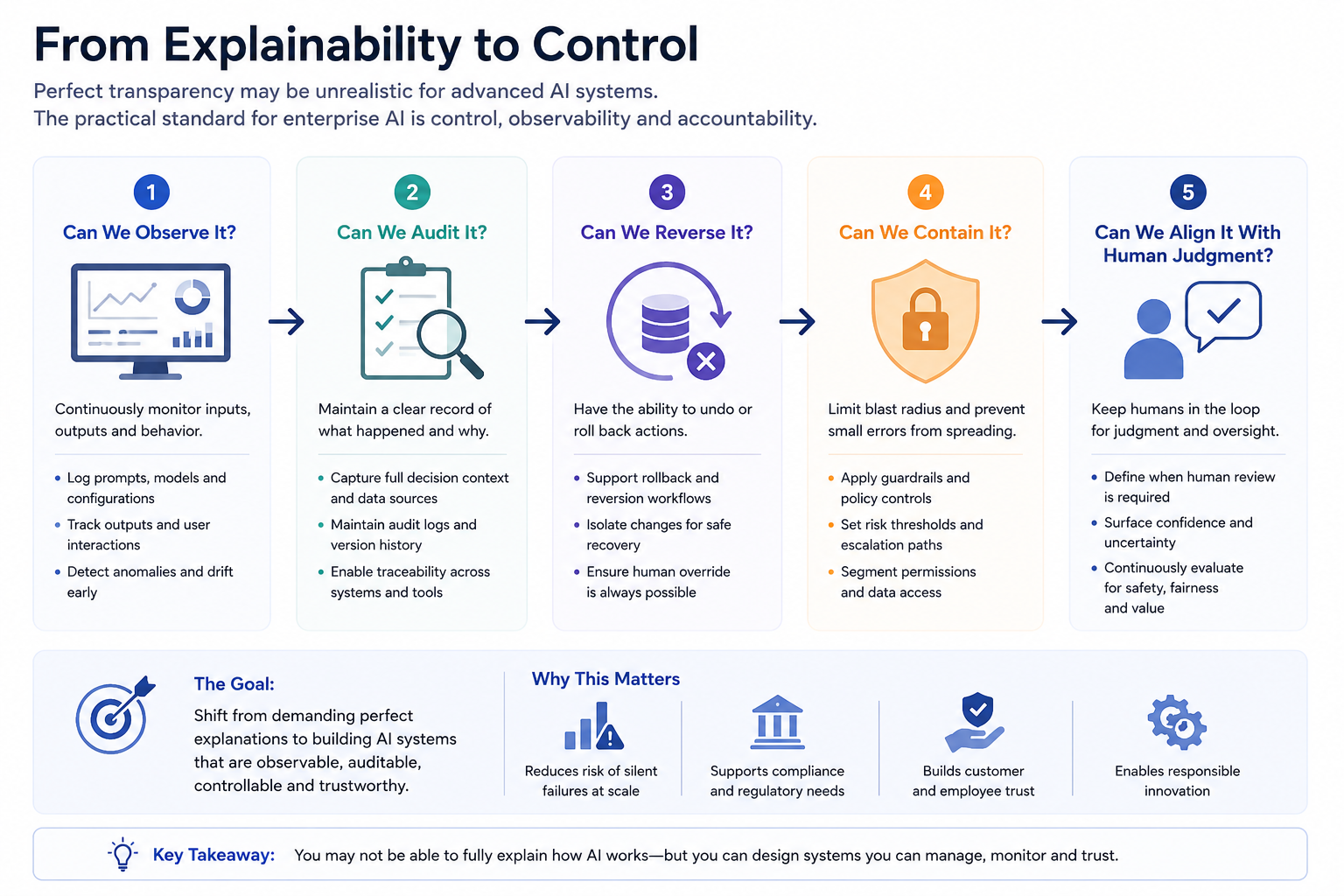
“The standard for enterprise AI shouldn't be ‘can we explain it.’ It should be ‘can we observe it, audit it, reverse it, and align it with human judgment.’ That's a higher bar in some ways, and a more honest one,” said Ramos.
That may be the more practical standard for enterprise AI. Instead of expecting perfect interpretability from complex systems, businesses may need to focus on controllability, auditability and accountability.
Quentin Reul, director of global AI strategy and solutions at expert.ai, said full transparency in purely neural models may not be realistic, "because they operate on statistical probability rather than reason."
The result is a more pragmatic approach to AI governance. Companies may not be able to eliminate opacity entirely. But they can decide how much opacity they are willing to accept, where human oversight is required and what safeguards must be in place before AI systems operate at scale.
The AI black box problem remains one of the biggest tensions in modern artificial intelligence: The systems becoming most useful are often the hardest to understand.
Explainable AI can help. Governance can help. Monitoring, audits and human oversight can reduce risk. But as enterprises adopt LLMs, AI agents and autonomous workflows, opacity is becoming an infrastructure issue, not just a model issue.
The challenge for businesses is making sure those systems remain observable, controllable and trustworthy as they take on more responsibility across real-world operations.
Companies can reduce AI black box risk by combining technical controls with governance processes. That includes:
The goal is not perfect explainability, but enough visibility to detect, audit and contain problems.
Explainability focuses on understanding why an AI system produced a specific output. Auditability focuses on whether a business can review what happened after the fact.
An AI system may not be fully explainable, but it can still be auditable if teams log the model used, the input, the retrieved data, the tool calls, the output and the actions taken.
AI systems used in healthcare, financial services, hiring, insurance, legal workflows, cybersecurity and customer-facing automation typically need higher levels of explainability. These use cases involve sensitive data and regulated decisions that can materially affect people and business operations.
Executives should ask:
They should also ask whether the company can reconstruct the agent’s decision path if something goes wrong.
A practical first step is building an AI inventory. Companies should document: