News
Guide
Is AI Making Your Organization More Productive or More Dependent?


Funding milestone reached. Gradium raises total funding to $100 million.
Silicon Valley expansion. New office in San Francisco Bay to boost AI presence.
Enterprise developer impact. Increased investment enables faster innovation for enterprise voice AI infrastructure.
Gradium has extended its seed financing to $100 million, seven months after launch. The extension added new investors including NVIDIA, and will fund a new San Francisco Bay Area office.
The company was founded in September 2025 by researchers behind Kyutai, an AI research lab known for real-time speech systems. Co-founders Neil Zeghidour, Laurent Mazaré, Olivier Teboul and Alexandre Défossez built Gradium to move frontier voice AI research into production.
According to company officials, the capital will accelerate AI research, product development and international expansion. Gradium said it generated revenue within weeks of launch, though it did not disclose figures.
"Surpassing $100 million in funding and expanding our investors marks an important milestone for Gradium. It enables us to accelerate our roadmap, expand our Bay Area presence, and bring years of breakthrough research into products used by developers and enterprises around the world."
- Neil Zeghidour
Co-Founder & CEO, Gradium
The company's recent product advances span speech generation, recognition, translation and developer tooling.
Feature | How It Works |
|---|---|
Next-gen real-time TTS | Improves pronunciation of acronyms, emails and alphanumeric codes |
Semantic turn detection | Detects when users finish a thought, not just stop speaking |
Gradium Translate | Ultra-low-latency speech-to-speech translation model |
Phonon | On-device text-to-speech model for edge deployments |
GradBot | Open-source framework for building voice agents in few lines of code |
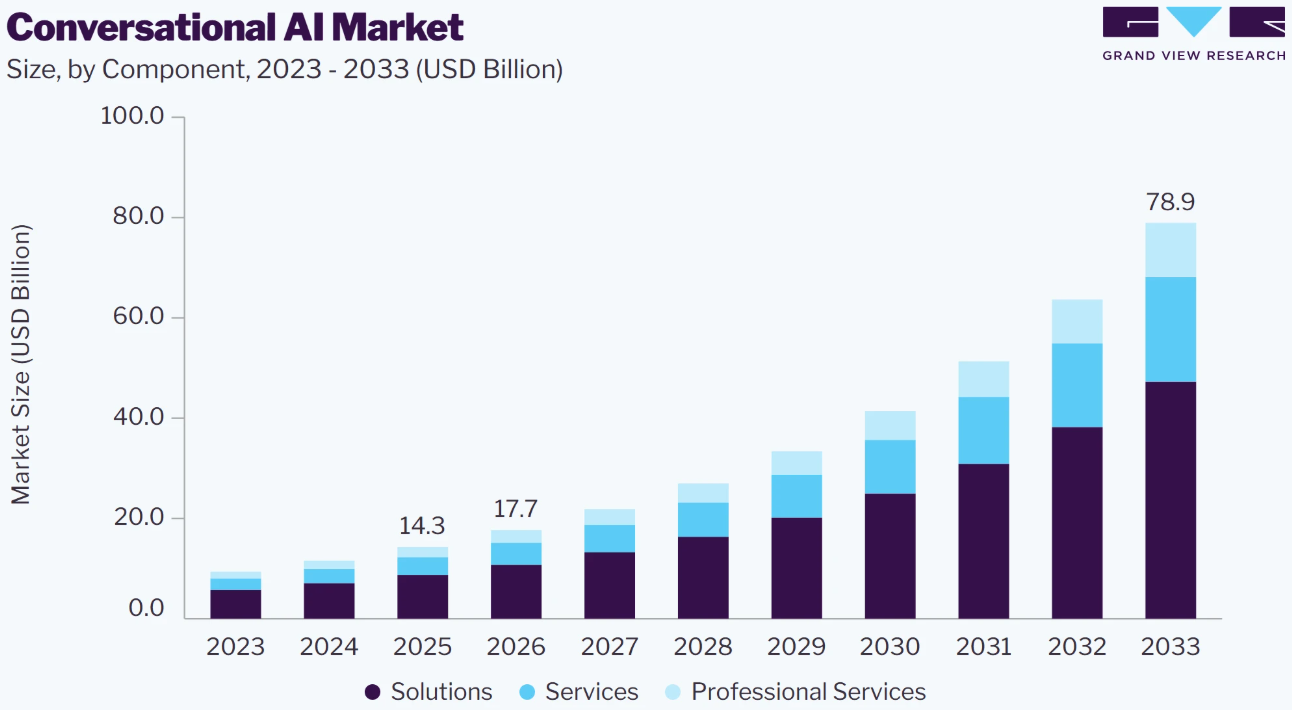
The conversational AI market is projected to grow from $17.7 billion to nearly $78.9 billion by 2033, pushing enterprises toward durable infrastructure choices.
Sub-100ms latency has become the threshold for natural conversation flow. Full-duplex architecture — continuous bidirectional processing — separates production-grade systems from earlier prototypes, as VKTR's coverage of OpenAI's GPT-Live launch noted.
Other competitors in the field include ElevenLabs, delivering low-latency voice capabilities through its ElevenAPI platform and Mistra AI's Voxtral Transcribe 2 suite, which targets sub-200ms streaming speech-to-text across 13 languages.
Another contender in the space, Deepgram, illustrates how full-stack voice infrastructure is taking shape. Its current offering includes:
Nova-3 — real-time speech-to-text
Aura-2 — text-to-speech for enterprise applications
Flux — conversational speech recognition with interruption handling
Voice Agent API — for building conversational AI agents
Saga — a voice operating system for orchestrating speech workloads
All models support cloud API, self-hosted and on-premises deployment, with customization for domain-specific terminology.
Cross-channel orchestration and contextual memory infrastructure are now baseline expectations for CX teams building at scale.
Gradium targets developer and engineering teams building real-time, production-grade voice systems for AI agents, customer support assistants and voice-enabled games. The company offers streaming TTS and STT APIs, instant voice cloning and orchestration tools designed for low-latency integration.