Editorial
Guide
Is AI Making Your Organization More Productive or More Dependent?


In Part 1 and Part 2, we established the problem — knowledge-intensive domains drowning in unstructured narrative text — and walked through the pipeline architecture behind Visual Judgements (VJ): NLP preprocessing with NLTK and spaCy, graph construction in Neo4j using Cypher queries and the aggregation-disaggregation strategy that made complex judicial narratives visually interpretable.
This final installment examines the concrete results from applying this approach to a Supreme Court of India criminal appeal, catalogs the challenges that surfaced and outlines the path from manual proof of concept to automated extraction at scale.
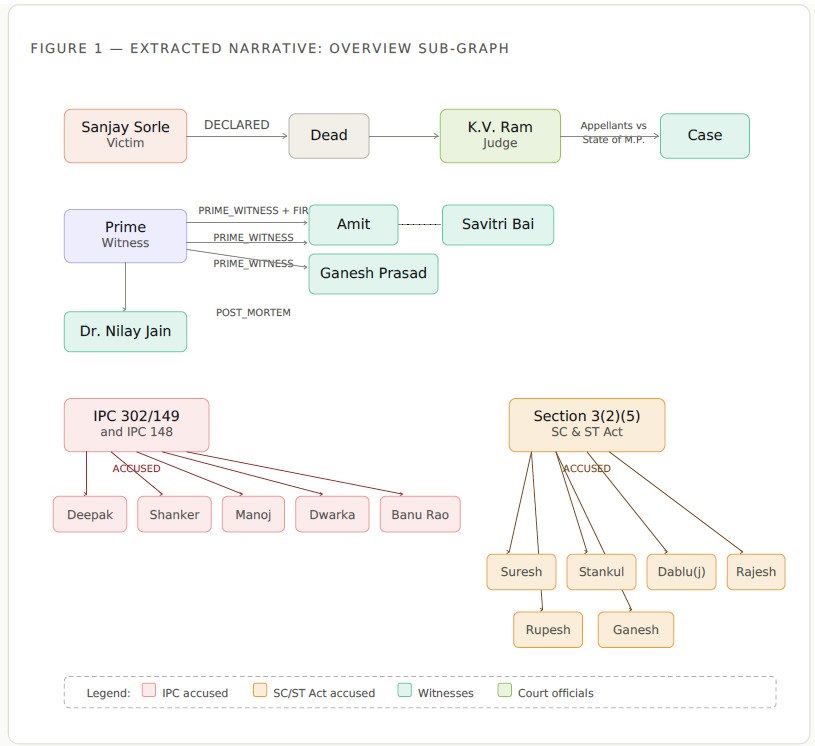
The aggregation-disaggregation strategy produced a set of directed sub-graphs in Neo4j, each capturing a distinct narrative dimension of Criminal Appeal No. 1785 of 2011.
The overview sub-graph mapped every entity in the case:
Information that required reading dozens of pages was collapsed into a single visual network.
The victim sub-graph traced the chronological sequence: Deepak arriving at the marriage ceremony on a motorcycle, the altercation between Sanjay Sorle and Deepak, Deepak threatening Sanjay while leaving, the return with ten accomplices and the group assault.
Each attacker radiated inward toward the Sanjay Sorle node — Shanker, Suresh, Shiv and "Gudda @ Sudhanshu" connected by "ATTACKED" edges, while the sequence continued:
"AFTER_ATTACK → Injured → FIR_Lodged → Police Station → Taken_to → Hospital → DECLARED_DEAD → Dead."
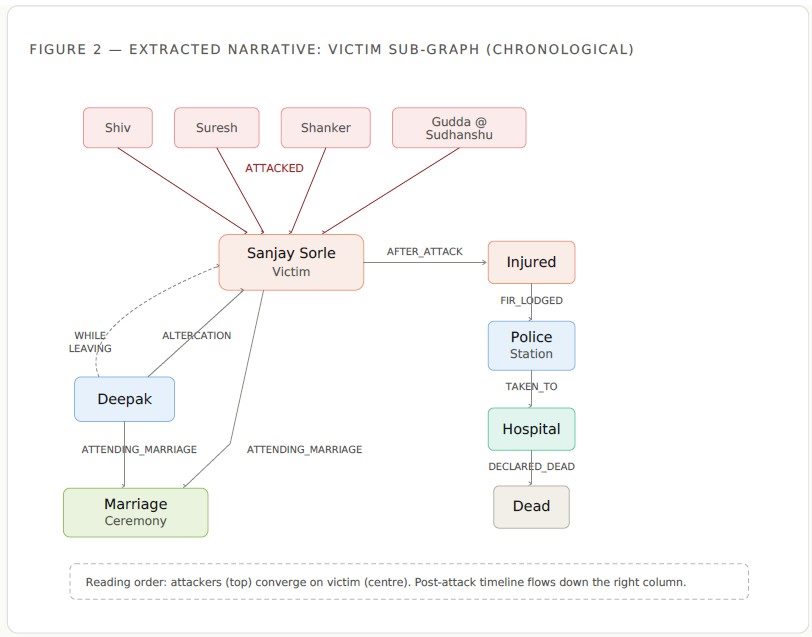
This visual separation produced the study's most important finding. The two appellants appeared in the graph connected to the victim only through edges representing fist blows. The fatal knife wound to the chest — confirmed by the post-mortem report as the sole cause of death — traced to an entirely different cluster of accused.
The disconnect between the appellants' alleged actions and the documented cause of death was visible in the graph within seconds. In the textual record, this inconsistency had taken over a decade and multiple rounds of appeals — through the trial court, the High Court of Madhya Pradesh at Jabalpur (Criminal Appeal Nos. 315, 316, 333, and 590 of 1999) and finally the Supreme Court — to surface.
Related Article: AI-Assisted vs. Human-Curated Metadata: The Hybrid Approach That Actually Scales
The manual construction process produced a systematic inventory of obstacles that any automated narrative extraction system must overcome. These challenges fall into categories recognizable across domains, but the Indian legal context gives each one a distinctive and instructive character.
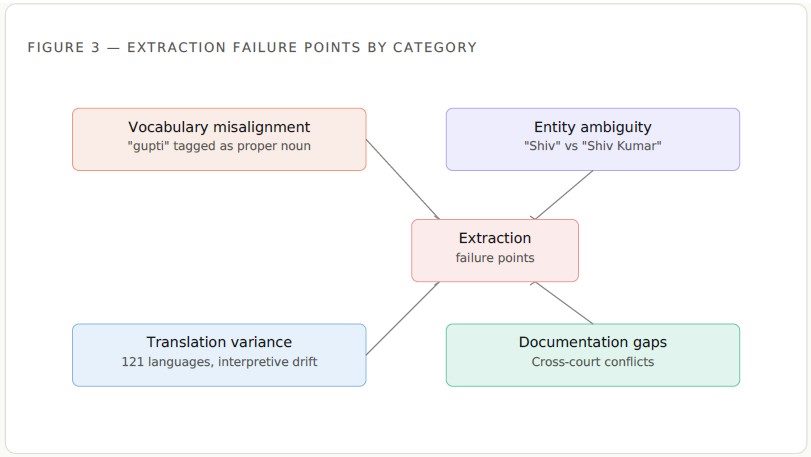
Vocabulary misalignment between domain-specific terms and general purpose NLP tools was pervasive. The Brill tagger misclassified "gupti" (a concealed dagger) as a proper noun because the term does not exist in standard English lexicons. Verbs describing culturally specific actions and adjectives describing injury types required manual correction. The implication is that production-grade narrative extraction requires custom lexicons built from within the domain — not as an enhancement, but as a prerequisite.
Entity ambiguity proved structurally challenging. One accused appeared as "Shiv" and "Shiv Kumar" without clear indication of whether these were the same person. Another was referenced under two different alias combinations — "Chokhu @ Sudhanshu" and "Dablu @ Sudhanshu" — creating genuine uncertainty. The "@" symbol in Indian legal documents denotes an alias, but when aliases are inconsistently applied, even careful human readers struggle. Standard named entity recognition could not resolve these ambiguities.
Translation-induced variance is endemic in a system operating across 121 languages. The FIR in this case was likely filed in Hindi or a regional dialect, translated for court proceedings and then referenced in an English-language Supreme Court ruling. Each layer introduced interpretive drift — not just in word choice, but in emphasis, framing and factual detail. The Supreme Court itself highlighted discrepancies between the original FIR and subsequent witness statements.
Documentation inconsistency across courts compounded all of the above. The numbering of accused, the assignment of charges and basic factual details varied between the trial court, the High Court and the Supreme Court records. Automated systems must be designed not just to tolerate these inconsistencies but to flag them — since the inconsistency itself is often the finding.
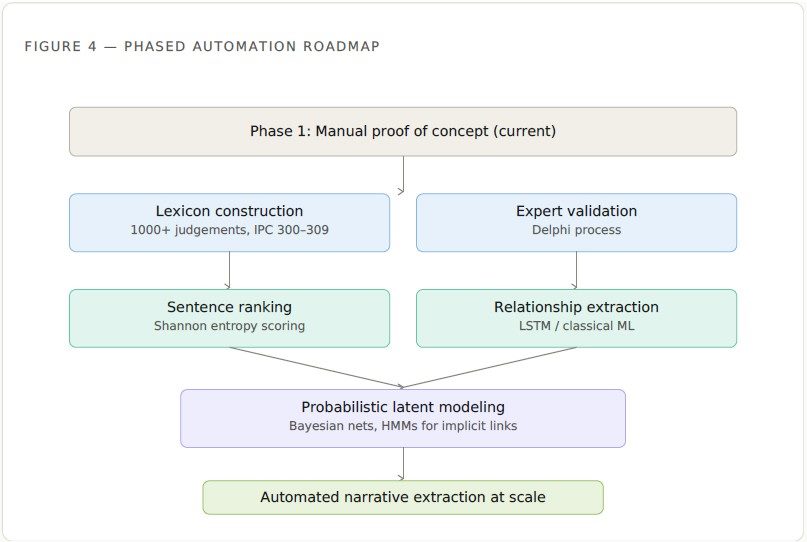
The path from manual proof of concept to automated system is clearly defined, informed by the specific failures and successes of the first phase.
Related Article: The Architecture of the Agentic Enterprise: Semantics, Governance & Safe Autonomy
This work began with a single criminal appeal, manually processed, producing sub-graphs in Neo4j that made a decade-old inconsistency visible in seconds. But the underlying insight is domain-agnostic: complex narratives buried in unstructured text are a universal bottleneck in knowledge work, and graph-based computational narratives — built through principled decomposition and domain-specific tooling — are a viable, powerful tool for overcoming it.
The technology stack — Python, NLTK, spaCy, Neo4j, Cypher — is mature, open-source and accessible. What has been missing is the willingness to invest in the domain-specific groundwork: custom lexicons, entity resolution logic and the manual discovery phase that reveals what automation must handle.
That groundwork has now been laid for the Indian legal domain. The proof of concept validates the approach. The roadmap is defined. The next step is to scale and to demonstrate that the same architecture can serve any field where justice, safety or accuracy depends on seeing a story that the text alone cannot show.
This concludes the three-part series on extracting graphical computational narratives from unstructured text.
 Learn how you can join our contributor community.

Abhinav Kumar is a credit strategy and data science leader who applies machine learning and causal inference to high-stakes decisions in consumer finance. As Vice President of credit acquisition strategy at a leading global bank, he leads strategy across a $12 billion credit card portfolio - consuming ML models, designing champion/challenger experiments, and translating model output into approval decisions and measurable P&L impact.