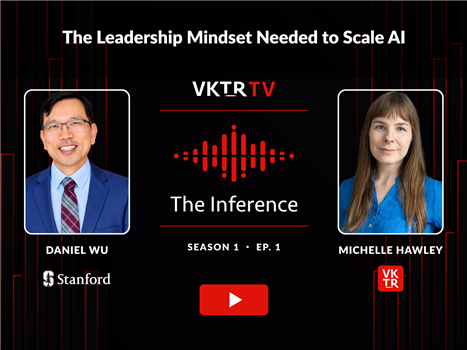
In this episode of The Inference, Shri Nandan, VP of AI Products and Experiences at Comcast, joins host Michelle Hawley to discuss what it actually takes to build and scale AI inside one of the largest enterprises in the country.
Nandan shares how her team uses agentic frameworks, customer data platforms and cross-functional alignment to drive AI strategy at Comcast. The conversation covers the real costs of scaling AI beyond the pilot stage, how to prioritize ideas using a revenue-cost-KPI-resource framework and why governance has become the most complex part of the job. Nandan also explores where AI delivers the clearest value in customer experience and who bears accountability when AI agents go wrong.
Host
Guest

Michelle Hawley

Shri Nandan
What Stood Out From Our Chat
Table of Contents
- AI Projects Need a Business Reason, Not Just a Cool Demo
- Scaling AI Means Budgeting for the Boring Parts
- AI Governance Has Become a Different Kind of Risk Discipline
- Customer Experience Is Where AI Can Win — or Go Viral for the Wrong Reason
- The Enterprise AI Advantage Is Discipline
Key Takeaways
- Find the Problem. Enterprise AI projects should start with a clear customer or business problem, not a flashy proof of concept.
- Consider the Costs. Scaling AI requires teams to account for cloud costs, maintenance, governance and operational support before a pilot reaches production.
- Humans Are Still Needed. AI can improve customer experience when companies clearly define what bots handle, when humans step in and who owns accountability when things go wrong.
Enterprise AI has no shortage of ideas. What it often lacks is a clear reason to pursue them.
Inside large organizations, the pressure to build with AI can quickly turn into a parade of shiny pilots and experimental agents that look impressive in isolation but fall apart when exposed to real customers, real infrastructure costs and real operational demands.
For Shri Nandan, VP of AI products and experiences at Comcast, that is precisely where enterprise AI leaders need to slow down.
“Start with the why, don’t start with the what,” she said.
AI Projects Need a Business Reason, Not Just a Cool Demo
In many enterprises, AI experimentation has become a default response to competitive pressure. Teams want to test new models, build agents, automate workflows and prove they’re not falling behind. Nandan does not dismiss that instinct. In fact, she encourages experimentation inside her team.
But there is a line between creative exploration and enterprise-scale execution.
When an idea lands on her desk, Nandan’s first question is simple: Why should the organization do it?
AI has made it easier than ever to build something that looks compelling in a demo but has little chance of surviving in production. A chatbot trained on internal documents might impress a leadership team. An agentic workflow might save a few hours for employees. But is the process repeatable? Can it scale to millions of customers? Does the organization have the resources to maintain it?
For Nandan, the evaluation framework comes down to a combination of customer value, business impact, cost, KPIs and resources. In practice, that means AI projects need to be tied to specific pain points, not general enthusiasm.
Related Article: How to Measure AI Performance: Metrics That Matter
Scaling AI Means Budgeting for the Boring Parts
The enterprise AI conversation often focuses on model capability. Nandan points to a less glamorous constraint: cost.
“AI is expensive,” she said. “AI costs a whole lot more than you think.”
That reality is becoming harder for companies to ignore. The cost of cloud infrastructure, development teams, governance, testing, contact center impacts, maintenance and ongoing model operations can turn a promising pilot into a budget problem quickly.
According to Nandan, organizations should think about scale before they build the proof of concept. They need to ask:
- If a pilot works, what happens when it reaches even 5% of customers?
- What does it do to cloud spend?
- What pressure does it place on infrastructure?
- Will the company need more contact center support if the system fails or creates confusion?
- Who maintains the agents after launch?
- Who improves them as customer needs change?
Before taking a new AI idea to the CEO, Nandan said leaders need to back it up with the real costs of scaling. Conservative estimates are better than optimistic guesses, especially when historical benchmarks are limited.
AI Governance Has Become a Different Kind of Risk Discipline
Nandan has worked across industries like healthcare, insurance, pharmaceuticals and telecommunications. That background has shaped how she thinks about AI risk.
Traditional digital governance, she said, was relatively straightforward by comparison. Teams had to follow rules, maintain compliance and ensure security. AI governance adds more uncertainty.
The risks now include security, compliance, ethics, bias, hallucinations, vendor controls, data protection and unpredictable model behavior. The pace of change makes the job harder. New risks can emerge in months, even days.
At Comcast, Nandan said the first rule is that teams should go through AI governance before adopting tools or launching AI products. Employees are encouraged to experiment, but within guardrails.
That balance is important. If employees feel they have to hide AI experimentation, companies lose visibility into risk. If they’re given transparent pathways to test tools responsibly, leaders can channel curiosity into safer innovation.
For Nandan, some of the guidance comes down to common sense: Do not put customer data into unauthorized tools. Ask vendors hard questions. Understand what can go wrong before introducing a tool into the organization.
Still, common sense alone is not enough. AI governance needs structure, authority and standards.
Customer Experience Is Where AI Can Win — or Go Viral for the Wrong Reason
Customer experience is one of the clearest areas where AI can create value, according to Nandan. But only when companies design the division of labor between AI and humans carefully.
Routine, repetitive tasks are good candidates for automation. A customer who wants a bill summary or help with a basic request may benefit from an AI system that can respond quickly and consistently.
But not every customer interaction should be automated. If a tree falls on someone’s house and they call for help, that is an emotional moment. Nandan said that kind of situation should be escalated to a human.
The point is not to remove humans from customer experience. The point is to design AI as a collaborative partner, which requires companies to decide what the bot handles, when a human takes over, how the handoff works and how the system returns to automation when appropriate.
Poorly designed AI customer experiences can create legal, reputational and operational problems. The Air Canada chatbot case, where a chatbot gave a customer incorrect information about bereavement fares, has become a cautionary tale for companies deploying customer-facing AI.
Nandan’s view is that accountability should be clear. If an AI agent hallucinates or performs poorly, the team that built it has responsibility for the failure. But accountability also needs to exist at the organizational level.
As Nandan noted, companies need a central entity — whether a person, team or governing body — setting engineering standards, evaluation requirements, vendor review processes and customer experience metrics.
Without that structure, teams risk building disconnected agents in silos.
Related Article: The Inference: The Leadership Mindset Needed to Scale AI
The Enterprise AI Advantage Is Discipline
The next phase of enterprise AI will be won by the companies that know which pilots deserve to scale.
That requires a shared North Star across engineering, product, customer experience and business leadership. It requires experimentation without recklessness. It requires governance that enables innovation rather than burying it. And it requires a realistic understanding of what AI costs after the demo ends.
For enterprise leaders, Nandan’s advice is a useful corrective to the current AI rush: Start with the customer problem. Ask why. Test for scale before you celebrate the pilot. Build governance before the risk shows up in public.
AI can reduce friction, improve service and create new operating models. But only if enterprises stop treating pilots as proof and start treating them as the beginning of a much harder question: Can this actually work at scale?