Editorial
Guide
Is AI Making Your Organization More Productive or More Dependent?


Enterprise AI leaders increasingly agree that autonomous agents still need human oversight. The less developed question is how work should transfer when an agent reaches a boundary it cannot safely or effectively cross.
Most organizations answer with some version of “send it to a person.” But escalation is not a routing rule. It is a transfer of work. The agent has already interpreted the goal, collected context, called tools and potentially changed a workflow. If it hands the task to a person without preserving that work, the human must reconstruct the problem from scratch.
As enterprises move agents into finance, procurement, legal, service, HR and operations, they need something more specific than human-in-the-loop. They need an escalation contract.
Approval is a predefined checkpoint. The AI agent proposes an action and waits for a yes-or-no decision.
Escalation occurs when the agent encounters ambiguity, missing information, conflicting policies, an unexpected system state or a problem beyond its competence. The human is not merely approving what the agent decided. The human is taking responsibility for resolving the blocker.
Approval interfaces can create a false sense of safety. Microsoft’s AI Red Team recently identified human-in-the-loop bypass as a consistently exploited failure mode. Red teamers succeeded through consent fatigue and incremental chains in which no single step appeared serious enough to warrant scrutiny, but the compound outcome did.
Adding more approval buttons will not solve a badly designed handoff.
This article assumes the agent is already authorized to operate within a defined workflow. The question is what happens when it should no longer continue alone.
A poor escalation usually fails in one of five ways.
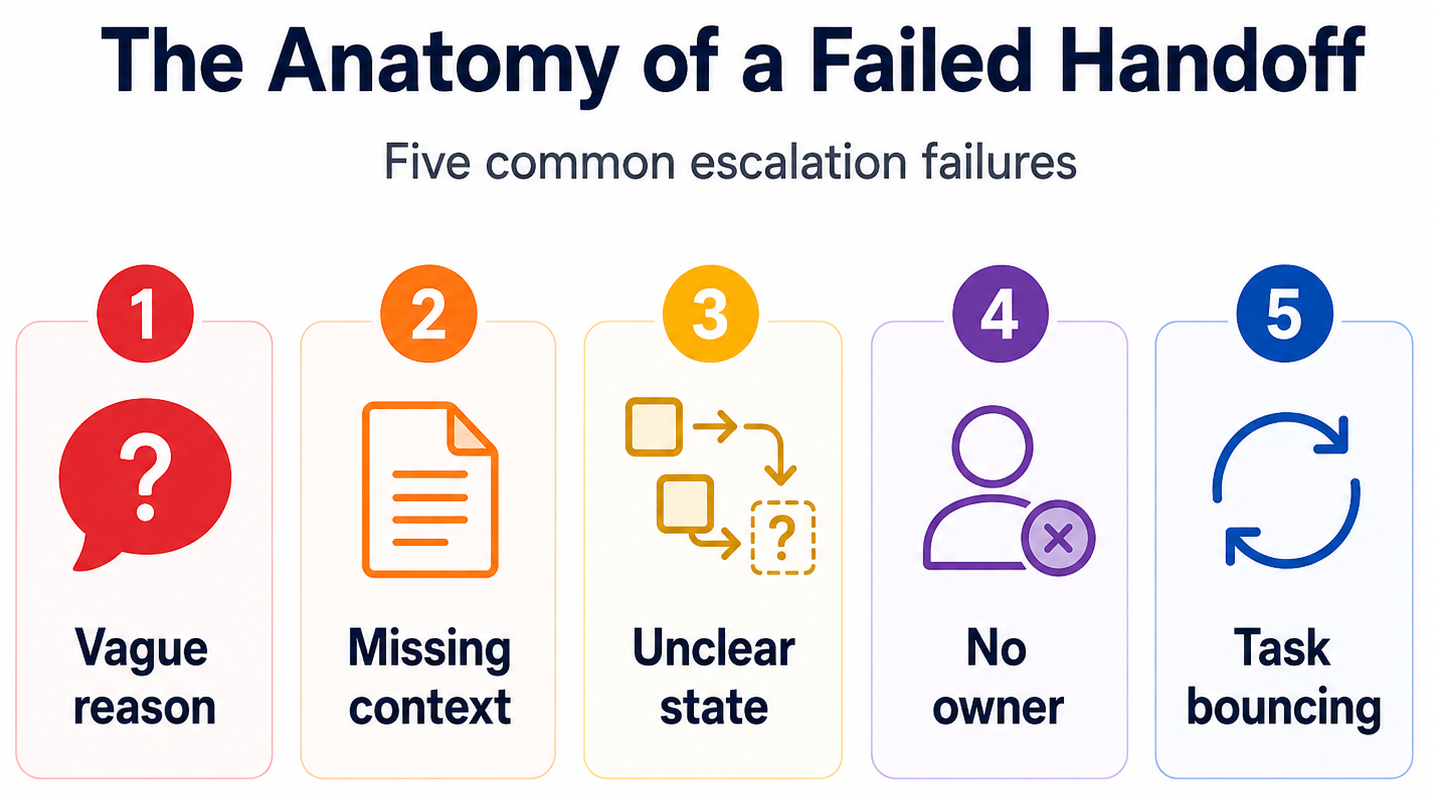
Each failure adds delay, rework and risk. An agent may complete most of a process quickly, but if the remainder forces a human to reconstruct the entire case, the productivity gain can disappear.
The Agency for Healthcare Research and Quality uses the SBAR framework — Situation, Background, Assessment and Recommendation or Request — to help clinical teams transfer critical information concisely and consistently. The clinical protocol should not be copied blindly into enterprise AI, but its operating principle is valuable: the receiver should not have to infer the problem from an unstructured history.
An AI-to-human context packet can follow the same logic:
Structured context is only part of the handoff. The system must also preserve state, transfer ownership and define what happens after the human acts.
An escalation contract governs how an AI agent stops, transfers work and either resumes or exits.
| Contract Element | Core Question |
|---|---|
| 1. Trigger and reason | What caused the agent to stop, and why can it not proceed? |
| 2. Context and uncertainty packet | What history, evidence, attempted actions and uncertainty must transfer? |
| 3. State checkpoint | What has happened, what remains pending and how is the workflow paused? |
| 4. Ownership and routing | Who accepts the escalation, and when does ownership transfer? |
| 5. Human intervention | What decision, correction, exception or information must the person provide? |
| 6. Resume, terminate and learn | Does the agent resume, does the workflow unwind or stop and is the resolution captured? |
“Escalate when confidence is low” sounds sensible, but confidence alone is a weak operating rule.
Escalation should consider the action type, available data, conflicting policies, repeated tool failures, unusual workflow paths and the cost of being wrong. A low-risk internal draft may tolerate uncertainty. A financial, legal or employee action may require intervention even when the model sounds confident.
The human should receive a concise account of the situation, relevant background, completed steps, unresolved questions and recommended next action.
Raw transcripts can remain available, but they should not be the primary handoff artifact.
The system should record which actions have occurred, which side effects may need reversal and whether parallel tasks remain active.
The receiving person or team should explicitly accept the task. A generic queue does not transfer accountability. The workflow should show whether it is agent-owned, awaiting acceptance, human-owned or cleared to resume.
The escalation should ask for a specific action: supply information, interpret policy, approve an exception, correct a parameter, take over the task or terminate it.
After intervention, the workflow should not restart from stale context. The agent needs the human’s decision, updated state and a clear instruction to resume, unwind or stop. The resolution should be logged so teams can identify recurring gaps.
Tracking escalation volume is not enough. A useful scorecard should include:
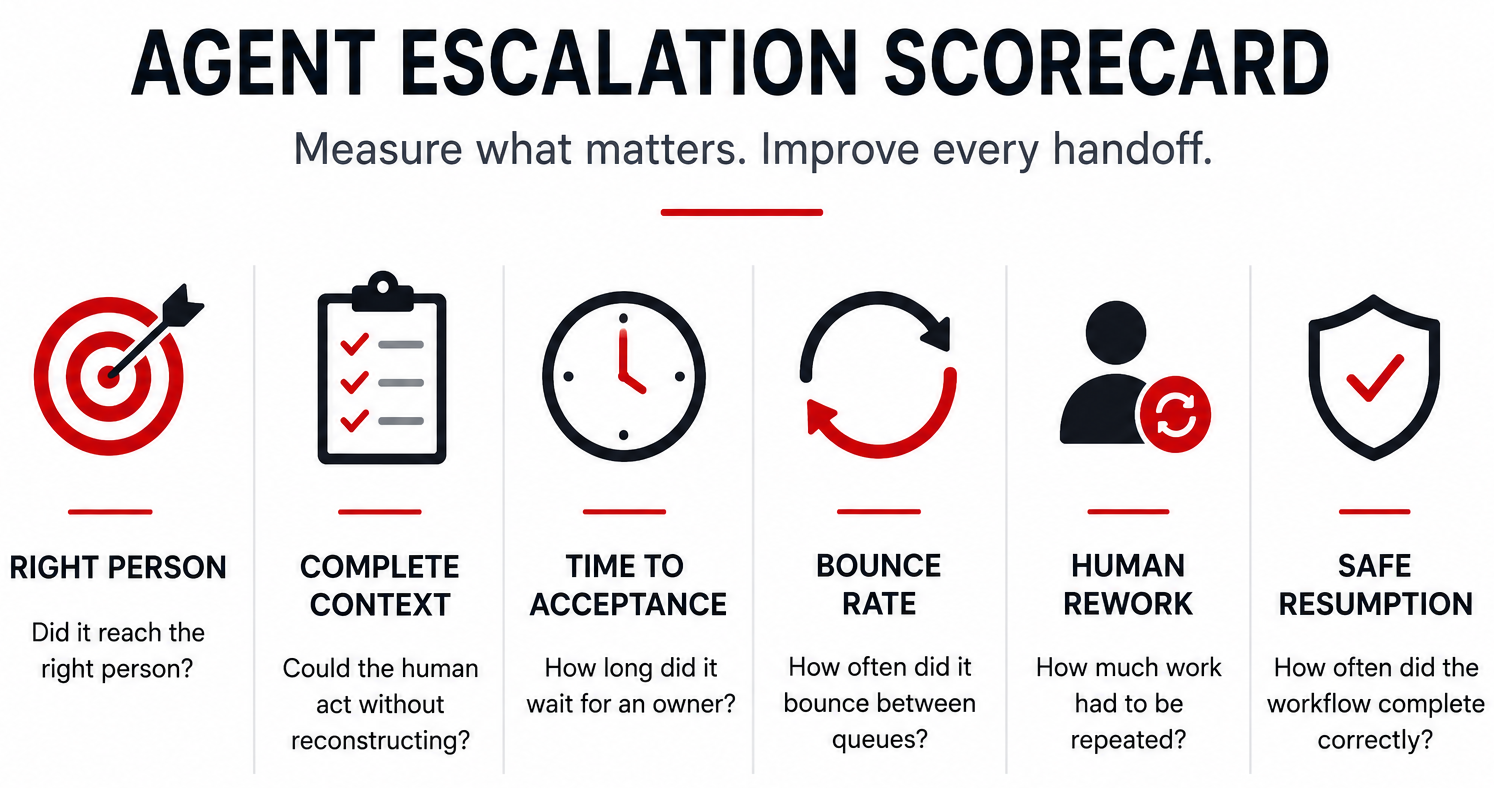
These measures turn escalation from a compliance checkbox into an operating capability.
NIST launched its AI Agent Standards Initiative in February 2026 to advance secure, interoperable agent systems. As standards develop, enterprises still have to solve the practical problem inside their own workflows: how an agent should pause, hand over and recover.
The most capable agent will eventually encounter an exception, ambiguity or situation requiring judgment it does not possess.
The maturity of an agentic system should be judged not only by how much work it completes autonomously, but also by how safely and efficiently it transfers the work it cannot.
Human oversight is a principle.
An escalation contract is how that principle becomes an operating model.
 Learn how you can join our contributor community.

Nixalkumar Patel is a senior product and digital transformation leader specializing in enterprise omnichannel digital commerce transaction execution and orchestration across D2C, B2C and B2B/SMB channels, including AI-enabled governed conversational commerce. With more than 13 years of experience, his work focuses on building the governance, validation and orchestration layers that help enterprise transactions execute correctly, reliably and auditably across customer journeys, fulfillment ecosystems and core business systems.