News
Guide
Is AI Making Your Organization More Productive or More Dependent?

A broad coalition of technology companies has formed the Open Secure AI Alliance, a new organization aimed at developing and sharing open source tools for defending AI systems and using AI for cybersecurity. According to NVIDIA, the effort is an extension of the Linux Foundation's existing Akrites initiative and OpenSSF community work.
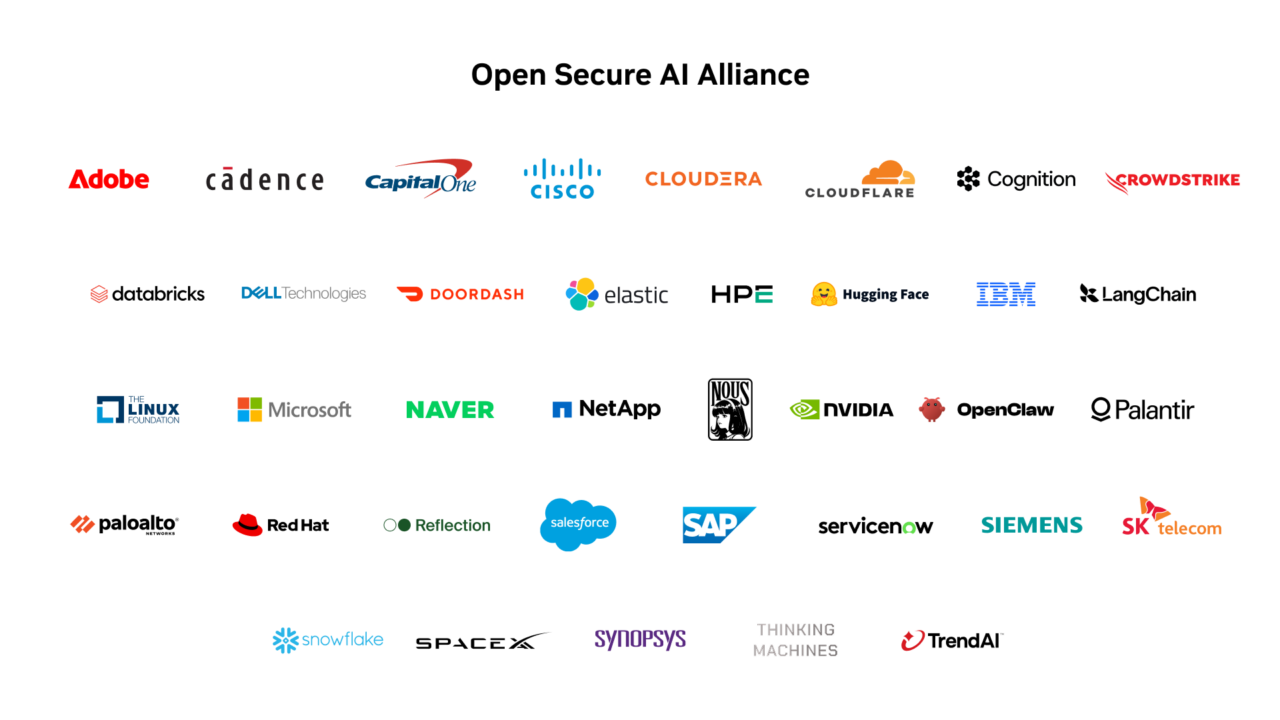
The founding membership spans cloud computing, cybersecurity, enterprise software and AI research. Notable names include NVIDIA, Microsoft, IBM, CrowdStrike, Cisco, Palo Alto Networks, Cloudflare, Databricks, Salesforce, Dell Technologies, Hugging Face, Palantir and SpacexAI, among others — more than 35 organizations in total.
The alliance's central argument is that cyber defenders need access to AI tools they can inspect, modify and run on their own infrastructure. As NVIDIA framed it, if defensive AI capabilities are locked inside a handful of closed systems, organizations face a single point of failure at the moments when speed matters most.
The announcement cited a recent Hugging Face security incident as a case study. According to NVIDIA's account, closed AI tools were unable to distinguish between attackers and defenders during the incident, blocking forensic analysis that the security team needed. Hugging Face ultimately ran the open-weight GLM 5.2 model on its own infrastructure to analyze over 17,000 actions and contain the breach.
While the alliance acknowledged that open models can be misused or have their safeguards removed, they contend that those risks also exist in closed systems and are better managed through guardrails and evaluation rather than restricting access to open tools.
Several of the Open Secure AI Alliance's founding members are bringing specific projects to the table:
| Contributor | Project | What It Does |
|---|---|---|
| NVIDIA | NOOA (Labs Object-Oriented Agent) | Open source framework for testing, tracing and auditing AI agent behavior |
| Microsoft | MDASH | Multi-model scanning harness that uses AI agents to discover and prove exploitable bugs |
| Hugging Face | Safetensors | Safe storage format for AI model weights, offered to the PyTorch Foundation |
| IBM / Red Hat | Lightwell | Digitally signed patches for securing the open source supply chain |
| HPE | SPIFFE/SPIRE contributions | Zero-trust identity framework for verifying AI agents and services |
| SpacexAI | Grok Build | Open sourced terminal-based AI coding agent; company also plans to open source Grok model weights |
The broader goal, per the announcement, is an "open defense stack" covering identity, isolation, model formats, multi-model scanning and secure coding workflows.
The announcement also doubles as a direct appeal to regulators. The alliance urged policymakers to treat open models and security tooling as defensive assets rather than liabilities, warning that blanket restrictions on open frontier AI systems would weaken defensive capacity and concentrate risk among a small number of closed providers.
The coalition calls for government investment in shared infrastructure for AI defense — including datasets, evaluation frameworks, attack simulators and red-teaming tools — drawing a parallel to earlier public investment in open source software.
The announcement is heavy on vision and founding contributions, but light on governance details. How the alliance will coordinate across 35+ members with competing commercial interests, what its release cadence will look like and how it will handle the tension between openness and responsible disclosure remain open questions. Whether the coalition delivers on its ambitions or becomes another industry letterhead will depend on what ships in the months ahead.